
Govt finalising 25-year master plan to modernise agriculture

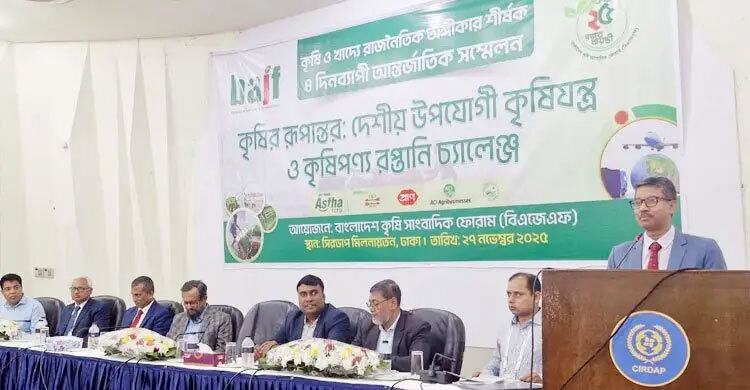
The government is in the final stages of formulating a 25-year master plan aimed at transforming Bangladesh’s agriculture into a modern, sustainable, and export-driven sector.
The comprehensive framework – designed to address future risks, climate uncertainties, mechanisation gaps, and global market demands — is expected to be ready by December, officials said.
Agriculture Secretary Dr Mohammad Emdad Ullah Mian shared the update on Thursday, November 27, during the opening day of the international conference titled “Political Commitment in Agriculture and Food,” organised by the Bangladesh Agricultural Journalists Forum (BAJF) at the CIRDAP auditorium in Dhaka.
This year's first-day theme focused on: “Transformation of Agriculture: Challenges of Exporting Domestically Suitable Agricultural Machinery and Agricultural Products.”
13 priority sectors, long-term and short-term action plans
Speaking at the event, the agriculture secretary said the master plan covers 13 major agricultural sectors and multiple sub-sectors. In addition, 17 agriculture-related organisations and research institutes will each receive separate long-term roadmaps to align innovation, research, and future priorities.
Alongside the long-term plan, the ministry will undertake several short-term, five-year projects – each backed by data, research, and feasibility review.
“Every project will be taken up after detailed research and scrutiny,” said Dr Emdad Ullah.
Cost-saving reforms in fertiliser management
Highlighting progress in sector reforms, Dr Emdad Ullah said fertiliser management policies alone could save Tk 2,000-3,000 crore annually.
“This year, we have already saved Tk 1,000 crore,” he said, adding that Tk 600 crore from the agricultural mechanisation project had returned to the national treasury after completion with just Tk 20 crore of planned allocation.
Expressing concern over farmer distress and volatile retail markets, he added: “When vegetables cost Tk 100 per kg, nobody reacts. But when onions hit Tk 100, there is outrage. Should farmers not get a fair price?”
The government has set a target to become self-sufficient in onion and ginger within the next three years, he said, expressing sorrow over a recent farmer suicide linked to poor potato prices.
Push for locally built agricultural machinery
Presenting the keynote, Dr KM Saiful Islam, Director of the Mechanized Rice Cultivation Project at BRRI, said the country is now building a full ecosystem for locally manufactured agricultural machinery to reduce import dependence.
With technical support from countries like Japan and Sri Lanka, local industries are now producing modern equipment, he said, which will significantly reduce labour shortages and production costs.
Barriers to industrial scaling
However, BRRI Scientific Officer Durul Huda warned that inefficiencies persist. The lack of CNC-based technology, trained manpower, and a capable light-engineering base remains major obstacles to mass production of combine harvesters and rice transplanters.
“Even after 54 years of independence, no state-owned engine manufacturing facility exists,” he noted.
Agriculture must become a respected profession, speakers say
PKSF Managing Director Md Fazlul Quader stressed the need to treat agriculture as an educated, profitable profession – not just a subsistence sector.
He said PKSF and its affiliates distribute Tk 1.40 lakh crore annually at field level, of which about 40 per cent goes to agriculture finance, mostly through microcredit networks.
Rising rice yields signal potential
BRRI Director General Dr Mohammad Khalequzzaman highlighted significant transformation since independence, noting that rice yields have risen from 1.5-2 tonnes per hectare to more than 8-10 tonnes in some regions. Innovations in hybrid seeds and technology could push averages beyond 10 tonnes in future, he added.
Export potential huge but challenges remain
Pran-RFL Group Director (Marketing) Kamruzzaman Kamal said the global agro-processing market is valued at $4 trillion, while Bangladesh’s share is just $1 billion, indicating massive untapped potential.
However, exporters currently require approvals from 18 government agencies, making the process costly and slow, he said.
He called for:
A one-stop export approval system
Stronger country branding
Better use of Bangladeshi embassies abroad
Improved international certification laboratories
He added that BSTI standards are not widely recognised internationally, forcing many exporters to test products in India and Singapore.
“Farmer-first" agriculture vision
Closing the session, Agriculture Secretary Dr Emdad Ullah iterated the government's stance: “There will be no sustainable agricultural economy without ensuring fair prices for farmers. All necessary measures will be taken to protect their interests.”