
Blood pressure crisis: Hypertension tops Bangladesh’s disease list

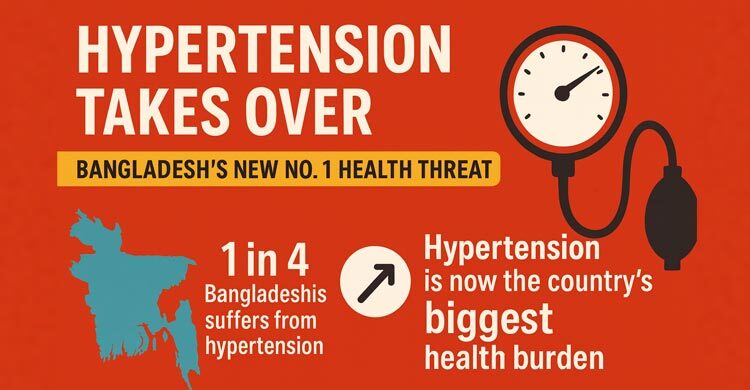
Hypertension has emerged as the single largest health burden in Bangladesh, overtaking all other illnesses, according to the newly released Health and Morbidity Status Survey (HMSS) 2025.
Public health experts say the findings signal an urgent need for a nationwide campaign focusing on prevention, mass screening and sustained access to affordable treatment.
Hypertension tops bangladesh’s disease list
The HMSS 2025, conducted by the Bangladesh Bureau of Statistics (BBS), identifies hypertension as the most common disease in the country, followed by peptic ulcer, diabetes, arthritis, skin diseases, heart disease, asthma, osteoporosis, hepatitis and diarrhoea.
Researchers warn that high blood pressure – often symptomless – has steadily grown into a silent national threat capable of triggering a surge in heart attacks, strokes and chronic kidney disease if left unaddressed.
The survey collected data from 1,89,986 individuals across 47,040 households in November–December 2024 and was unveiled at a dissemination event on Sunday.
One-third of Bangladeshis reported illness recently
The report found that 332 out of every 1,000 people (33%) reported suffering from some form of illness within the 90 days preceding the survey.
Medical costs remain a significant burden. Average per-person expenditure was Tk 2,487, with women spending slightly more (Tk 2,576) than men (Tk 2,387). Women also relied more heavily on government facilities for treatment.
Tobacco use and diet fueling the crisis
The survey shows that 26.7% of people aged 15 and above use tobacco, with higher rates in rural areas (27.7%) than urban areas (24.1%). Combined with poor dietary patterns and sedentary lifestyles, experts say this is accelerating the rise of non-communicable diseases (NCDs).
The World Health Organization (WHO) has long pointed to high salt consumption, trans-fat, and low intake of fruits and vegetables as major risk factors. WHO estimates that 3.9 million deaths globally in 2017 were linked to insufficient consumption of fruits and vegetables.
Call for healthier food systems
Professor Dr Mohammad Shoeb of the Bangladesh Food Safety Authority (BFSA) said the agency is enforcing trans-fat regulations and working to introduce front-of-pack labelling to help consumers make informed food choices.
Echoing this, Professor Dr Sohel Reza Choudhury of the National Heart Foundation urged the government to establish a system that allows buyers to see salt and ingredient levels in processed foods before purchase.
Despite such efforts, one in four Bangladeshis still suffers from hypertension, and experts agree that current measures fall short. Ensuring uninterrupted supplies of anti-hypertensive drugs at Community Clinics and Upazila Health Complexes is essential, they said.
Bangladesh earns global recognition but risks remain
The WHO’s Global Report on Hypertension 2025 recognised Bangladesh as a positive example, noting improved hypertension control rates in several regions – from 15% in 2019 to 56% in 2025. The report underscores the role of free medicines at grassroots levels and sustained long-term investment.
Globally, hypertension remains a deadly force behind heart disease – the cause of one in every five premature deaths. In Bangladesh, 34% of all deaths are linked to heart-related conditions.
According to WHO estimates, 283,000 Bangladeshis die each year from cardiovascular diseases, and 52% of those deaths are linked to hypertension. Worldwide, more than 1,000 people die every hour from strokes and heart attacks caused by uncontrolled blood pressure—deaths that experts say are largely preventable.
Experts demand early detection, community-level campaigns
Professor Dr Abdullah Al Shafi Majumder, former Director of NICVD, stressed early diagnosis and medical follow-up as the strongest tools against hypertension-induced deaths.
Dr Geeta Rani Devi, Programme Manager of Community Based Health Care (CBHC), highlighted the importance of starting health promotion at community level, backed by strong policy support for healthy eating habits.
Drug supply still a challenge
Officials from the Directorate General of Health Services (DGHS) admitted ongoing budgetary and logistical challenges in ensuring a steady supply of NCD medicines at primary health facilities.
“We hope these issues will be resolved soon,” said Dr Muhammad Habibur Rahman, Deputy Director at DGHS.
Essential Drugs Company Limited (EDCL) also reiterated its commitment to delivering anti-hypertensive medicines on time.
“We ensure medicines reach NCD corners and Community Clinics for people at the grassroots, and we remain committed to its continuation,” said Md Riad Arafin of EDCL.
Source: UNB