
Hidden traps in Tanore: The silent threat of abandoned 'death wells'

Published: 13 December 2025, 10:12 PM | Updated: 13 December 2025, 10:13 PM
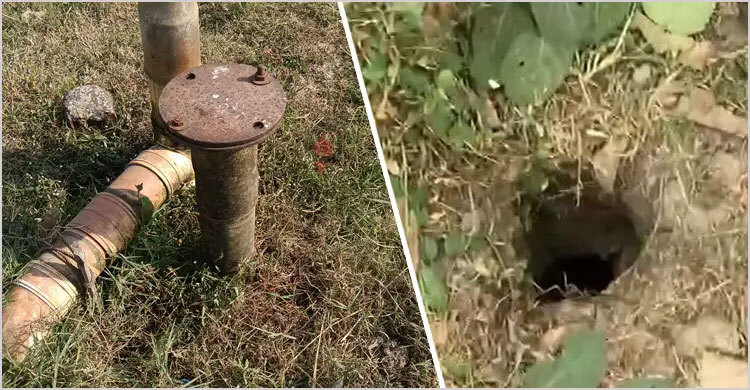
In the vast, sunbaked fields of the Barind Tracts in Rajshahi, life seems deceptively calm. Farmers move rhythmically with their ploughs, children chase each other along dirt paths, and the distant hum of irrigation pumps punctuates the quiet. Yet beneath this ordinary rural landscape, a hidden danger lies in wait – one that has already claimed innocent lives and continues to threaten the community.
These are the abandoned deep tube wells of Tanore, colloquially referred to by locals as “death wells.” Many were drilled in pursuit of irrigation, some by the government, others by private operators, and still more without any official sanction. Once productive, these wells often become useless after a few years. Unlike ordinary unused wells, they are rarely sealed, leaving gaping holes that can swallow anything – or anyone – who strays too close.
On December 10, tragedy struck when two-year-old Sajid fell into one such abandoned borehole in Purbapara, Koelerhat. Despite a grueling 32-hour rescue operation, Sajid was pronounced dead at the hospital. The incident shook the local community and brought renewed attention to the growing problem of unsealed boreholes scattered across the Barind Tracts.
Sajid’s grandfather, Ayub Ali, recounts the moment with a trembling voice: “It wasn’t closed. Even before yesterday, it was a 5-7 foot hole. Someone should have taken responsibility to cover it properly.” Local residents speak in hushed tones, fearing that any child could be the next victim. Alamgir Hossain, a neighbor, estimates that 25 to 30 abandoned wells are scattered across this small area alone, none properly sealed, each a potential death trap.
The scale of the problem is staggering. According to the Barind Multipurpose Development Authority (BMDA), there are around 16,000 government-installed deep tube wells and more than 20,000 privately operated wells. Add to that thousands of unauthorized wells, and it becomes clear that a patchwork of open boreholes now dots the Barind landscape, many dangerously hidden among crops, pathways, and homesteads.
Superintendent Engineer Nazirul Islam of BMDA explains the complexity: “We have limited jurisdiction over wells installed without government permission. Each upazila has an irrigation committee, chaired by the UNO, to approve deep tube wells. But some residents bypass this process entirely, using household electricity connections to operate wells illegally. Enforcement is challenging.”
Local lawyer and landowner Hossain adds perspective from the field: “To get a single operational well, we often had to drill five test wells. Once they became unproductive, they were abandoned – but never sealed. These holes remain scattered, invisible until an accident occurs.” He notes that around 70 per cent of irrigation water in the Barind Tracts comes from private wells, most of which are poorly monitored.
The Bangladesh Water Act 2013 declares groundwater a state resource, requiring permission for extraction. Yet it does not mandate the sealing of wells, leaving countless boreholes abandoned across Rajshahi, Naogaon, and Chapainawabganj, each a hidden peril.
Walking through the fields of Koelerhat, the danger is tangible. Some boreholes are narrow, only six inches wide, while others measure over a foot across and stretch up to 150 feet deep. Stones sometimes block the installation of wells, leaving incomplete “test bores.” Once abandoned, these pits are left open, ready to claim anyone who steps carelessly nearby.
The tragic death of Sajid has prompted authorities to act. Tanore UNO Naima Khan says, “BMDA has been instructed to identify all boreholes and submit a detailed list with exact locations. Future applications for deep tube wells will be scrutinized thoroughly.” While this is a step in the right direction, residents say enforcement remains slow and incomplete.
For the locals, every day is a delicate balance between utilizing the land for irrigation and avoiding these hidden hazards. Farmers hope for water to nurture their crops; children hope to play freely in the fields; yet, beneath the surface, the abandoned boreholes wait silently.
As the sun sets over Tanore, the shadows stretch long across the fields. The gaping wells, some hidden under grass, others marked only by the faintest dirt mound, serve as a chilling reminder: in the Barind Tracts, danger can be buried just a few feet beneath the ground.