
Fair voting at ‘risky’ centres a major test for police in JS elections

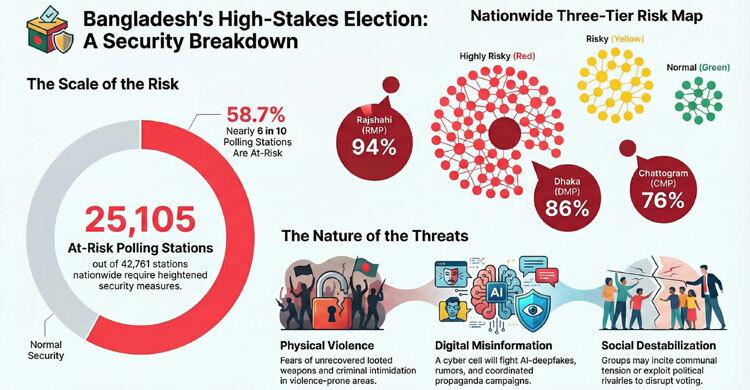
With the 13th Jatiya Sangsad elections approaching, Bangladesh’s law enforcement agencies are bracing for what senior officials describe as one of the most challenging elections in the country’s history. Ensuring free, fair and peaceful voting at thousands of “risky” polling stations has emerged as a critical test for the police.
Out of 42,761 polling stations nationwide, police have identified 8,746 as “highly risky” and another 16,359 as “risky”. In other words, nearly six in every 10 polling centres will require heightened security, a reality that has put enormous pressure on policing plans.
Senior police officials admit privately that managing these centres – many located in politically sensitive, remote, densely populated or violence-prone areas – has become their biggest operational headache.
Fears of sabotage and communal tension
Beyond physical security, police are increasingly worried about attempts to destabilise the electoral environment through misinformation, communal incitement and targeted violence. According to Police Headquarters, vested interests, including the banned Awami League, may attempt to fuel unrest through social media campaigns, religious propaganda and misleading election narratives.
These concerns echo earlier warnings by Election Commissioner Anwarul Islam Sarkar, who said last August that the upcoming election could be the “riskiest” Bangladesh has ever faced.
Three-tier risk map of polling stations
To prepare, Police Headquarters has divided polling stations into three categories:
Red: Highly risky
Yellow: Risky
Green: Normal
The classification is based on voter density, distance from police stations, past records of violence, local political dominance, border proximity, hill tracts and other geographical and social factors.
Despite these measures, police data show that only 17,656 polling stations fall into the “normal” category.
Heavy security at vulnerable centres
According to police planning documents, each highly risky polling centre will initially be guarded by three armed police personnel, while risky centres will have two and normal centres one. Officers responsible for polling centre security will be equipped with firearms and body-worn cameras.
In addition, 13 Ansar members will be deployed at every polling station. Members of the Bangladesh Army, Border Guard Bangladesh (BGB) and other law enforcement agencies will be on standby to provide backup and rapid response.
Unrecovered weapons and criminal threats
A confidential Police Headquarters document paints a troubling picture. A significant number of weapons looted from police lines, stations and outposts after August 5 have yet to be recovered. Authorities fear these weapons could resurface during the election.
The document also notes that several high-profile criminals released on bail in recent months have resumed activities such as extortion and intimidation. Police fear that such individuals could be used by vested groups to trigger violence, disrupt polling or intimidate voters.
To counter these risks, special operations are planned to recover looted and illegal weapons before election day.
Cyber threats and AI-driven misinformation
Recognising the growing digital threat, police are preparing to set up a dedicated cyber monitoring cell during the election period. The unit will track rumours, hate speech, coordinated propaganda and AI-generated deepfake videos or messages designed to mislead voters.
Officials say verification capacity is being strengthened to ensure that no group can manipulate public opinion through fake speeches, forged videos or fabricated election notices.
Constituency-wise risk assessment
Police have conducted a detailed security analysis of all 300 parliamentary constituencies. The assessment highlights the presence of extremist groups in parts of the southwest and armed groups in the three hill districts, involved in crimes ranging from extortion and abduction to murder.
Authorities fear that any political actor could attempt to exploit these groups to influence voting or destabilise entire regions.
The analysis also points to communal sensitivities. Minority communities make up around 10 per cent of Bangladesh’s population, with at least 113 constituencies having minority voters exceeding that proportion. Police warn that interest-driven groups could try to inflame communal tensions to disrupt polling.
Shadow of past elections
The security assessment further notes that banned political groups may attempt to obstruct voting in constituencies where past elections were tightly contested or historically dominated by the Awami League. In seats previously decided by margins of fewer than 10,000 votes, police expect heightened tension and potential conflict.
The backdrop to these fears is a history of controversial elections. The 2014 polls were widely criticised as one-sided, with voting not held in 153 seats. The 2018 election became infamous for allegations of “night-time voting”, while the 2024 polls were dismissed by critics as a “dummy election”.
Law enforcement agencies themselves faced heavy criticism for their role in those elections.
Reforms under the interim government
In an effort to rebuild trust, the interim government has introduced a series of reforms. Police superintendents in all 64 districts have been appointed through a lottery, and officers-in-charge of police stations nationwide have been reshuffled using the same method.
Training programmes focusing on election conduct, neutrality and legal boundaries are under way for around 150,000 police personnel. More than 60,000 officers have already completed the training, with the rest expected to finish by January.
High-risk hotspots across the country
Police statistics reveal that a significant concentration of polling stations has been classified as risky or highly risky across both metropolitan and divisional jurisdictions, underlining the scale of the security challenge facing law enforcement.
In the Dhaka Metropolitan Police (DMP) area, 695 of the 2,131 polling stations have been marked as highly risky, while 1,133 are risky and only 303 are considered normal.
In Chattogram Metropolitan Police (CMP) jurisdiction, 312 of 607 polling stations are classified as highly risky, 149 as risky, and 146 as normal.
Under the Khulna Metropolitan Police (KMP), 79 of 309 centres are highly risky, 128 risky, and 102 normal.
In Rajshahi Metropolitan Police (RMP) areas, 87 of 217 polling stations are highly risky, 116 risky, and just 14 normal.
In Barishal Metropolitan Police (BMP) jurisdiction, 21 of 199 centres are highly risky, 82 risky, and 96 normal.
In Sylhet Metropolitan Police (SMP) areas, 95 of 294 polling stations are highly risky, 134 risky, and 65 normal.
In Gazipur Metropolitan Police, 80 of 398 polling stations are highly risky, 227 risky, and 91 normal.
In Rangpur Metropolitan Police areas, 47 of 204 centres are highly risky, 70 risky, and 87 normal.
At the divisional (range) level, the figures are equally striking.
In Dhaka Division, out of 8,031 polling stations, 1,980 are highly risky, 2,552 risky, and 3,499 normal.
In Chattogram Division, 1,440 of 7,347 centres are highly risky, 3,737 risky, and 2,170 normal.
In Khulna Division, out of 4,824 polling stations, 730 are highly risky, 1,565 risky, and 2,529 normal.
In Rajshahi Division, 881 of 5,247 centres are highly risky, 1,670 risky, and 2,736 normal.
In Barishal Division, out of 2,635 polling stations, 697 are highly risky, 1,092 risky, and 846 normal.
In Sylhet Division, 362 of 2,641 centres are highly risky, 898 risky, and 1,381 normal.
In Rangpur Division, 827 of 4,546 polling stations have been marked as highly risky, 1,772 risky, and 1,985 normal.
Finally, in Mymensingh Division, out of 3,091 polling stations, 413 are highly risky, 1,072 risky, and 1,606 normal.
Senior police officials said these centres will remain under round-the-clock surveillance, with additional forces, rapid response teams and intelligence monitoring deployed to prevent violence, intimidation or attempts to influence voters.
‘Zero tolerance’ pledge
Senior police officials say round-the-clock surveillance will be maintained at risky and highly risky centres. Quick response teams will be deployed, and mobile courts may be set up to deal swiftly with intimidation, violence or attempts to influence voters.
DIG (Operations) Md Rezaul Karim said police are making “all possible preparations” to ensure a credible election, including deploying additional forces at vulnerable centres.
Inspector General of Police Baharul Alam has urged officers to break with past controversies. “The interim government wants this election to be free, fair, impartial and festive,” he said, adding that officers with controversial records would not be placed in key election-related roles.
As election day draws closer, the scale of the challenge is clear: for the police, delivering a credible vote at thousands of risky polling stations may ultimately determine whether this election marks a clean break from the troubled past – or repeats it.