
Repatriation to Myanmar only viable solution to Rohingya crisis, experts say

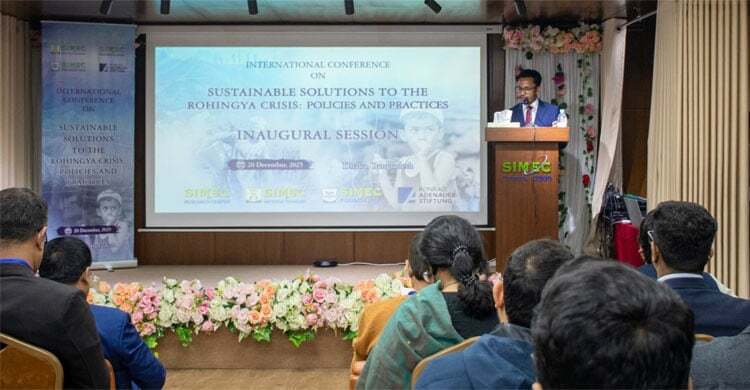
Sustainable resolution of the Rohingya crisis lies in Myanmar, with repatriation remaining the only viable long-term solution, speakers said at an international conference in Dhaka on Saturday, December 20.
“The solution to the Rohingya crisis lies in Myanmar. Among the three classical solutions, only repatriation remains sustainable,” said Abu Saleh Mohammed Obaidullah, additional refugee relief and repatriation commissioner (joint secretary) at the Office of the Refugee Relief and Repatriation Commissioner (RRRC), Cox’s Bazar.
He was speaking at the inaugural session of the international conference titled “Sustainable Solutions to the Rohingya Crisis: Policies and Practices”, held at the SIMEC Institute of Technology in Uttara. The conference was jointly organised by the SIMEC Research Centre, Singapore, and the SIMEC Institute of Technology, Bangladesh.
Obaidullah said Bangladesh is not in a position to locally integrate Rohingyas, while resettlement options remain bleak amid shifting global politics and growing anti-migrant sentiment. “So far, only about 5,500 Rohingyas have been resettled. Given the current international political landscape, large-scale resettlement is not a realistic option,” he added.
The inaugural session was chaired by Dr Ratan Kumar Roy, director of the SIMEC Research Centre, Singapore, while Dr Sariful Islam, research coordinator of SIMEC Institute of Technology, delivered the opening remarks.
Rohingya representatives, who joined the conference virtually from refugee camps in Cox’s Bazar, reiterated their strong desire to return to their homeland in Arakan, Myanmar. They stressed the need for recognition of their identity and restoration of citizenship rights as prerequisites for safe and dignified repatriation.
Highlighting the role of technology, Astrid Castelein, assistant representative for protection at UNHCR Bangladesh, said digital interventions such as biometric data registration are crucial not only for humanitarian assistance but also for achieving sustainable solutions. She noted that UNHCR began biometric registration of Rohingya refugees in Bangladesh in 2018 under a joint memorandum of understanding.
The conference featured an inaugural session, two plenary sessions, seven parallel thematic sessions, a special session on academic publishing and a valedictory session.
In the concluding session, Dr Imtiaz Ahmed underscored the importance of regional cooperation, international responsibility-sharing and justice-oriented approaches to build confidence in collective efforts to resolve the crisis. He stressed the need to view the Rohingya situation comprehensively, recognising the roles of states, Myanmar’s military, intergovernmental organisations, business communities and civil society.
Engr Sardar Md Shaheen, founder chairman of the SIMEC Foundation and chief guest at the closing session, said Bangladeshi scholars and institutions must continue producing research and engaging in policy deliberations to find sustainable solutions to a crisis that has placed enormous social, economic and environmental pressure on Bangladesh.
The conference brought together scholars, policymakers, humanitarian practitioners, Rohingya representatives, media professionals and government officials from Bangladesh, the United States, Singapore, Germany and India. Discussions throughout the event highlighted the limitations of short-term humanitarian responses and called for urgent, rights-based and politically informed solutions to the protracted Rohingya crisis.