
Noakhali tops bribery chart, BRTA most corrupt sector

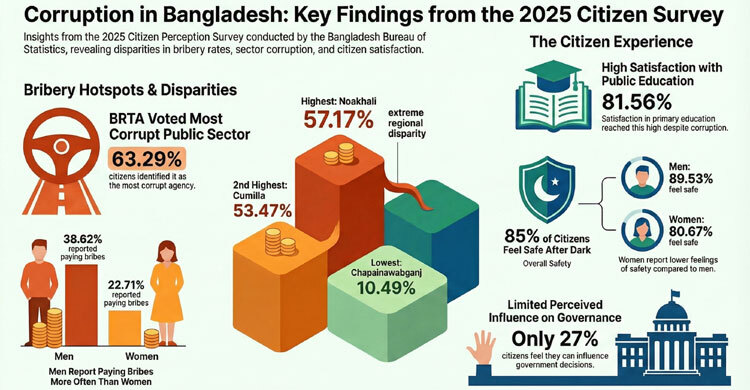
Noakhali has emerged as the district with the highest prevalence of bribery in Bangladesh, according to the Citizen Perception Survey (CPS) 2025 conducted by the Bangladesh Bureau of Statistics (BBS).
The nationwide survey, covering all 64 districts, highlights significant disparities in citizens’ experiences with corruption and government services across the country.
The CPS 2025 final report was officially unveiled at the BBS auditorium in Agargaon, Dhaka, on Wednesday, December 24, with Planning Division Secretary SM Shakil Akhtar present at the ceremony.
Bribery hotspots and lowest rates
The district-wise data reveal alarming levels of bribery in several districts. Noakhali leads with 57.17% of respondents reporting having paid bribes while accessing government services, followed by Cumilla (53.47%), Faridpur (51.70%), Bhola (49.01%), and Sirajganj (48.37%). In these districts, roughly half or more service-seekers faced bribery, particularly in land administration, police, and local government offices.
In contrast, Chapainawabganj recorded the lowest bribery rate at 10.49%, followed by Magura (13.98%), Lalmonirhat (14.50%), Gazipur (15.24%), and Sylhet (15.61%). The gap of nearly 47 percentage points between the highest- and lowest-ranking districts underscores stark regional inequalities and calls for targeted reforms.
Gender and sector disparities
The survey found that 38.62% of men reported paying bribes, significantly higher than the 22.71% of women. Sector-wise, the Bangladesh Road Transport Authority (BRTA) was voted the most corrupt by 63.29% of respondents, followed by law enforcement agencies (57.96%) and passport offices (57.45%). Almost all respondents (98.48%) identified “money” as the form of bribery.
Citizens’ experiences with services
Despite these challenges, the survey also highlights usage and satisfaction with public services. Nationally, 47.12% of respondents accessed government healthcare in the past year, 40.93% had children in government schools, and 73.77% sought other government services such as identity cards or citizen registration. Satisfaction levels were highest in primary education (81.56%), followed by secondary education (78.18%), healthcare (72.69%), and other services (66.91%).
Only 27.24% of citizens felt they could influence government decisions, and just 21.99% believed they could impact political decisions, reflecting limited citizen engagement in governance. Security perceptions were relatively positive, with 84.81% of citizens feeling safe walking near their homes after dusk, although women reported lower levels of safety (80.67%) compared to men (89.53%).
Calls for reform
Experts say the wide variation in bribery reflects differences in administrative capacity, service digitalisation, local monitoring, and citizen awareness. They argue that districts with higher corruption require focused reforms, greater transparency, and stronger accountability mechanisms. Using district-level CPS data, policymakers could design targeted action plans to reduce bribery and improve public service delivery.
The CPS 2025 survey was conducted from February 6 to 23, 2025, covering 1,920 primary sampling units and interviewing 84,807 respondents from 45,888 households across Bangladesh.
This comprehensive survey provides a roadmap for addressing corruption while improving governance and citizen trust in government services, highlighting the urgent need for regional reforms and national accountability measures.