
A system designed to fail: How a regulatory vacuum fuels hospital graft

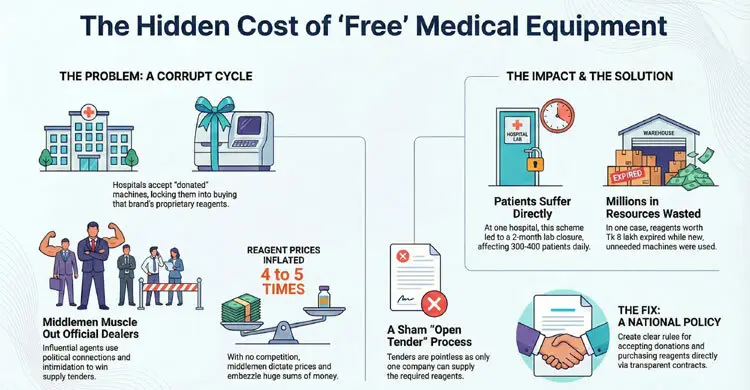
Doctors rely on advanced machines and chemicals, called reagents, to perform tests. These expensive machines are often donated by foreign companies to hospitals in Bangladesh, but the catch is that hospitals must buy the reagents from the same companies, creating a monopoly. While this system worked initially, a vast corruption network involving businessmen, political cadres, middlemen, and hospital insiders has emerged, siphoning public funds through sophisticated schemes. After an extensive investigation, Jago News uncovers this previously unknown scandal. Today, the second and final part of this eye-opening two-part series is published, revealing the full extent of the corruption.
Crores of takas are being siphoned off under the guise of supplying reagents, with diagnostic machines gifted to government hospitals through a tender system that is both unnecessary and unreasonable. This system has been preserved for years by a shadowy circle within the hospitals themselves.
In collusion with them, muscle-bound political cadres, opportunistic middlemen, and dishonest business circles continue to perpetuate this exploitative practice. What Jago News uncovered more clearly in its investigation is that this vast opportunity for corruption has been created primarily due to the absence of policy.
For years, valuable equipment has been traded as “free gifts” in government hospitals, while behind the scenes, manipulation of public funds has flourished. Officials charged with supervising this serious corruption appear either unaware or unwilling to speak. When their attention is drawn to the matter, their responses are startling in their vagueness.
Yet, when pressed, they strongly emphasise the urgent need for the government to formulate specific policies: policies to regulate the gifting and receiving of such instruments, to fix the price of reagents, and to ensure reagents are purchased directly from companies or authorised dealers through written contracts.
The excesses of middlemen
Hospital laboratories across the country rely on machines from global brands: Beckman Coulter of the United States, Sysmex of Japan, Siemens of Germany, Mindray of China and Spinreact of Spain. Their local dealers – OMC, Biotech Services, Bio-Trade International, ABC Corporation and Rajanigandha International – are tasked with importing reagents and supplying them to hospitals.
In private hospitals, this system functions as intended. But in government hospitals, muscular forces, including political cadres, obstruct dealers from participating directly in tenders. Dealers are compelled to appoint influential agents, who obtain trade licences, enter tenders under their own names, and inflate prices at will.
Take CSB Enterprises, for example. Last fiscal year, it supplied reagents for machines donated by dealers such as OMC, Biotech and ABC to Shaheed Suhrawardy Medical College Hospital. CSB is not an authorised dealer of any foreign company; it is merely a vendor with a trade licence.
Jointly owned by Anwar and Pintu, the company thrives on political connections – Pintu is close to the local Awami League ward general secretary Kajal, while Anwar is involved in BNP politics and currently leads operations.
At the National Institute of Cardiovascular Diseases (NICVD), reagents were once supplied by Probir Enterprise, owned by Kazi Kabir. Its rise is steeped in fear.
In the Sher-e-Bangla Nagar hospital zone, no one dared to participate in tenders after Kabir’s elder brother was murdered in a dispute over tender rigging. Even while absconding after August 5, Kabir continued to control contracting in the area through an associate named Kamrul, who remains elusive.
Elsewhere, Beckman Coulter’s dealer OMC was unable to supply reagents directly to the NICVD last year. Instead, Radix Trade Limited acted as its representative. Owned by former Chhatra League leader Biplob, Radix operated under the blessing of the Prime Minister’s Office of the previous government. Biplob insisted to Jago News: “Like everyone else, I have done business legally through an open tender with the company’s representation.”
Another contracting company, Restech, also supplies reagents to the NICVD. Its owner, Elias, is known to be close to fugitive Awami League leader Sheikh Selim and was once an Awami League parliamentary candidate in Nagarpur, Tangail.
Dealers themselves admit the distortion. Shahriar Sourav, Managing Director of ABC Corporation, which represents China’s Mindray, explained:
“Our market price is the same everywhere, but slightly lower in government hospitals. However, in some places, we cannot provide directly. Then the price increases through third parties.”
Pressed further, Sourav conceded that prices can rise four to five times higher than normal: “Actually, we have no control over it. We do business. If they want, we pay the price. What can we do if they charge more? Whenever we go directly to a hospital, we face obstacles. We cannot go due to the muscle power and political influence of the locals. Many times, it has happened that we could not even supply directly. For example, when I went to Kishoreganj and Manikganj and returned, I could not install the machine. This has been happening in the health sector for a long time. A very difficult situation.”
Asked who these obstructive figures were, Sourav replied: “One person works in each place. There are more locals among them. At one time, they had political shelter. Now the situation is different. We are thinking of paying ourselves. Let’s see what happens.”
Ramzan Ali, Managing Director of Biotech Services Limited, echoed the frustration: “Those who change hands and take jobs do not know anything. Rather, they create trouble. We tried hard but could not pay ourselves directly. We had to delegate to a third party. If there is a third party, the price will increase – this is natural. If you want the best for the patients, stop this hand-wringing.”
He added: “The more the chaos is, the more the cost increases. The hospital director has control over all this. The problem can be solved only if there is political will.”
An official at a government hospital, speaking anonymously, confirmed that everyone – including ministers and secretaries – knows why and how prices rise. Bribes must be paid at every level to secure budgets and process bills. From the moment donated machines are received, hospital administrators, doctors, and technologists must be “managed” with payments. Even in accounts and store departments, bribes are demanded before bills are cleared.
One reagent supplier at the Heart Hospital summed it up bluntly: “Those in the hospital administration or the government can stop these irregularities if they want. But they don’t want to. Because they also benefit personally from this.”
Unreasonable tender
Every year, government hospitals purchase reagents through open tenders to keep diagnostic machines running. Yet the reagents required for these machines are not available in the open market. Only the companies that manufacture the machines can supply them. In such circumstances, what purpose does an open tender serve – or is there any need for it at all?
When asked, Dr Mohammad Sehab Uddin, Director of Suhrawardy Medical College Hospital, told Jago News: “You are right. When the product is not open in the market, those who provide the machines will provide the reagents. There is no need for open tenders here. Rather, an agreement is needed. But we have to follow the statutory rules. Without open tenders, the audit will not accept it.”
The director added candidly, “Many of us do not understand what you are saying. This is not the work of doctors. Many of those who do administrative work do not understand.”
His words are borne out by the statement of Dr Sheikh Iftekhar Rahman, Director (Finance) of the Directorate General of Health Services. He explained to Jago News: “It is purchased through an open tender. There is a quoted price in the tender, and the one who offers a competitively low price is chosen and purchased.”
Yet this director appeared unaware that there is no real competition in such tenders. There is no scope for competition at all, because only the company that manufactures the machine can supply the reagents – without them, the tests cannot be performed.
ABC Corporation’s Shahriar Sourav described the system in place at hospitals such as Suhrawardy and the Kidney Hospital: “A director called me and said, those who participate in the tender, you do not give one price to anyone. You offered Tk 100, he offered Tk 120 in the tender. Instead of doing this, he suggested three different prices to the three authorised people. For example, he proposed one product costing Tk 120 to one bidder, Tk 110 to another, and Tk 105 to another.”
“He told me, ‘It’s your product, but we can select it and get it at a lower price. That’s why we are authorising three people at that hospital,” added Sourav.
Behind the scenes of the NICVD episode
The mysterious incident of August 7, mentioned at the beginning of the first part of this report, prompted Jago News to begin investigating both inside and outside the hospital the very next day, August 8.
As a result of extensive efforts to unravel the mystery, the hospital administration eventually responded. On August 12, the then acting chief medical officer of the pathology department, Dr Abdullah Al Mueed Khan, was removed. Although the authorities formed an investigation committee, no report has yet come to light. Meanwhile, the eight machines that had been inserted into the NICVD under the cover of darkness remained untouched. Neither accepted outright nor returned, attempts were made to officially approve the machines under invisible pressure.
On September 17, the hospital director, Professor Dr Abdul Wadud Chowdhury, wrote to the heads of four departments: “There are proposals for the following machines for donation from various institutions. Is there any requirement for the machines mentioned in your department or not? Requested to be informed within the next five working days.”
The departmental heads replied promptly, stating they do not need these machines.
Following this, the director asked the hospital’s donation machine acceptance committee to review the entire process, including the replies. The committee also concluded that there was no need to accept those machines.
Finally, on November 7, the director wrote to the companies concerned, instructing them to take back the machines. During the investigation, Jago News obtained the names and specifications of the eight machines: six had been sent as gifts by ABC Corporation, one by Biotech Service, and one by SS Enterprise.
Yet after receiving the director’s letter, ABC Corporation refused to take back the machines. Instead, its marketing officer, Ahsanul Reza, misbehaved with the acting head of the pathology department, Associate Professor Dr Dilshad Parveen, during a phone call. Dr Dilshad reported the incident verbally to the director.
Further investigation revealed that Ahsanul Reza is the brother of Dr Ekramul Reza, a junior consultant and resident physician at the NICVD. When asked, Dr Ekramul Reza confirmed: “My brother Ahsanul Reza works for ABC Corporation, the supplier of the machines, that’s right. They came to me. I told them to contact the relevant department. I did not lobby for them.”
Responding to questions, the recently removed acting head of pathology, Dr Abdullah Al Mueed Khan, explained: “I took those machines in the interest of the hospital. Indeed, the procedure was not followed. My intention was not bad.”
NICVD Director Professor Dr Abdul Wadud Chowdhury stated: “I have asked the firms concerned to take the machines back. They will take them.”
Dr AHM Mainul Ahsan, Director (Hospital) at the Directorate General of Health Services, added: “We have been monitoring the irregularities related to the machines of the NICVD for a long time. A ban has been imposed on the installation of any new machines.”
Health and Family Welfare Adviser Nurjahan Begum reinforced the warning: “If anyone commits irregularities or satisfies self-interest in the name of grants, they will not be spared. We are monitoring the matter closely.”
No tests for two months, Tk 8 lakh wasted
The manipulation of donated machines by vested interests had devastating consequences for patients. While tests were being conducted on some of the eight machines, reagents purchased for the existing machines expired unused. For a time, laboratory tests were even carried out with expired reagents. Once higher authorities became aware, operations were halted.
This mismanagement resulted in reagents worth approximately Tk 8 lakh being wasted, and the pathology department of the NICVD remained closed for nearly two months, from mid-August to mid-October. The closure caused immense suffering for 300 to 400 patients each day, who were forced to undergo tests at private hospitals.
Eventually, the pathology department reopened with machines donated by Rajanigandha International, which had been lying idle for a long period.
During the investigation, Jago News obtained two letters. In one, the hospital director sought an explanation from the lab-in-charge, Ganesh Chandra, regarding the use of expiry of reagents. In his reply, Ganesh Chandra explained that because two new machines from ABC Corporation and Biotech had been put into operation, the hospital’s existing machines and reagents were not used, leading to their expiry. Despite this, department head Dr Abdullah Al Mueed Khan instructed staff to continue conducting tests with the new machines.
A resolution to such a situation needs a policy
Professor Dr ABM Yunus, a renowned haematologist and former chairman of the Haematology Department at Bangladesh Medical University, believes that a clear policy on the acceptance, installation, and supply of donated machines is essential to resolve the crisis.
He told Jago News: “Like every sector in the country, the health sector is also immersed in a deep mess. The corruption that you have brought up in the process of accepting lab machines and purchasing reagents has been going on for a long time. It has become normal in this sector. Now, if you raise questions, many will want to make you the culprit. Because, the people of our country will rarely be able to catch such subtle irregularities. Many of those who will monitor the matter also do not understand. Those who do understand are involved in corruption. To stop the way organised groups are embezzling crores of takas with machines worth Tk 10-12 lakh, we need to change the current system.”
Asked what should be done, he explained: “Since reagents are not available in the open market, control is in the hands of those who import them. This will not protect the government’s interests in an open tender. Rather, machines and reagents should be purchased directly from the brand’s domestic dealer in a transparent process. For this, both parties should enter into a specific agreement. The agreement should mention who will provide which service, and who will get what benefits in return. If necessary, a ‘policy regarding acceptance of gifted machines and supply of reagents’ can be made at the government level for the entire country.”
Earlier, three machines gifted by Rajanigandha International to the NICVD had not been installed even after a year. Valuable equipment – including a state-of-the-art Haematology Analyser (five parts), a Multi-channel Coagulation Analyser, and a BA210 model microscope made in Spain – were being used as tea tables. A report on this was published in Jago News on July 15, 2025.
In response, the Directorate General of Health Services formed a committee to investigate the incident on July 16, 2025. Acting on the committee’s recommendations of 3 September, the Directorate issued 13-point instructions, including the installation of the machines. By mid-October, the machines were activated, reopening the previously closed pathology department.
Professor Dr Abdul Wadud Chowdhury, Director of the NICVD, told Jago News: “While working on the matter, I came to know that there was a theft here. I caught it. We reached an agreement as a solution, so that the interests of the hospital are protected, and the company also survives.”
Health and Family Welfare Secretary Md Saidur Rahman confirmed that the government is considering a nationwide policy modelled on the NICVD agreement: “All our work is not above question. There are inconsistencies. However, since the matter has come to our attention through you, we will work on it. We will see if a policy can be made for accepting donated or gifted machines and purchasing their reagents.”
Health and Family Welfare Adviser Nurjahan Begum acknowledged the broader challenge: “We have many limitations. The biggest one among them is the budget shortage, due to which we cannot buy all the machinery. So, we have to take donated or gifted machines. This opportunity leads to a cycle of irregularities or corruption. To stop these, the entire system will have to be changed. This will take a long time. But we (the interim government) don’t have that time.”