
In tears and prayer, Bangladesh farewells Khaleda Zia

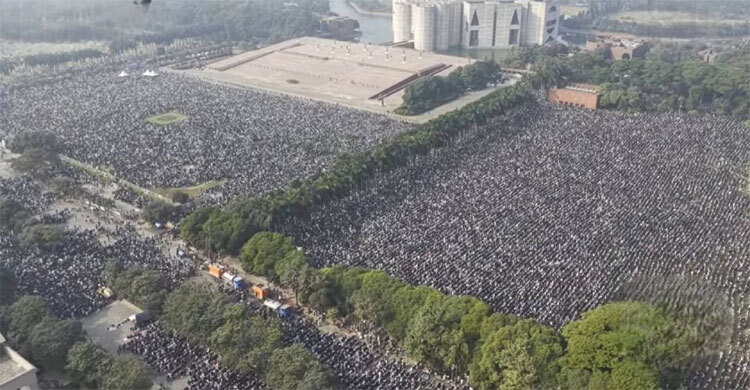
Bangladesh witnessed an unprecedented outpouring of grief on Wednesday, an ocean of mourners gathered at Manik Mia Avenue to attend the funeral prayers for BNP Chairperson and three-time former Prime Minister Begum Khaleda Zia.
In what is being described as the largest funeral in the country’s history, the capital turned into a sea of mourners united in sorrow, remembrance, and respect.
With no room left on the ground, people climbed rooftops – of metro rail stations, nearby buildings and houses – standing shoulder to shoulder under the open winter sky to take part in the namaz-e-janaza. From above, hands were raised in prayer, tears rolled down faces, and a city mourned in unison.
Under the clear winter sky, the namaz-e-janaza was held at around 2:40pm, led by Mufti Abdul Malek, Khatib of the Baitul Mukarram national mosque.
As prayers echoed across the avenue, waves of emotion swept through the crowd – many weeping openly, others standing silently, hands raised, eyes fixed on the bier draped in the red and green of the national flag.
Manik Mia Avenue, Bijoy Sarani, Agargaon, the Old Trade Fair Ground, Asad Gate, Arong intersection and every connecting road were overwhelmed by the massive crowd. Beyond the inner grounds, the outer precincts of the National Parliament Building and the entire stretch of the avenue were filled with mourners, leaving no path untouched by sorrow.
Ahead of the funeral prayer, Khaleda Zia’s eldest son and BNP Acting Chairman Tarique Rahman, speaking briefly on behalf of the bereaved family, sought prayers from the nation for his mother.
During the namaj-e-janaza, Tarique Rahman stood to the left of Chief Adviser Professor Muhammad Yunus. Beside him were NCP Convener Nahid Islam, BNP Secretary General Mirza Fakhrul Islam Alamgir, Jamaat-e-Islami Secretary General Mia Golam Parwar and election expert Badiul Alam Majumder.
To the right of the Chief Adviser stood Chief Justice Zubair Rahman Chowdhury, followed by Jamaat-e-Islami Amir Dr Shafiqur Rahman, Army Chief General Waker-uz-Zaman, Navy Chief Admiral Mohammad Nazmul Hasan and Air Chief Marshal Hassan Mahmud Khan.
Interim government advisers Asif Nazrul, Adilur Rahman, Fawzul Kabir Khan, AFM Khalid Hossain, Ali Imam Majumder, CR Abrar and M Sakhawat Hossain were also present.
Senior BNP leaders, leaders of various political parties joined the funeral prayers, reflecting the national significance of the moment.
Foreign dignitaries, including Indian External Affairs Minister S Jaishankar, Pakistan’s parliament speaker Sardar Ayaz Sadiq, and representatives from several South and Southeast Asian countries, were also present to pay their last respects.
From early morning, people poured into the capital from every corner of the country.
Manik Mia Avenue, Khamar Bari, Farmgate, Karwanbazar on the East Bijoy Sarani, Agargaon and Asadgate on the North and surrounding areas were overwhelmed by the sheer number of mourners. Many had travelled overnight, braving the biting winter cold, determined to be part of history and to say goodbye to a leader who shaped the nation’s politics for decades.
At around 11:50am, a freezer-van carrying Khaleda Zia’s body arrived at Manik Mia Avenue from the Gulshan Avenue residence of her elder son, BNP Acting Chairman Tarique Rahman.
As the hearse entered the venue, chants, prayers, and sobs rose from the crowd, marking one of the most emotional moments of the day.
A multi-layered security arrangement was enforced to maintain order amid the massive gathering. Members of the army, police, RAB, BGB, and other law enforcement agencies remained deployed throughout the area, as mourners continued to arrive in large numbers until the final prayers.
Even before dawn, crowds were seen around the National Parliament area, Evercare Hospital, the Gulshan office, and Firoza, standing vigil through the night. For many, the farewell was not just to a former prime minister, but to a symbol of an era.
After the funeral, Khaleda Zia was to be laid to rest beside her husband, late President Ziaur Rahman, at Zia Udyan in Sher-e-Bangla Nagar, where a grave has been prepared next to his – reuniting in death a couple central to Bangladesh’s political history.
Begum Khaleda Zia passed away at Evercare Hospital at around 6:00am on Tuesday, December 30, after more than a month of treatment. She was 80.
On Wednesday, Bangladesh did not merely witness a funeral – it witnessed a nation pausing, bowing its head, and bidding farewell to one of its most towering and consequential leaders.