
Eight July uprising martyrs identified after 18 months


The identities of eight previously unidentified martyrs have been confirmed after 18 months as part of the ongoing programme to exhume and identify the bodies of unknown victims of the July 2024 mass uprising.
A total of 114 unidentified bodies were exhumed from Rayerbazar graveyard in Mohammadpur, Dhaka, where autopsies were conducted and DNA samples were collected.
The operation was carried out under the supervision of the Ministry of Liberation War Affairs and in compliance with a court order. Through DNA profiling, the identities of eight martyrs have been established by matching samples provided by nine victim families. The identification process of one additional body is still underway.
The information was disclosed on Monday (January 5) by CID Chief and Additional Inspector General of Police Md Shibgat Ullah at a programme titled “Identification of Unidentified Martyrs’ Bodies” held at Rayerbazar graveyard.
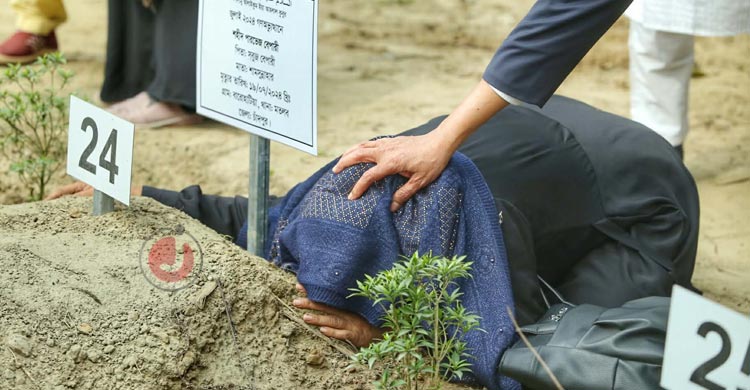
After the graves were identified, they were formally handed over to eight families. Family members broke down in tears during the emotional moment.
The identified martyrs are Kabil Hossain, 58, of Madartek in Dhaka; Sohel Rana, 38, of Mohammadpur in Dhaka; Asadullah, 31, of Sherpur; Rafiqul Islam, 29, of Feni; Mahim, 32, of Mymensingh; Faisal Sarker, 26, of Cumilla; Rafiqul Islam, 52, of Pirojpur; and Parvez Bepari, 23, of Chandpur.
The event was attended by Liberation War Affairs Adviser Faruk-e-Azam, Local Government, Rural Development and Cooperatives Adviser Adilur Rahman Khan, and Special Assistant to the Ministry of Health and Family Welfare Professor Dr Sayedur Rahman, among others.
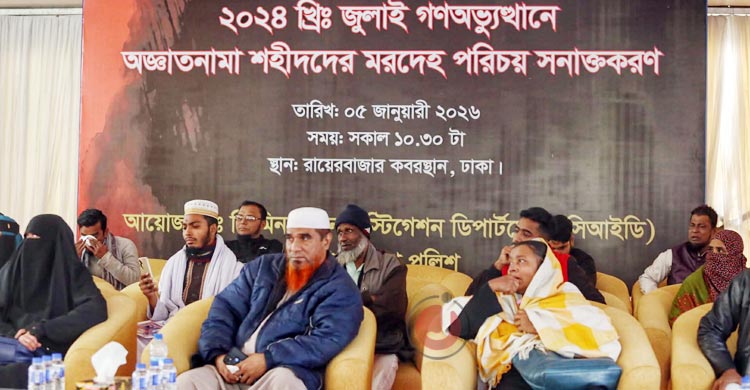
During the July 2024 mass uprising, the bodies of many martyrs killed at different locations in Dhaka were buried as unidentified at Rayerbazar graveyard. Later, in response to demands from victims’ families and in the interest of justice, the authorities initiated the exhumation and identification process.
According to a decision of the Ministry of Liberation War Affairs, and to ensure international standards and expert involvement, the Criminal Investigation Department (CID) was entrusted with the overall supervision of the sensitive operation. The programme was led by CID Chief and Additional IGP Md Shibgat Ullah.
With support from the United Nations Human Rights Commission, the exhumation process began on December 7 last year under the direct guidance of internationally renowned forensic anthropologist and forensic consultant Dr Luis Fondebrider.
Earlier, a United Nations Special Rapporteur on extrajudicial, summary or arbitrary executions visited Bangladesh and provided a two-day special training programme for CID’s forensic, DNA and medical forensic teams.
The entire process, including exhumation, DNA sample collection, profiling and reburial, was conducted in accordance with the Minnesota Protocol, an internationally recognised guideline designed to ensure human rights and impartiality in investigations of potentially unlawful deaths.
A temporary morgue was set up at Rayerbazar graveyard, where the exhumation and DNA sampling of all 114 bodies were successfully completed between December 7 and December 27.