
Yunus leads all-party walk through July’s memory

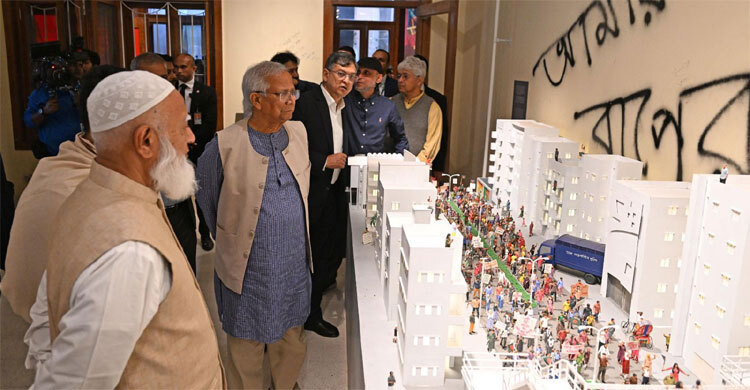
On a quiet Tuesday afternoon, history spoke back inside Ganabhaban.
Led by Chief Adviser Professor Muhammad Yunus, leaders from across Bangladesh’s political spectrum walked together through the nearly completed July Uprising Memorial Museum – a rare moment of collective reflection in a nation shaped by deep political divides.
Arriving around 3:00pm, Professor Yunus began his tour of the museum’s final phase, moving slowly through galleries that document the July Uprising and what the curators describe as 16 years of authoritarian rule under Sheikh Hasina.
Photographs, blood-stained clothes of martyrs, handwritten letters, newspaper clippings, audio-visual testimonies and state documents unfolded a painful yet defiant national story.
What made the visit remarkable was not only the weight of memory, but the company. Standing beside Yunus were BNP Standing Committee Member Salahuddin Ahmed, Jamaat-e-Islami Amir Dr Shafiqur Rahman, National Citizen Party Convener Nahid Islam, student leaders who once stood at the front lines of the uprising, and families of enforced disappearance victims - voices long separated by politics, now united by remembrance.
Cultural Affairs Adviser Mostofa Sarwar Farooki guided the delegation through the museum along with curator Tanjim Wahab, architect Marina Tabassum Khan and researchers.
One gallery freezes the dramatic escape of former Prime Minister Sheikh Hasina; another confronts visitors with “mirror rooms,” designed to simulate the psychological torment endured by detainees.
Professor Yunus watched a 15-minute documentary produced by the Ministry of Cultural Affairs, chronicling disappearances, repression and mass killings during the July 24 Uprising.
Visibly moved, he called the museum “an unprecedented example in the world,” built while “the blood of the July martyrs is still fresh.”
“We hope there will never again be a need to build such a museum,” Yunus said. “But if the nation ever loses its way, it will find its direction here.”
He urged citizens, especially students, to spend time inside the museum, even a full day. “Only then will people truly understand what atrocities this nation endured,” he said, adding that sitting inside the mirror rooms allows visitors to grasp, even briefly, the suffering of prisoners.
Reflecting on the uprising, Yunus highlighted its defining lesson: unarmed youth standing fearlessly against brutality. “They had nothing, no weapons, yet they resisted. This courage must unite us so that Bangladesh never returns to such dark days.”
Cultural Affairs Adviser Farooki noted that the museum’s rapid progress is itself historic. “Many young people worked here for eight months without pay,” he said. “Before the elections, this museum will open to all. It will anchor Bangladesh’s past, present and future political discourse.”
As the all-party delegation stepped out of the museum, the message lingered: beyond politics, memory demands unity – and history, once confronted together, may yet shape a different future.