
Tk 15.74cr consultancy fee raises eyebrows in rabies project

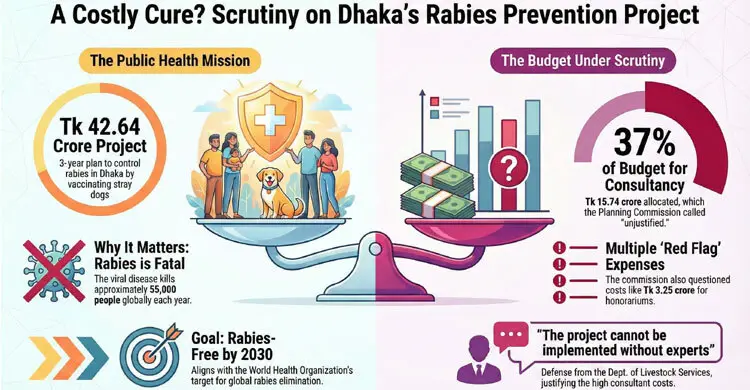
The government is set to undertake a Tk 42.64 crore project aimed at preventing rabies, but a proposal allocating Tk 15.74 crore for consultancy fees has drawn objections from the Planning Commission.
Under the project titled “Prevention of Rabies Transmission Through Stray Dogs,” the Department of Livestock Services (DLS) submitted a development proposal to the Forest, Fisheries and Livestock Wing of the Planning Commission’s Agriculture, Water Resources and Rural Institutions Division. The commission described the proposed consultancy expenditure as “unjustified.”
The issue was raised during a meeting of the Project Evaluation Committee (PEC), where members questioned the necessity of consultancy costs spread across 37 expenditure heads. The Planning Commission has suggested reducing what it termed unnecessary consultancy expenses to a more reasonable level.
The three-year project is planned for implementation within the Dhaka City Corporation area. The commission also found a lack of justification for several other proposed costs. For instance, Tk 28 lakh has been allocated for overseas training for four people, while Tk 15.46 crore has been earmarked for hiring consulting firms.
Defending the allocation, Dr Md Habibur Rahman, head of the Planning and Evaluation Cell of the Department of Livestock Services, told Jago News that expert involvement is essential.
“This work requires experts. The project cannot be implemented without experts. That is why Tk 15 crore has been allocated for consultant expenses,” he said.
Explaining expenditures related to two officials, he said the proposed salaries include various benefits such as house rent, special benefits, entertainment allowance, and other entitlements, all of which have been combined in the total allocation.
Rabies is a fatal viral disease that spreads mainly through dogs to animals and humans. There is no cure once symptoms appear, and death is inevitable. Globally, around 55,000 people die from rabies each year.
Project Objectives
The project aims to protect public and animal health by preventing rabies through mass vaccination of stray dogs, controlling and improving stray dog health through sterilisation, and raising public awareness about humane animal treatment and rabies prevention.
Key Activities of the Project
Planned activities include domestic training for 10 people and overseas training for four, organising seminars and workshops, procuring vaccines and medicines, implementing preventive activities, controlling stray dogs, providing food for neutered dogs, hiring consulting firms, and delivering medical training. The project also includes the purchase of three laptops, one projector, six air coolers, and office furniture.
Proposed Nine Types of Expenditure for Two Officials
Basic salaries for two officials—primarily the project director and deputy project director—have been set at Tk 35.67 lakh. Additional allocations include Tk 17.83 lakh for house rent, Tk 1.08 lakh for medical allowance, Tk 72,000 for education allowance, Tk 5.94 lakh for festival allowance, Tk 1.98 lakh for leave and recreation allowance, Tk 36,000 for mobile allowance, Tk 69,000 for Bangla New Year allowance, and Tk 3.57 lakh for special benefit allowance.
An additional Tk 1.16 lakh has been allocated for monetisation of residential telephone facilities.
Nearly Tk 2 crore has been proposed for outsourcing 20 personnel. Other allocations include Tk 1.16 lakh for domestic training, Tk 72,000 for internet bills, Tk 6 lakh for tender advertisements, Tk 20 lakh for video documentaries, and Tk 3.25 crore for honorariums.
Further expenditures include Tk 19.47 lakh for seminars and workshops, Tk 12 lakh for additional honorariums, Tk 6 lakh for miscellaneous costs, Tk 49.50 lakh for car hiring, Tk 2.74 crore for animal vaccines and medicines, Tk 1.30 crore for food for neutered dogs, Tk 74 lakh for awareness campaigns, and Tk 19.73 lakh as engineering consultancy fees (2 per cent).
The proposal also includes Tk 5 lakh for office renovation, Tk 3.60 lakh for desktop computers, Tk 70,000 for multimedia projector accessories, Tk 1.20 lakh for laptops, Tk 3.50 lakh for a photocopy machine, Tk 11.53 lakh for furniture, Tk 1.60 crore for a mobile pet clinic, Tk 1 lakh for IPS purchase, Tk 9.60 lakh for six air coolers, Tk 2.40 crore for surgical and medical equipment, and Tk 9.86 crore for constructing a Central Veterinary Hospital (CVH) pet clinic under a static clinic upgradation programme.
Further Objections Raised by the Commission
The Planning Commission also raised concerns about the lack of clarity regarding training and seminar participants. The proposal includes one training programme for 10 participants and three seminars with 100 participants each, but does not specify who the trainees or participants will be.
Despite assigning four veterinary surgeons with additional responsibilities and appointing three veterinary surgeon consultants through consulting firms, the project has allocated Tk 3.25 crore in honorariums for veterinary surgeons engaged in dog neutering. The commission questioned the justification for this expense.
Similarly, although Tk 2.40 crore has been allocated for purchasing surgical and medical equipment for the CVH pet clinic, the Development Project Proposal (DPP) does not include specifications or market price verification.
Responding to the criticism, Dr Anjan Kumar Deb Roy, head (additional secretary) of the Forest, Fisheries and Livestock Wing of the Agriculture, Water Resources and Rural Institutions Division, said the consultancy costs were being misunderstood.
“This cannot really be called consultancy in the conventional sense. It can be described as operational services. The cost is for vaccinating stray dogs and providing related services,” he said.
Regarding concerns over expenditures across 37 sectors, he added that items were reviewed in multiple meetings and unjustified external expenses were excluded.
Rabies Situation in Bangladesh
According to the Department of Livestock Services, around 250,000 people in Bangladesh are bitten or scratched each year by dogs, cats, or jackals, most of them children. While comprehensive livestock data is unavailable, 1,232 livestock animals died of rabies in 2023.
The Disease Control Wing of the Directorate General of Health Services (DGHS) is implementing a National Rabies Elimination Programme using science-based methods. During the 2020–21 fiscal year, approximately 500,000 dogs were vaccinated in nationwide drives across 20 districts.
Since 2010, the Ministry of Health, the Ministry of Local Government, and the Ministry of Fisheries and Livestock have jointly implemented the National Rabies Control and Elimination Programme, initially aiming to make Bangladesh rabies-free by 2022. A total of 67 rabies control and elimination centres have been established nationwide, providing modern treatment and free anti-rabies vaccines.
To meet Sustainable Development Goals, the World Health Organization is targeting global rabies elimination by 2030. Scientific evidence shows that vaccinating at least 70 per cent of dogs in an area creates herd immunity, and three consecutive annual vaccination rounds can reduce transmission to near zero.
To accelerate mass dog vaccination and achieve a rabies-free Bangladesh by 2030, the Department of Livestock Services, in coordination with the DGHS Disease Control Wing, has proposed initially implementing the project in the Dhaka City Corporation area.