
Govt twists minority violence data through ‘intellectual propaganda’: Debapriya

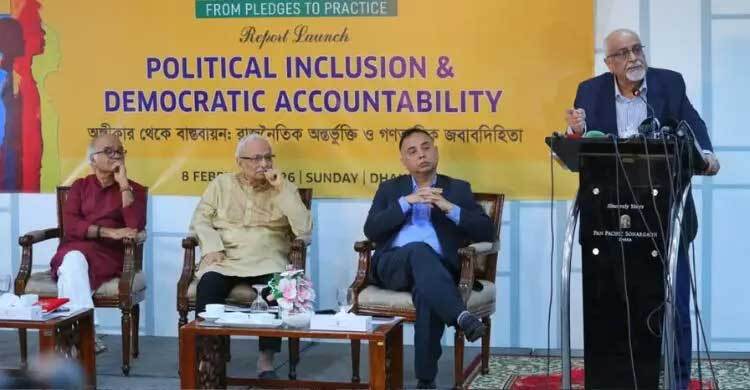
Economist Debapriya Bhattacharya on Sunday accused the interim government of intellectual propaganda and distortion of information over attacks on religious minorities, alleging that official data has been presented in a fragmented manner that conceals the real extent of violence against vulnerable communities.
He made the remarks while speaking at the release of a research report organised by the Centre for Governance Studies (CGS) at a hotel in the capital on February 8.
The event was attended by economist Dr Selim Jahan, SUJAN Secretary Dr Badiul Alam Majumder, politicians, teachers, economists, civil society representatives, media professionals and representatives of minority communities. CGS President Zillur Rahman presented the research report titled “From Promise to Practice: Political Inclusion and Democratic Accountability – Bangladesh Election 2026.”
Debapriya criticised statements made by the interim government’s spokesperson on minority violence, saying data from within the government has been selectively framed.
Referring to a January press briefing, he said a government spokesperson claimed there were 645 attacks on religious minorities in 2025, but described only 71 incidents as “communal”.
“This is an example of intellectual propaganda and distortion of information,” Debapriya said.
On January 19, the press wing of the chief adviser said that police records showed 645 incidents involving minority community members in 2025. Of these, police identified “communal elements” in 71 cases based on verified FIRs, GDs, charge sheets and investigation progress, adding that legal action had been taken.
Questioning this classification, Debapriya said attacks on temples or idol vandalism were labelled communal, while incidents described as land disputes, business conflicts or neighbourhood disputes were excluded.
“If a woman is attacked, do we say there was no violence against women, only violence against a person?” he asked, arguing that minorities were targeted precisely because they belonged to a weaker community.
“When intellectual propaganda turns into distortion, then it is time for that government to go,” he said, adding that the country must move towards a new transition.
Debapriya also criticised what he called a gap between the chief adviser’s statements and actions, noting that assurances of equal protection for all communities had not been reflected on the ground.
On elections, he said political party manifestos lacked clear and progressive commitments, and stressed the need to monitor implementation.
“There has been a deficiency in inclusion, there is no denying it,” he said, adding that participation of women, minorities and dissenting political forces must be ensured.
Emphasising the importance of voting, he said, “Those who say people should express opinions without voting are not thinking in the national interest. Voting is our strength.”
Referring to minority security during polling, Debapriya said if the interim government could ensure a non-violent election, it might still “earn some space in the pages of history.”