
Bangladesh polls test India ties as China deepens outreach

Bangladesh’s upcoming elections on February 12 could reshape South Asia’s geopolitical balance, as Beijing strengthens its influence while relations with India face fresh strains, analysts say.
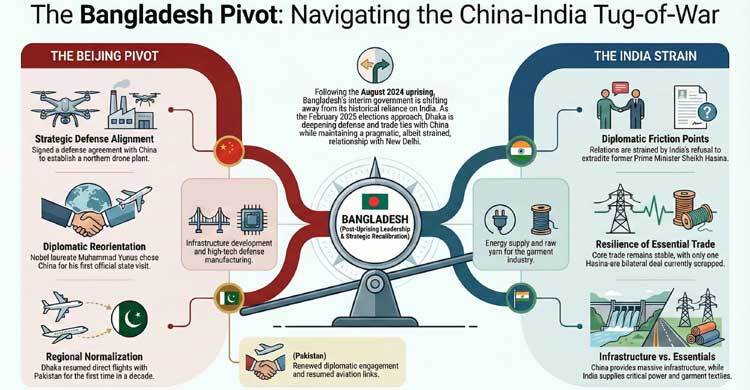
The vote will be the first since a student-led uprising toppled former Prime Minister Sheikh Hasina’s government in August 2024. Hasina’s continued shelter in India, despite extradition requests from Dhaka, has angered the interim government led by Nobel laureate Muhammad Yunus, which has responded by deepening engagement with China and Pakistan.
While Bangladesh maintained strong trade and defence ties with China under Hasina, New Delhi had been the country’s pre-eminent partner. Analysts note that this arrangement appears to be shifting.
Beijing pivot
“The interim government in Bangladesh, and a future government, is really pivoting to China,” said Joshua Kurlantzick, senior fellow at the US-based Council on Foreign Relations. “Bangladesh now occupies a central position in China’s strategic thinking regarding the Bay of Bengal, and China is increasingly confident Bangladesh will play a pro-China role.”
Yunus’ first state visit was to China, signalling a strategic shift. In January, the two countries signed a key defence agreement to establish a drone plant at a proposed northern airbase near India.
“Whatever the outcomes of the elections, there is a strong likelihood that Bangladesh-China relations will deepen further,” said Delwar Hussain of the University of Dhaka.
Strained India ties
Relations with New Delhi have been tense since Hasina’s ouster. India’s foreign ministry condemned what it called “unremitting hostility against minorities,” citing violence against Hindus, with police reporting around 70 minority deaths in 2025. Dhaka has accused India of exaggerating the scale of the violence.
Despite tensions, sporadic reconciliation efforts have taken place. India’s Foreign Minister Subrahmanyam Jaishankar visited Dhaka in January for the funeral of former leader Khaleda Zia, whose party, the Bangladesh Nationalist Party (BNP), is widely seen as a frontrunner in the election. Prime Minister Narendra Modi sent condolences to Zia’s son Tarique Rahman, 60, a potential prime ministerial candidate if the BNP wins.
However, relations frayed after a Bangladeshi cricketer was removed from the Indian Premier League following protests by Hindu right-wing groups, prompting Bangladesh to withdraw from the T20 World Cup in India.
Pragmatism and stability
Analysts say both sides are likely to pursue pragmatic approaches. “Both New Delhi and Dhaka are fully aware of the costs of letting relations deteriorate,” said Praveen Donthi of the International Crisis Group.
The interim government has also resumed direct flights with Pakistan, India’s regional rival, for the first time in more than a decade. Experts suggest a new government will likely continue normalising ties with Islamabad without undermining relations with New Delhi.
Retired diplomat Hyumayun Kabir said ties could stabilise under an elected government, particularly if the BNP comes to power. Even Jamaat-e-Islami, a party historically hostile to India, has adopted a “pragmatic realism” in its campaign.
Despite heightened rhetoric, the core India-Bangladesh relationship remains intact. Trade has been stable, and only one Hasina-era bilateral deal – Indian tugboats – has been scrapped.
“China delivers infrastructure in ways India cannot, but India provides things Bangladesh critically needs – power and yarn for the garment industry,” said former Indian diplomat Dilip Sinha.
Analysts stress that closer ties with China need not come at the expense of relations with India. “It is not an either-or situation,” Kabir said. “Both relationships can thrive simultaneously.”
Source: AFP