
Women in top administrative posts see slight dip

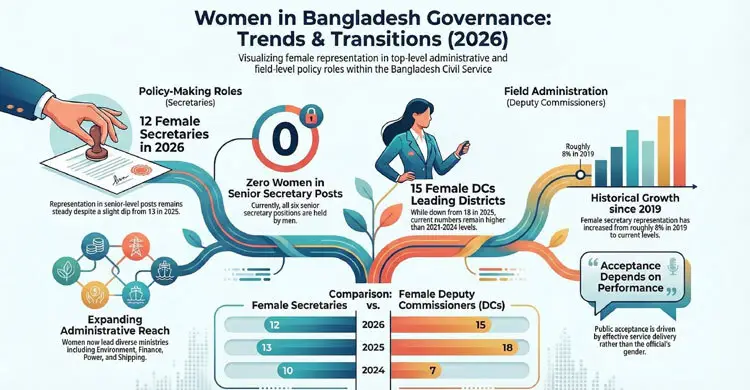
The number of women in top administrative positions has slightly decreased compared to last year. Secretaries of ministries and divisions are considered policy-making roles, while the most important field administrative post is that of the Deputy Commissioner (DC). In both roles, the number of women has declined compared to the same period last year.
Female officials, however, say that women’s participation in administration has increased over time. Women are increasingly taking up key positions, but the government must remain vigilant and supportive to ensure this trend continues.
As of last Thursday, out of 79 senior- or secretary-level posts, 12 are held by women. Among 64 districts, 15 have female DCs. In 2025, at the same time, there were 13 female secretaries and 18 female DCs, the highest number in recent history for these positions.
After the new government took office, many officials appointed by the previous administration were removed, leaving 10 secretary positions vacant. Notably, there are currently no women serving as senior secretaries, while six men hold such posts. Women are also largely absent from key ministries and departments with significant budgets.
Following the 13th national parliamentary elections, the BNP formed the government on 17 February after winning two-thirds of the seats. The new administration has begun replacing officials appointed by the previous government, with appointments gradually being made to these positions. Officials from the Ministry of Public Administration said that once the process is complete, the number of women in key positions is expected to rise.
Statistics show that in 2024, out of 86 secretaries, senior secretaries, and equivalent posts, 10 were women. Among 64 deputy commissioners, seven were female. In 2023, there were 10 women among 85 senior- or secretary-level officials, and 10 female DCs out of 64 districts. In 2022, there were 12 female secretaries and eight female DCs. In 2021, 10 women held secretary-level posts out of 76 officials, with 10 female DCs. In March 2019, six women served among 78 secretaries, senior secretaries, and acting secretaries, representing about 8 percent. In March 2020, there were 10 female secretaries and eight female DCs.
Currently, female secretaries include Farhina Ahmed (Ministry of Environment, Forest and Climate Change), Najma Mobarak (Financial Institutions Division), Israt Chowdhury (Ministry of Liberation War Affairs), Nasrin Jahan (Ministry of Civil Aviation and Tourism), Farzana Momtaz (Power Division), Mahbuba Farzana (Ministry of Information and Broadcasting), Aleya Akter (Statistics and Information Management Division), Zaheda Parvin (Cabinet Division – Coordination and Reform), Kaniz Mowla (Bangladesh National Parliament Secretariat), Najnin Kawser Chowdhury (Executive Chairman, National Skills Development Authority), Bilkis Jahan Remi (Ministry of Textiles and Jute), and Dr. Nurunnahar Chowdhury (Ministry of Shipping).
Among eight divisional commissioners, one is female: Farah Shammi serves as the Mymensingh Division Commissioner. Female DCs include Monira Haque (Feni), Sharmin Akter Jahan (Brahmanbaria), Nazma Ashrafi (Rangamati), Shamim Ara Rini (Bandarban), Afia Akhter (Rajshahi), Asma Shaheen (Natore), Afroza Akhter (Satkhira), and Taslima Akter (Barguna). Other female DCs are Tahsina Begum (Shariatpur), Sharifa Haque (Tangail), Nazmun Ara Sultana (Manikganj), Syeda Nurmahal Ashrafi (Munshiganj), Sultana Akter (Rajbari), Ishrat Farzana (Thakurgaon), and Annapurna Debnath (Kurigram).
Aleya Akter, Secretary of the Statistics and Information Management Division, told Jago News, “Every achievement in Bangladesh has been the result of combined efforts of men and women. Women’s participation and leadership in administration have increased more than ever. Female officials now serve as secretaries, additional secretaries, deputy commissioners, and upazila executive officers, performing crucial roles.”
She added, “Through their participation in administration, police, foreign service, health, and education cadres, female officials are contributing significantly in education, health, law and order, land management, judicial functions, banking, engineering, disaster management, and SDG achievement.”
“Female officials are tackling challenges in field administration efficiently, setting positive examples for women’s empowerment. Many pursue higher education at renowned universities abroad, then return to apply advanced knowledge and improve the quality of their work,” Aleya Akter said. She emphasized that a better working environment, supportive male colleagues, larger-scale daycare facilities, and improved sanitation would further encourage women to join challenging administrative roles.
Monira Haque, DC of Feni, spoke about women’s experiences and challenges: “Beyond official duties, women have additional responsibilities at home as mothers and homemakers. Managing both is an extra challenge, which working women face and overcome.”
Regarding public acceptance of women DCs, she said, “Acceptance depends on performance. If I meet the needs of the people, acceptance is not an issue. If I fail, then it doesn’t matter if the DC is male or female; people will judge based on service delivery.”
On whether she faces specific obstacles as a woman in fieldwork, the DC said, “I don’t feel any particular barriers. It is true, though, that society generally views men differently than women. But it varies from case to case.”