
Coal, hardrock stockpile threatens production at Dinajpur mines
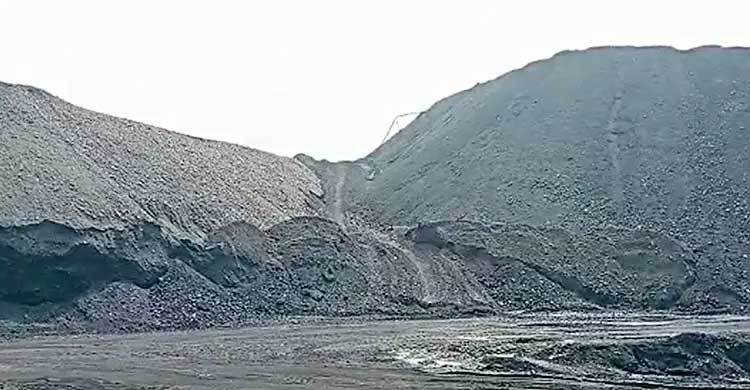
Falling demand for coal and hardrock has created a growing crisis at two key state-owned mines in northern Bangladesh, raising fears of production disruptions and financial losses as stockpiles swell beyond storage capacity.
Authorities at the Barapukuria coal mine and the Madhyapara hardrock mine in Parbatipur, Dinajpur, say the lack of buyers and restrictions on sales have led to excessive accumulation of resources, putting pressure on storage facilities and threatening to halt operations.
Coal pile grows beyond capacity
At the Barapukuria coal mine, around 3,50,000 tonnes of coal are now stored in a yard designed to hold only 2,00,000 tonnes, officials said. As the piles grow higher, spontaneous fires are occurring frequently, raising safety concerns and causing wastage.
The situation stems largely from a government policy introduced in 2019 that made the Barapukuria Thermal Power Plant the sole buyer of coal from the mine. However, operational disruptions at the power plant have sharply reduced coal demand.
Although the mine extracts around 3,000 tonnes of coal per day, the power plant currently consumes only about 700 tonnes daily. This means nearly 2,300 tonnes of coal are being added to the stockpile every day.
Earlier, when coal could be sold through open tenders in the market, production and sales remained balanced, officials said.
At that time, the three units of the Barapukuria Thermal Power Plant had a combined generation capacity of 525 megawatts, requiring roughly 4,500 tonnes of coal daily.
But Unit-2 was shut down in 2020 due to mechanical faults, while Unit-3 with a capacity of 275 MW is currently under overhaul.
Chief Engineer of the power plant Abu Bakkar Siddique said only Unit-1, with a capacity of 125 MW, is now operating.
“As a result, the plant needs only around 700 tonnes of coal per day. Unit-3 may take another three months to resume operations,” he said.
He added that the power plant had asked the mining authorities to suspend coal extraction, but mining continued.
“This has led to an additional three lakh tonnes of coal being stored. If production had been stopped earlier, the problem would not have become so serious,” Siddique said.
Mining contract limits flexibility
Officials at Barapukuria Coal Mining Company Limited (BCMCL) said they cannot easily halt mining operations because coal extraction is being carried out by a Chinese contractor under a long-term agreement with the government.
BCMCL General Manager Khan Md Zafar Sadiq said stopping mining suddenly could create operational complications and safety risks underground.
“In the current situation, it is not possible to stop mining completely even if we want to,” he said.
Managing Director Shah Alam said coal stock has already reached nearly double the yard’s capacity, increasing the risk of fires.
“The problem will be resolved if the power plant authorities take coal at the agreed rate,” he said.
Hardrock mine faces similar crisis
A similar situation has emerged at the Madhyapara hardrock mine, Bangladesh’s only granite mine, where declining sales have pushed the project into financial stress.
Currently, about 1.446 million tonnes of hardrock worth roughly Tk 420 crore are lying unused in 25 storage yards of the mine, with piles reaching the height of a three-storey building.
Although production has increased, sales have dropped sharply, causing stock to accumulate month after month.
Mine officials say the company is struggling to meet operational costs and pay contractors, staff salaries and allowances.
Preference for imports blamed
Bangladesh’s annual demand for hardrock is estimated at around 2.16 million tonnes, with large quantities used in railway infrastructure, river management and other government development projects.
However, a significant portion of the demand is met through imports from India, Bhutan, Vietnam and Indonesia, despite the availability of domestic supplies.
Mine officials allege that government agencies often fail to follow instructions requiring the use of Madhyapara hardrock in development projects.
Sources involved with the project say the mine could face closure as early as March 25 if major buyers such as Bangladesh Railway and the Water Development Board do not start purchasing contracted hardrock sizes, including 80/120 boulders and 40/60 aggregates.
Such a shutdown would cause daily financial losses for the company and reduce government revenue.
Storage yards overflowing
According to Syed Rafizul Islam, General Manager (Administration and Services) of Madhyapara Granite Mining Company Limited (MGMCL), the current stockpile includes:
900,000 tonnes of 40-60 mm stone
367,000 tonnes of 80/120 boulders
Several other sizes are used in construction and infrastructure
MGMCL Managing Director Engineer DM Jobayed Hossain said storage yards are already full because government agencies are not purchasing the material.
He also warned that mining operations could be disrupted if the royalty on imported explosives used in blasting is not reduced.
“If Bangladesh Railway and the Water Development Board ensure the use of domestically mined hardrock in development projects, the country’s only hardrock mine will regain momentum,” he said.
He added that increased use of local resources would also save foreign currency by reducing imports.