
Bangladeshi scientist Senjuti wins top vaccine honour

On a quiet morning in Dhaka, inside a modest laboratory bustling with microscopes, freezers, and sequencing machines, Dr Senjuti Saha is at work. Around her, a team of young scientists analyses samples from hospitals across Bangladesh, decoding the genetic blueprint of pathogens that threaten children’s lives. Every sequence, every data point, is a piece of a puzzle that will decide where vaccines go next.
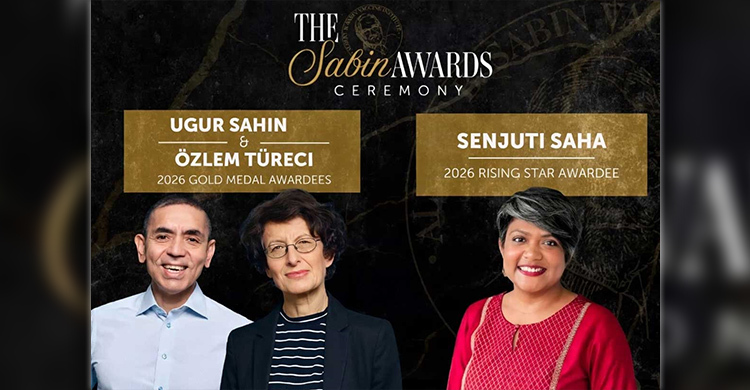
This work is earning global recognition. Dr Saha has been named the 2026 Rising Star at the Sabin Awards, an honour that places her alongside the world’s most influential figures in vaccine research.
She is being recognised for her leadership in guiding Bangladesh’s nationwide typhoid vaccination campaign – one of the largest of its kind – which has protected over 40 million children from a disease that has long plagued the country.
“It’s incredibly meaningful because it reflects years of work by an extraordinary community in Bangladesh,” she says. “It shows that great science can grow anywhere when people are determined to solve problems together.”
Bangladesh has often been at the frontlines of global health challenges, from infectious disease outbreaks to climate-linked epidemics. But Dr Saha’s work represents a turning point: the country is no longer just implementing solutions; it is generating them.
Her team at the Child Health Research Foundation has built one of the nation’s leading genomic laboratories, sequencing thousands of pathogen genomes to track outbreaks, identify resistant strains, and inform vaccination strategies.
During the 2025 typhoid vaccination campaign, these insights allowed public health officials to deploy vaccines where they were needed most, preventing outbreaks before they could take hold. Beyond typhoid, the lab’s research extends to Klebsiella, respiratory viruses, and other diseases that disproportionately affect children, combining cutting-edge science with practical solutions on the ground.
Dr Saha is also mentoring the next generation of scientists, ensuring that Bangladesh can sustain its own capacity to fight infectious diseases. Her work is a model of how local expertise, when nurtured, can have a global impact.
The Rising Star Award will be presented alongside the Albert B Sabin Gold Medal, which this year honours Professors Uğur Şahin and Özlem Türeci for developing the COVID-19 vaccine that protected billions. While the world remembers the pandemic for its devastation, Bangladesh now has its own story of scientific leadership to tell – a story where a local scientist’s work is changing public health for millions.
Experts say Dr Saha’s recognition sends a broader message: solutions to global health challenges can, and should, emerge from countries like Bangladesh. Her research demonstrates how data-driven strategies can save lives, even in resource-limited settings, and highlights the importance of investing in local talent.
“Dr Saha exemplifies the next generation of scientific leadership,” says Amy Finan. “Her work goes beyond the lab. She uses evidence to shape policy and protect communities, proving that scientific innovation can happen anywhere, not just in traditional hubs of wealth and research.”
For the children of Bangladesh, her work is life-changing. For the country, it is a statement: Bangladesh is not only part of the global health conversation, but it is also helping lead it.
And for Dr Saha, the award is both recognition and responsibility, a reminder that every sample sequenced, every vaccine guided by data, is a chance to save a life.
As she prepares to receive the Rising Star Award in Washington, DC, Dr Saha reflects on the journey: from a small lab in Dhaka to the global stage, proving that science, when paired with dedication and vision, can transcend borders and transform the world.