
West Zone crippled: 55% vacancy kills 43 trains, 67 stations

Published: 15 April 2026, 11:33 AM
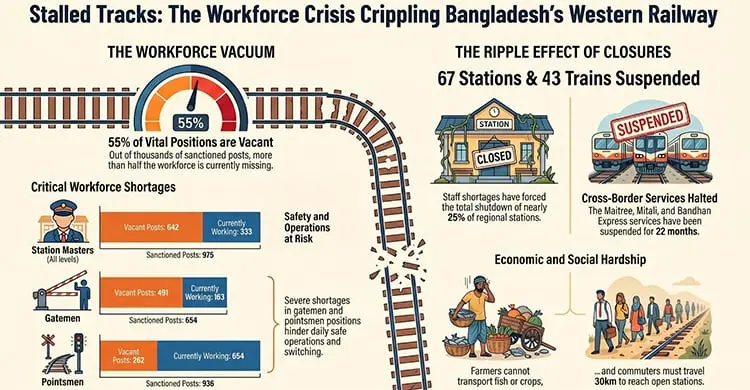
Severe manpower shortages have brought Bangladesh Railway’s western zone close to a standstill. Out of 273 stations under the Pakshi and Lalmonirhat railway divisions, 67 have already been completely shut down. At the same time, 40 local and mail trains remain suspended due to shortages of locomotives and coaches. In addition, the cross-border Maitree, Mitali, and Bandhan Express services have been suspended for nearly 22 months, causing major inconvenience to hundreds of thousands of passengers.
According to sources from the office of the Western Zone Chief Operating Superintendent, there are 975 sanctioned posts for station masters, assistant station masters, platform masters, and cabin station masters in the western region of Bangladesh Railway. However, only 333 officials are currently working, leaving 642 posts vacant. Out of 235 guard positions, 202 are filled; out of 654 gatemen positions, only 163 are occupied; and out of 936 pointsmen posts, 654 are currently serving. Overall, around 55% of the workforce positions remain vacant.
Sources from the transport offices of the Pakshi and Lalmonirhat railway divisions said that due to manpower shortages, 56 stations in the Pakshi division and two stations partially remain closed, while 11 stations in the Lalmonirhat division are shut. In addition, 8 mail trains and 7 local trains in the Pakshi division, and 11 mail/commuter trains along with 14 local trains in the Lalmonirhat division, have been suspended.
Furthermore, Guakhara and Gafurabad stations on the Ishwardi–Dhaka railway route have remained closed for over two decades. These stations, located in the Chalan Beel area of Pabna, once served as key hubs for transporting agricultural products and fish across the country. Due to their long-term closure, railway employee housing, platforms, and other assets have fallen into disrepair and have been encroached upon. Cracks have also appeared in station buildings.
A local resident of the Gafurabad station area, Amzad Hossain, said the station, built during the British colonial period, was once in good condition. However, no one is now responsible for its maintenance, and no station master is posted there. When it was operational, a local train used to stop at the station. Guakhara station has also remained closed for a long time, forcing people to travel to distant stations to transport agricultural goods, increasing both cost and hardship.
Another resident of the Guakhara station area, Anisur Rahman, said that due to the presence of beels and wetlands, fish farming is common in the area. However, because the station is closed, farmers are unable to properly market their fish.
Nandan Gachhi station in Charghat, Rajshahi, has also remained closed for more than a decade. Former market committee president Abul Kalam Azad said the once-busy station is now completely abandoned due to a lack of personnel. Equipment such as loop line meters and other instruments have become inoperative. Although a local train named “Mahananda” still stops there, passengers must board and alight without a proper platform, making it risky and difficult, especially for women, the elderly, and children. Previously, three trains—Mahananda, Uttara, and 64 Aarai—regularly stopped at the station.
Union Parishad Chairman of Nandan Gachhi Nimpura, Mizanur Rahman, said thousands of people in the area travel to Rajshahi, Natore, and other districts for jobs, business, and medical services. Due to the station’s closure, they now have to travel around 30 kilometers to Rajshahi or Natore stations to board trains, causing significant hardship.
Not only Guakhara, Gafurabad, and Nandan Gachhi, but a total of 67 stations in the western railway zone have remained closed for a long time due to manpower shortages, causing severe suffering for hundreds of thousands of passengers. Locals allege that the closures have disrupted agricultural marketing and business activities. In addition, valuable railway assets worth hundreds of crores of taka are being encroached upon due to long-term abandonment.
Pakshi Railway Division transport officer Hasina Begum said the main reason for station closures is manpower shortages, while train services have been suspended due to shortages of locomotives and coaches, along with staffing issues.
Lalmonirhat Railway Division transport officer Abdullah Al Mamun told Jago News that station and train services have been suspended due to manpower shortages. He added that recruitment is currently underway in the railway, and once staffing shortages are addressed, some stations and train services may resume.
Western Zone Assistant Chief Operating Superintendent Md Abdul Awal said Bangladesh Railway is facing a shortage of personnel, which is why some stations and train services have been suspended.