
Nahid takes blame for failure to dismantle 'fascist structure'

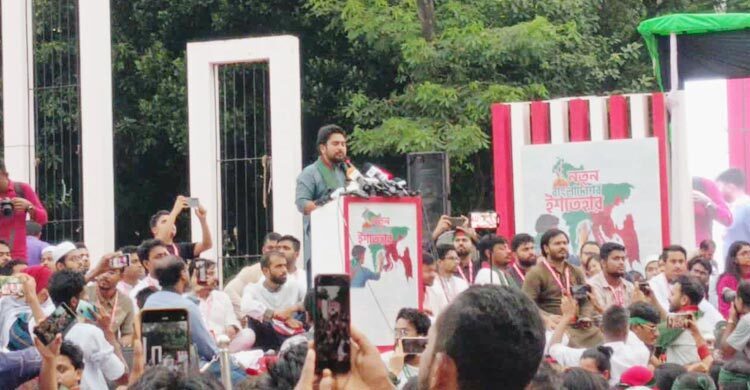
A year after the historic one-point demand to abolish the so-called “Mujibist system” was declared at Dhaka’s Central Shaheed Minar, National Citizen Party (NCP) convener Nahid Islam publicly acknowledged on Sunday that the movement has so far failed to dismantle the entrenched power structures it sought to transform.
Speaking at a large rally held at the same iconic site to mark the anniversary of the July Uprising and launch the NCP’s 24-point manifesto for a “New Bangladesh,” Nahid Islam expressed regret over the unfulfilled promises of the past year.
“We could not overthrow the old order. We failed to draft a new constitution, dismantle the corrupt pillars of power, or transform the military-administrative apparatus,” he said, standing huge crowd. “Today, we are here to admit our shortcomings and recommit ourselves to the people’s unfinished revolution.”
The rally, held in the afternoon and attended by thousands of party activists and leaders from across the country, cantered on the unveiling of the NCP’s comprehensive 24-point manifesto aimed at building a just, democratic, and equitable Bangladesh.
The manifesto outlines a sweeping agenda for national transformation, including:
- The dissolution of the Rapid Action Battalion (RAB) and the creation of new, accountable, and people-friendly law enforcement agencies.
- The formation of a constituent assembly to draft a new constitution, replacing what the party calls the “outdated Mujibist framework.”
- Full recognition and justice for the martyrs and participants of the July Uprising.
- Establishment of an independent, fair, and efficient judiciary.
- Building a corruption-free, service-oriented civil administration.
- Ensuring women’s safety, rights, and full participation in public life.
- Guaranteeing universal healthcare with digitized medical records and strengthened primary care.
- Implementing education reforms focused on critical thinking, innovation, and national development.
- Promoting youth employment, labour rights, sustainable agriculture, and a welfare-based economy.
- Strengthening local governance through village parliaments and decentralized decision-making.
- Adopting a Bangladesh-centric foreign policy and a modern national defence strategy.
- Championing press freedom, civil society, climate resilience, and diaspora engagement.
“This is not just a political programme,” Nahid Islam declared. “This is the people’s roadmap to a Second Republic – a New Bangladesh built on justice, equality, and true democracy.”
He emphasised that the original one-point demand announced a year ago did not belong to any individual, party, or organisation. “It was the voice of the uprising student masses, the people of Bangladesh, and our martyred brothers and sisters. They were the true authors of that demand.”
Reflecting on the past year, Nahid said: “Exactly one year ago, from this very spot, we pledged to free our nation from autocracy. Because you answered that call, together we toppled a fascist regime and reclaimed our sovereignty. Today, we renew that promise — let us unite to turn this 24-point vision into reality.”
Chief Organiser (North) Sarjis Alam echoed this sentiment, criticizing the existing 1972 Constitution as a product of one-party dominance and drafted abroad. “We no longer want the Mujibist constitution to govern Bangladesh. It’s time to dismantle it and build a new constitutional order through a sovereign constituent assembly.”
Chief Organiser (South) Hasnat Abdullah stressed the urgency of action over rhetoric. “It has been a year of speeches. Now is the time to act.” He also warned against threats to NCP activists: “From Rupsha to Pataria, if anyone dares to intimidate an NCP worker, we will respond politically. We will not retreat.”
Member Secretary Akhtar Hossain underscored the need for systemic accountability. “Power has long been concentrated in unaccountable hands. We demand a system where every public official, from the Prime Minister down to the union council member, answers directly to the people. State institutions must be depoliticised.”
Dr Tasnim Jara, Senior Joint Member Secretary, highlighted the party’s commitment to healthcare and economic justice. “No one should be denied medical treatment due to poverty. We envision a digital health system accessible to all. Our politics is not about slogans – it’s about solving real problems.”
She added that the NCP aims to build a welfare economy with dignified jobs and a reformed tax system to bridge the gap between rich and poor.
The NCP rally began around 4:00 PM at Central Shaheed Minar, drawing processions of activists from district, metropolitan, and upazila units under banners of the NCP, its labour wing, and the Bangladesh Gonotantrik Chhatra Sangsad. Participants carried flags, banners, and festoons, creating a vibrant display of political mobilization.
Security was tight, with the Dhaka Metropolitan Police (DMP) setting up a control room at the Kazi Motahar Hossain Building near Dhaka University. The Rapid Action Battalion (RAB), Counter Terrorism and Transnational Crime (CTTC) unit, K-9 squads, and bomb disposal units were deployed across the venue.