
Yunus rallies politicians with pledges of unity over Hadi attack plot

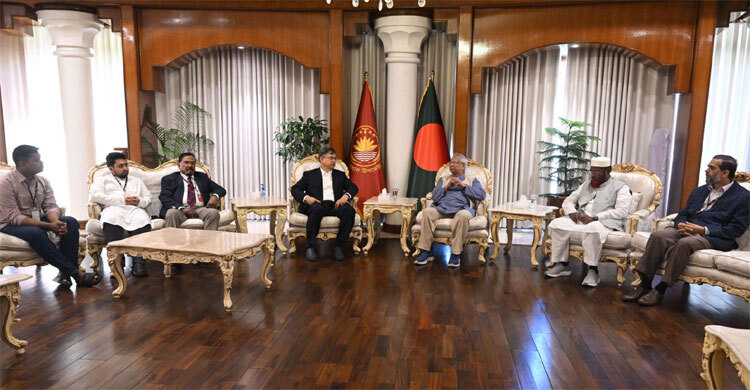
Chief Adviser Professor Muhammad Yunus met leaders from major political parties on Saturday, December 13, at the state guest house Jamuna, where they assured him of their unified stance against conspiracies aimed at undermining the July uprising.
The gesture came particularly in light of the recent attack on Sharif Osman Hadi, spokesperson for Inqilab Mancha and a prospective independent candidate for the Dhaka-8 constituency.
Attendees included BNP Standing Committee members Salahuddin Ahmed and Hafizuddin Ahmed, Jamaat-e-Islami Secretary General Mia Golam Parwar and Assistant Secretary General Advocate Ehsanul Mahbub Zubair, National Citizen Party (NCP) convener Nahid Islam and southern region chief organiser Hasnat Abdullah, Inqilab Mancha member secretary Abdullah Al Jaber, and law adviser Asif Nazrul.
Addressing the meeting, Professor Yunus described the attack on Osman Hadi as part of a premeditated and deep-rooted conspiracy backed by significant forces.
He said the conspirators’ objective was to prevent the upcoming election from taking place. “This attack is highly symbolic. They want to demonstrate their power and disrupt all electoral arrangements. These threats must be addressed collectively,” he said.
He added that intelligence so far indicated the conspirators had expanded their networks and deployed trained gunmen.
The political leaders responded by pledging unity and assured the chief adviser of their commitment to counter the threats.
BNP leader Salahuddin Ahmed emphasised the need for unity in the current circumstances. “We must avoid mutual accusations at all costs,” he said, calling for a unified voice against the conspiracy and stating: “We will not tolerate any malign forces.”
He also proposed intensifying operations against illegal weapons and conspirators in the national interest, despite political differences.
Jamaat leader Golam Parwar noted that recent statements had fuelled mutual blame, giving opponents an advantage. “We must regain the unity we once had,” he said, warning against creating divisions over minor party interests and urging all parties to honour their commitments.
NCP convener Nahid Islam said that since the July revolution, certain elements had been working to diminish its significance. He alleged an organised campaign against the July events was underway in media and administrative circles. “Those who assume power after the elections will also fall victim to this. No one can govern alone,” he said.
He claimed narratives were being shaped in media and social media to portray the revolution as a crime, while efforts were made to rehabilitate the Awami League and Jatiya Party through TV appearances, administrative meetings, university events, and court slogans.
“We do not require special security; we will not accept it. Everyone must take ownership of July. We are dissipating the revolution amid tensions over rhetoric. Conspirators exploit our disunity as weakness. They operate freely from India while we remain ineffective,” he said.
Nahid Islam further demanded action against those advancing Awami League objectives under the guise of intellectuals and cultural figures.
Hasnat Abdullah warned: “Without unity, no security measures will protect us. Parties are inadvertently creating opportunities for the Awami League due to political self-interest.”
Asif Nazrul observed that the Awami League had grown stronger amid inter-party clashes and called for political parties to prioritise national interests alongside party concerns.
In his closing remarks, Professor Yunus stressed the need to focus on the future, urging strength not only from the government but from all stakeholders. “We must prevent internal conflicts from escalating. Political statements are inevitable, but we should avoid a culture of enmity or personal attacks,” he said.
He acknowledged that elections bring tensions but insisted they must be contained within acceptable limits.