
AB Party boss regrets joining Jamaat bloc, crowd rejects apology

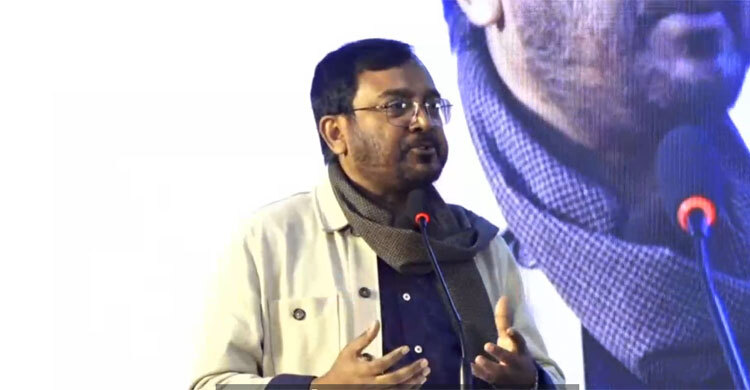
At a public discussion in Dhaka on Tuesday, Amar Bangladesh Party (AB Party) chairman Mojibur Rahman Monju did something unusual in Bangladesh’s political arena: he apologised. And the audience refused to accept it.
The event, titled “National Election 2026 and Citizens’ Expectations” and organised by Citizen's Platform for SDGs, Bangladesh in Agargaon, turned into an unexpected referendum on the AB Party’s identity crisis. Standing before a hall packed with civil society members, young voters and sceptical observers, Monju said his party had let people down by joining the Jamaat-led 11-party alliance.
“As a new political party, we could not meet your expectations,” Monju said. “Many of you were hurt by our decision. I apologise.”
When he asked the crowd if they accepted his apology, the response was instant and unanimous: “No.”
For a moment, the hall fell into a tense silence. Monju attempted to recover, saying that refusing forgiveness had become part of a “negative culture.” But the exchange captured what many voters have been saying for months: the AB Party, once projected as a fresh, youth-driven alternative, has now blurred into the old political order it promised to challenge.
The harsh math of small-party survival
When Citizen's Platform Convener Debapriya Bhattacharya asked why AB Party failed to create a new political arrangement, Monju defended his alliance with Jamaat by painting a bleak picture of Bangladesh’s electoral ground reality as the party lacked the necessary capacity. "As a small party, we did not have the ability. From deploying polling agents to managing the broader electoral process, it was not possible for us to do it alone."
Expressing frustration, Monju said party leaders and activists are regularly subjected to bullying and ridicule on social media. "People mock us, asking whether all of us together would even get 100 votes, or whether we are fit to form a party and contest elections."
Referring to Tasnim Jara's decision to contest elections independently after resigning from the National Citizen Party (NCP), Monju said not everyone enjoys such advantages.
"Jara has a different background and strong media support. Even then, she struggled to secure one percent support. Those who do not have such privileges cannot simply leave a party and contest independently, even if they want to," he said.
“In this reality, small parties cannot survive without aligning with bigger ones,” he said, adding that the AB Party accepts “60 per cent of the responsibility” for that decision.
The remarks underscored what many analysts argue: new political outfits in Bangladesh often crumble not due to a shortage of vision, but due to the suffocating weight of entrenched electoral machinery.
Humiliation, trolling and a crisis of credibility
Monju also aired his frustration at the intense ridicule his party faces online. Supporters mock AB Party activists, he said, questioning whether the entire party could even secure 100 votes.
Even former allies have fared poorly. Citing Tasnim Jara’s independent candidacy after leaving the NCP, Monju said her struggle showed how unforgiving Bangladesh’s political ecosystem is.
“She has strong media visibility, yet she struggled to reach one percent support,” he said. “Most people do not have that privilege.”
A different idea of political reform
Despite the defensive tone, Monju tried to frame his party’s journey as part of a broader experiment in political reform.
“We will make mistakes. You will point them out. We will correct them. That is the new political arrangement,” he said.
He also argued that the country relies more on the honesty of district administrators and police chiefs than on MPs. According to him, “If DCs and SPs are honest, 70 per cent of the country’s work gets done.”
He even told voters in Feni-1, where he is contesting, that he would not interfere in the work of local administrators if elected. “People don’t care about theory. They want roads, tin for houses, tupi and blankets.”
A new party with familiar problems
AB Party officially joined the Jamaat-led alliance in late December, following the NCP and LDP, expanding the bloc to 11 partners. The announcement triggered disappointment among many young voters who once saw AB Party as an alternative to both major political camps.
Source: UNB