
Debapriya doubts fair polls, says govt swayed by extremists

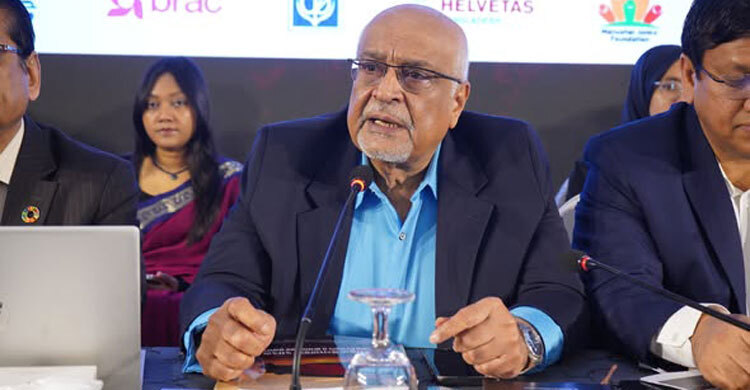
Economist Dr Debapriya Bhattacharya has launched a sharp critique of the interim government, warning that its hopes of fresh political energy have instead been undermined by its growing dependence on “small and extremist groups.”
He questioned whether such a government could now credibly deliver an impartial election.
Speaking at a press conference in Gulshan on Thursday, Debapriya, convener of the Citizen's Platform for SDGs, Bangladesh and CPD Honorary Fellow, said the interim administration had promised reform and openness but failed to show the political capacity needed to carry them out.
“They talked about new force and ended up becoming hostages to narrow and extremist interests. They could not behave, they could not protect citizens,” Debapriya said. “The question now is whether they can hold an election in a fair and neutral manner.”
The briefing, titled Selected Policy Recommendations and Proposed National Programs for the Next Government, was organised by the Citizen's Platform for SDGs, Bangladesh.
The group presented 12 policy proposals and a set of national programmes aimed at stabilising the economy, restoring governance and addressing long-standing social gaps.
The policy statements were outlined by CPD Honorary Fellow Prof Mustafizur Rahman, while the proposed national programmes were presented by CPD Additional Director (Research) Taufiqul Islam Khan.
Several core group members including Asif Ibrahim, Rasheda K Chowdhury, Shaheen Anam and Sultana Kamal also attended.
‘Architects of a new settlement became part of the old one’
Debapriya criticised the government’s narrow focus on political actors during national dialogues, saying it sidelined the broader participation needed to build consensus.
“The idea of a new settlement through national awakening, national participation and a surge of citizen engagement was never presented,” he said. “Those who wanted to be architects of something new slipped back into the old system. They entered the electoral process and became part of an expensive election culture.”
His comments add to the growing debate over whether the interim authority has drifted from its original reform commitments and become entangled in the same power structures it claimed it would overhaul.
12 policies to stabilise the economy and rebuild governance
Presenting the core proposals, Prof Mustafizur Rahman warned that Bangladesh’s economic management had reached a point where “the country is on a plan holiday.” He said restoring an accountable parliament was essential for any recovery.
“We need short and medium-term plans focused on efficiency and good governance,” he said. “This includes corruption-free resource mobilisation and proper management of foreign debt. We must also bring discipline back into the financial sector.”
Mustafizur Rahman placed heavy emphasis on agriculture, calling it central to Bangladesh’s long-term growth. Despite 41 per cent of the labour force being in agriculture, the sector contributes only 12 per cent to GDP, a sign of low productivity and neglected investment.
“The issue is how to raise both labour and capital productivity, how to link agriculture with industry, and how to ensure land and financial access for marginal farmers,” he said.
‘Minorities remain vulnerable’
Mustafizur Rahman also highlighted the repeated vulnerability of ethnic and religious minorities, including Dalit and indigenous communities. He called for separate commissions to safeguard their rights and criticised the current Human Rights Commission as being in a “fragile state.”
The event underscored a broader message from civil society: without structural reforms, transparent planning and credible elections, Bangladesh risks deepening its political and economic instability.
With the election countdown underway, Debapriya’s warning – that the interim government may no longer be in control of its own agenda – adds yet another layer of uncertainty to an already tense national moment.