
Jamaat pitches interest-free loans, tax cuts and ‘zero corruption’ vision

Jamaat-e-Islami has rolled out an ambitious mix of welfare pledges, economic reforms and anti-corruption vows, promising interest-free loans, lower taxes and expanded social protection as part of its vision for what it calls a “new and prosperous Bangladesh”.
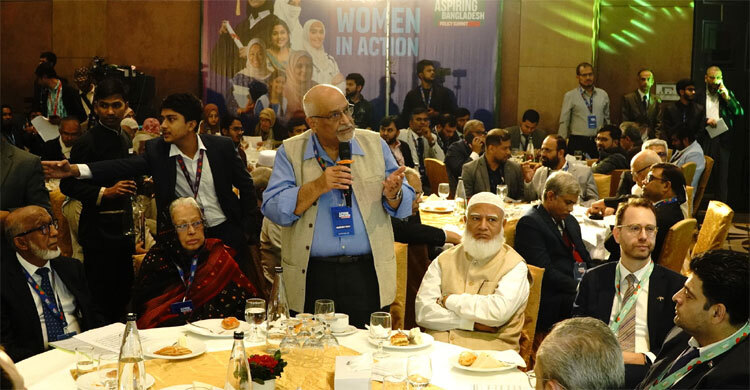
At its “Policy Summit 2026”, held at a city hotel on Tuesday, the party announced that if it comes to power, it will provide interest-free loans of Tk 10,000 per month to 500,000 unemployed people for up to two years, starting after they complete their education and secure jobs. The proposal is aimed squarely at young graduates struggling to enter a job market marked by unemployment and insecure work.
The summit, attended by diplomats, politicians, academics, business leaders, journalists and civil society figures, was used by Jamaat to position itself as an alternative economic and governance model ahead of the February 12 national election.
Big promises, bold numbers
Beyond employment loans, Jamaat unveiled a wide-ranging set of commitments. The party said it would gradually reduce income tax to 19 per cent and VAT to 10 per cent in the long run, while enforcing what it described as “zero tolerance” against corruption.
A “smart social security card” combining NID, TIN, health and social service access was also promised, alongside free healthcare for citizens above 60 and children under five, and the establishment of specialised hospitals in every district.
For the industry, Jamaat pledged not to raise gas, electricity or water prices for the next three years and to revive closed factories through public-private partnerships, with 10 per cent ownership allocated to workers.
Farmers and students were also brought into the fold. The party promised interest-free agricultural loans, Tk 10,000 per month in interest-free education loans for 100,000 students based on merit and need, and full funding each year for 100 students to study at top global universities, including Harvard, MIT, Oxford and Cambridge.
In a headline-grabbing proposal, Jamaat said it would merge Eden Mohila College and Badrunnesa Government Girls’ College to create what it described as the world’s largest women’s university.
‘No election without justice and reform’
Addressing the summit, Jamaat-e-Islami Amir Dr Shafiqur Rahman framed the party’s agenda as part of a broader political reset, arguing that Bangladesh stood at a “historic crossroads”.
“After a dark period of authoritarian rule, we are now in a phase of democratic transition,” he said, calling for institutional rebuilding and the restoration of public trust. He insisted that elections must follow accountability and reform, declaring that there could be “no election without the trial of fascism and necessary reforms”.
Tracing Bangladesh’s political journey since 1947 and 1971, Shafiqur said the core promises of independence remained unfulfilled. “Democratic institutions have weakened, accountability has eroded, and citizens have too often been denied their rightful voice,” he said, blaming governance failures and authoritarian practices over the past 17 years.
Referring to the July 2024 uprising, he said young people had once again stepped forward to reclaim their rights and their future.
Economy, dignity and jobs
On the economy, the Jamaat chief argued that Bangladesh’s challenge was no longer survival but stability. “Growth alone is no longer sufficient,” he said. “Economic success must be measured by whether people can plan their lives with confidence and provide for their families with dignity.”
He pointed to unemployment, inflation and the dominance of informal work as structural problems, saying many graduates were unable to convert education into opportunity, while women continued to face systemic barriers. Expanding women’s participation, he added, was not just a moral issue but an economic necessity.
Shafiqur also highlighted Bangladesh’s untapped strengths, citing its young workforce, migrant workers, global diaspora and strategic location.
A familiar question
Jamaat’s promises, rich in scale and ambition, are likely to sharpen political debate as the election nears. Supporters see a people-focused alternative centred on interest-free finance, welfare and discipline. Critics, however, are expected to question the feasibility, funding and implementation of such expansive commitments.
For now, Jamaat has made its pitch clear: a politics of loans without interest, services without fees and governance without corruption. Whether voters see it as a credible roadmap or an election-season wish list will become clearer in the weeks ahead.