
BNP slams misuse of religion, NID data collection ahead of polls

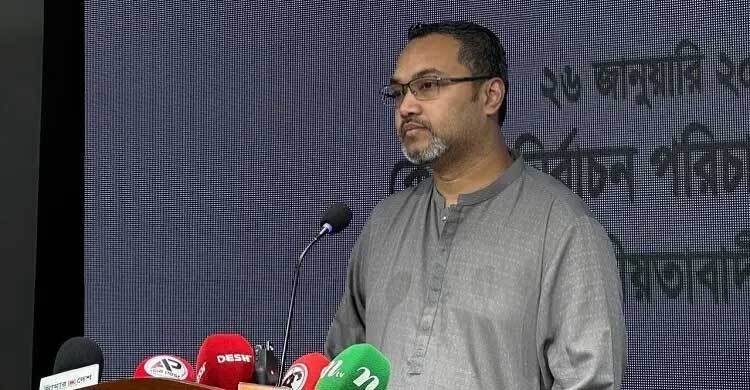
The Bangladesh Nationalist Party (BNP) on Monday alleged that a rival political party is attempting to influence voters by exploiting religious sentiments ahead of the upcoming national parliamentary elections.
Speaking at a press conference at BNP’s Gulshan Election Office on January 26, BNP Election Management Committee spokesperson and party chairman’s adviser Dr Mahdi Amin urged the Election Commission (EC) to take immediate action against what he described as efforts to manipulate voters through religion and the collection of personal voter data.
Dr Mahdi claimed that social media posts and campaign materials are being circulated in which voting for a particular election symbol is portrayed as a religious duty, with appeals linking voting to faith and the afterlife.
“Seeking votes by misinterpreting religion is undesirable and undermines the credibility of the election,” he said, adding that such activities violate provisions of the Representation of the People Order (RPO), 1972, and amount to punishable “undue influence.”
Concerns over NID and personal data collection
The BNP spokesperson also expressed concern over the alleged collection of voters’ National ID (NID) copies, mobile phone numbers, and mobile financial service details such as bKash accounts.
He warned that such data could be misused for fraudulent voting, voting in the names of deceased persons, or financial inducements to influence voters.
“These activities are punishable under multiple laws, including the Voter List Act 2009, the Penal Code 1860, and the Digital Security Act 2018,” he said, calling on the Election Commission to immediately stop what he termed illegal practices. He added that BNP has already informed the EC and welcomed its attention to the issue.
Ansar-VDP deployment questioned
Dr Mahdi also questioned the plan to deploy 13 to 15 Ansar and VDP members at each polling station, noting that many of them are expected to be local residents.
“Assigning locally based individuals to polling centres raises concerns about neutrality,” he said, urging the EC to deploy election personnel outside their own police station jurisdictions to ensure impartiality.
BNP campaign, candidates and women’s representation
At the press briefing, Dr Mahdi highlighted large public turnouts during BNP Chairperson Tarique Rahman’s recent election tours in Chattogram, Feni, Cumilla, and Narayanganj, describing them as a sign of public trust in the party’s leadership.
He said BNP is contesting in 292 constituencies under the “Sheaf of Paddy” symbol, with 85 former members of parliament and 19 former ministers among its candidates. According to him, 237 BNP candidates hold at least a bachelor’s degree.
On women’s representation, Dr Mahdi said BNP has nominated 10 female candidates in the upcoming election, calling it a reflection of the party’s commitment to women’s empowerment. He criticised other political parties for not nominating any women candidates, despite women comprising half of the country’s population.
Disappearance victims among BNP candidates
Dr Mahdi also said several BNP candidates are victims of enforced disappearances or relatives of missing persons from what he described as a previous “authoritarian period.”
He named Salahuddin Ahmed, Anisul Rahman Talukder Khokon, and Hummam Quader Chowdhury as candidates who were themselves victims of enforced disappearance. He also mentioned Tahsina Rushdir Luna, wife of former MP Ilias Ali, and Sanjida Islam Tuli of “Mayer Daak,” as candidates representing families of missing persons.
Sovereignty and election environment
Responding to questions, Dr Mahdi said BNP views the country’s internal affairs as closely tied to national sovereignty, adding that the party expects the international community to respect Bangladesh’s independence while supporting a free and fair electoral process.
He reiterated BNP’s demand for swift and decisive action from the Election Commission to ensure a transparent, neutral, and credible election.