
AI-driven disinformation targets BNP as elections near

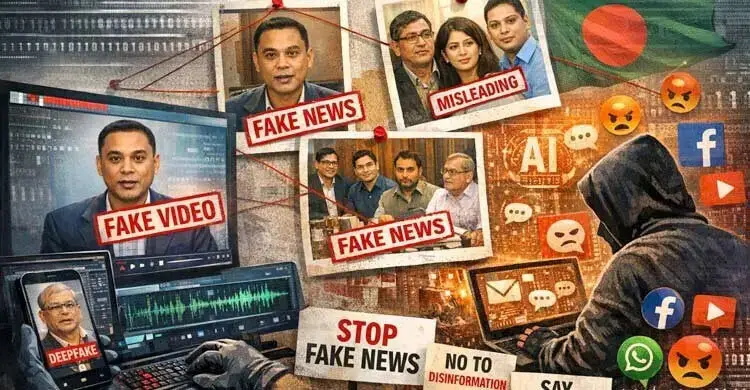
With voting day for the 13th national parliamentary elections drawing near, the political arena in Bangladesh is heating up, while digital disinformation is reaching alarming proportions. Fake videos, deepfakes, voice cloning, and AI-manipulated photo cards are spreading widely on social media. A significant portion of these disinformation campaigns has targeted the Bangladesh Nationalist Party (BNP) and its top leaders.
BNP leaders allege that a coordinated effort is deliberately using highly offensive language and distorted content to tarnish the party’s image. At the same time, they assert that the public is not easily misled by digital propaganda. Political analysts, however, warn that the misuse of AI technology ahead of elections poses a serious threat to democracy and social stability.
Truth in the Guise of Falsehood: AI-Generated Disinformation
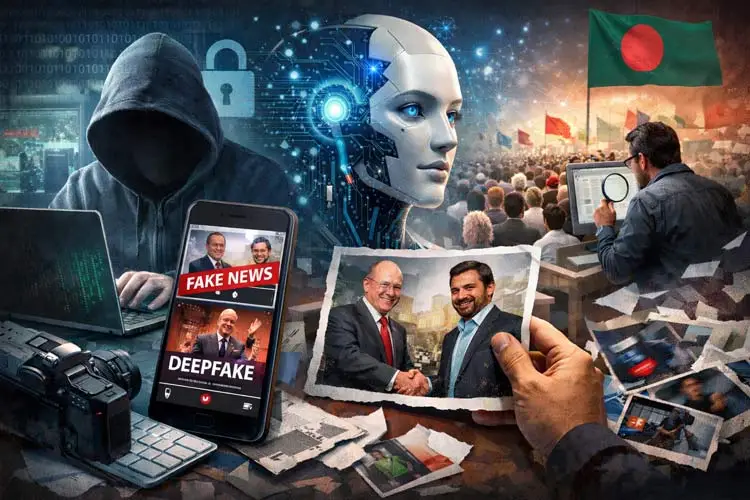
As the elections approach, AI-generated “truth-like falsehoods” are proliferating on social media. Deepfake videos, voice cloning, and fake photo cards featuring the images and names of top political leaders are being circulated to mislead the public.
Recently, an AI-generated video in the name of BNP Chairman Tarique Rahman surfaced on social media, showing him launching a new Facebook page and urging followers to join. Verification later confirmed that the video was entirely fake, created using AI from a different scene of an old video.
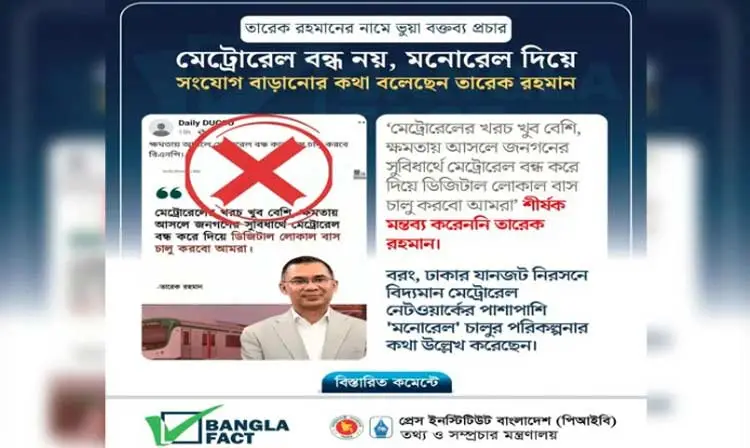
On January 20, a Facebook page named “Daily DUCSU” circulated a fake photo card claiming that if the BNP came to power, the metro rail would be closed and digital local buses would be introduced. Fact-checking confirmed that the claim was baseless.
In another AI-generated video featuring Tarique Rahman, his wife Dr. Zubaida Rahman, and daughter Zaima Rahman, misleading dialogues were inserted, and the video ended with politically provocative content, making it even more controversial.
Amir Khasru’s Alleged RAW Meeting: A Case of AI-Manipulated Images
On the night of January 30, four images allegedly showing BNP Standing Committee member Amir Khasru Mahmud Chowdhury meeting with an officer of India’s intelligence agency RAW circulated on social media. The AI-generated images also depicted BNP Vice Chairman Abdul Awal Mintu and Joint Secretary General Humayun Kabir.

The images quickly went viral. Fact-checking organizations Rumor Scanner and Dismislab later confirmed that all four images were entirely fake, created using AI.
Meanwhile, Facebook posts circulating photo cards and video clips quoting Tarique Rahman, such as “Until the 12th, you follow the people; for the next 5 years, the people will follow you,” were also misleading. Fact-checking revealed that the clips were taken from a longer speech where Rahman was commenting on a statement made by a Jamaat leader in Comilla.
It is not just these incidents—images and videos of Tarique Rahman, BNP Secretary General Mirza Fakhrul Islam Alamgir, Standing Committee member Mirza Abbas, and other leaders have been widely circulated with negative connotations. Observers fear that this trend may intensify as voting day approaches.

Alarming Statistics of Fake Information
Analyses by Rumor Scanner, FactWatch, Dismislab, BanglaFact, and The Descent show that at least 93 pieces of false information related to the elections were circulated on Facebook in the past seven days, 29 of which directly involved Tarique Rahman.
Among these, 22 images/videos and two deepfake videos were AI-generated. In January alone, 60 negative disinformation items targeted Tarique Rahman, while a total of 238 false pieces circulated about the BNP and its affiliated organizations.
Rumor Scanner’s report, “Record Rise of False Information in January Amid Election Hype: 577 Identified,” indicates that false information surged in the months leading up to the elections. In January, 271 disinformation items were identified, 238 of which involved the BNP, its affiliated organizations, and leaders. Of these, 86 items targeted the party, with around 62% presenting it negatively. Tarique Rahman faced 60 items, 72% of which were negative. Nine items involved the student wing Chhatra Dal, and one involved the youth wing Juba Dal.
BNP’s Response
Saif Ali Khan, BNP’s co-secretary for information technology, told Jago News that the party is actively fact-checking and countering fake content. “BNP does not believe in the mischief spread through fake content. We believe that truth will ultimately prevail over falsehood,” he said.
BNP Joint Secretary Habib un Nabi Khan Sohel stated, “The country has reached a threshold of new opportunities, free from fascism. Yet a section remains engaged in propaganda against BNP using highly offensive language and distorted narratives.” He referred to these actors as a “bot force” and added, “Their thinking is stuck in the past, but truth will eventually come to light.” Quoting Abraham Lincoln, he noted, “You can fool some people all the time, and all people some of the time, but you cannot fool all people all the time.”
BNP Standing Committee member and Election Management Committee Vice Chairperson Selima Rahman said, “Continuous false rumours are being spread against BNP through AI. Our IT department is actively countering them, and party workers have been instructed not to be misled.”
Expert Analysis
Assistant Professor Touhidul Haque of Dhaka University’s Institute of Social Welfare and Research told Jago News, “Democratic competition has turned into a contest of vengeance. Alongside the real political arena, a digital arena has emerged where parties try to tarnish each other. Content is deliberately created to mislead the public.”
Political analyst Sabbir Ahmed warned, “If AI-based disinformation is not controlled during the election campaign, misunderstandings could escalate into violent situations. This undermines voters’ ability to make independent decisions and poses a major threat to democracy.”