
Protect women, reform politics, Zaima urges political parties

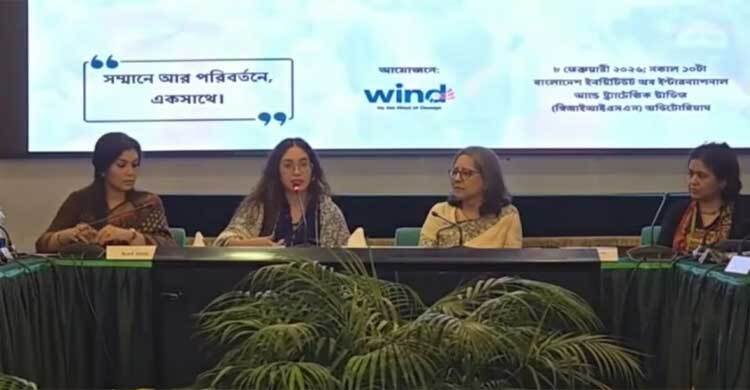
At a time when women’s participation in politics is expanding yet remains fraught with risk, Zaima Rahman has urged political parties to assume greater responsibility for ensuring women’s safety – both in the physical world and in the increasingly hostile digital space.
Speaking at a seminar in the capital on Sunday, the daughter of BNP Chairman Tarique Rahman said women continue to face cyberbullying, harassment and security threats that cannot be addressed by state laws alone.
“Political parties should take more responsibility for women’s security, particularly in terms of cyberbullying and physical safety,” she said, stressing that protection must also begin from within party organisations.
The seminar, titled “Women’s Struggle for Democracy: Contributions and the Bangladesh of Tomorrow,” was held at the Bangladesh Institute of Strategic Studies (BISS) conference hall and brought together political activists, academics and civil society members to reflect on women’s role in shaping the country’s democratic future.
Zaima argued that political parties need to introduce and enforce internal codes of conduct to safeguard women members from harassment and abuse, and to stand by them when violations occur.
“Parties should have their own codes of conduct so that women feel protected within the organisation and are supported if any untoward incident takes place,” she said.
Beyond safety, Zaima highlighted structural barriers that continue to limit women’s advancement in politics. She pointed to the absence of a sustained leadership pipeline, from student politics to local government and national decision-making bodies.
“If we fail to create and maintain this pipeline, capable women leaders will not come forward, and opportunities will remain limited,” she said, underlining the need for continuity in leadership development.
She noted that men often receive greater access to political opportunities, networks and exposure, while women are left to navigate politics with fewer resources and support systems. In this context, mentorship and training, she said, should be treated as a responsibility rather than a favour.
“Political parties must actively mentor and train young women so that new leadership can emerge,” Zaima said.
Economic constraints, she added, remain one of the most significant obstacles for women in politics. Campaign financing, organisational costs and lack of institutional backing often discourage women from contesting leadership roles.
“Financing is a major factor in politics. More support and facilities are needed to reduce inequality,” she said, adding that increased financial assistance would lead to greater participation and stronger women’s leadership.
Concluding her remarks, Zaima called for a broader change in mindset to fully harness the potential of young people and women alike.
“To build a different and inclusive Bangladesh, we must learn to value and use the talents of the younger generation,” she said.
Source: UNB