
‘Not leaving, not losing,’ Jara’s defiant Dhaka-9 message

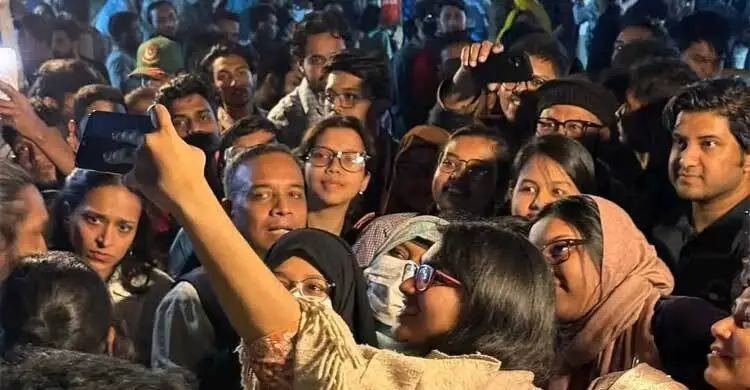
In defeat, she chose defiance. In disappointment, she spoke of determination.
Following the announcement of the 13th National Parliament Election results, Dhaka-9 independent candidate Tasnim Jara issued an open letter to her supporters, striking a tone that was at once gracious, resolute and forward-looking.
Though she did not secure the seat, Jara framed the outcome as the beginning of a longer political journey rather than its end.
“While we did not cross the finish line first, we achieved something many said was impossible,” she wrote, referring to the more than 44,000 votes cast in her favour within just weeks of campaigning.
Congratulating rivals, pledging constructive politics
In a rare gesture in Bangladesh’s often combative political landscape, Jara publicly congratulated the Bangladesh Nationalist Party (BNP) for its sweeping national victory. She also confirmed that she personally called Habibur Rashid Habib, the BNP candidate who won Dhaka-9, to offer congratulations.
With the BNP set to form the next government under chairman Tarique Rahman, Jara pledged to play what she described as a “constructive force” — supporting policies beneficial to citizens while maintaining a principled opposition stance when necessary.
Her remarks came amid the broader political shift marked by the BNP’s landslide win, according to unofficial results announced by the Election Commission of Bangladesh.
A campaign ‘without loudspeakers or malice’
Jara’s campaign stood out for its deliberate departure from traditional power politics. She described it as a movement built “without loudspeakers, without muscle, and without malice,” positioning it as an experiment in respectful, integrity-driven campaigning.
Political observers say the 44,000-plus votes she received signal a growing appetite among urban voters for alternative political styles, particularly among young and first-time voters.
A message to women: You belong in the halls of power
One of the most striking elements of her letter was its emphasis on women’s political participation.
Jara highlighted what she called “an unprecedented level” of female involvement in her campaign, arguing that women’s presence in policymaking spaces changes the national conversation.
“This was a fight for the safety, dignity, and agency of every woman in this country,” she wrote, addressing young girls who followed her campaign. “Know that you belong in the halls of power.”
Analysts note that her candidacy – and the visibility it generated – may influence future female participation in mainstream politics, traditionally dominated by entrenched party structures.
Addressing rumours, reaffirming commitment
Speculation had circulated that Jara might relocate to the United Kingdom after the election. She addressed the rumours directly.
“My roots are here, and my work is here. I am not going anywhere,” she declared, framing her political engagement as “the work of a lifetime.”
The clarity of that statement appeared aimed at consolidating her support base and signalling long-term intent.
Lessons learned, organisation ahead
While celebrating the symbolic victory of building a clean campaign, Jara also acknowledged its vulnerabilities. She conceded that integrity alone is not enough without organisational strength, particularly on election day.
“To protect a peaceful model, we must build a more robust organisation that can withstand intimidation,” she wrote, hinting at plans for stronger grassroots coordination in the future.
Tribute to the July Uprising and reform efforts
Jara credited the broader democratic environment to what she termed the “July Uprising,” paying tribute to those who sacrificed for political change. She also expressed gratitude to Professor Yunus and his team, as well as the Election Commission, for organising what she described as a credible national election in a complex landscape.
A foundation, not a finale
For many candidates, defeat marks retreat. For Tasnim Jara, it appears to mark recalibration.
“44,000 votes are a strong foundation,” she wrote. “We have shown that there is a hunger for honesty.”
In Dhaka-9, she may not have won the seat. But in the crowded theatre of national politics, her message suggests she intends to remain part of the conversation – organised, vocal and, as she put it, together.
“The best is yet to come.”