
ICC flags real security risks for Bangladesh in India

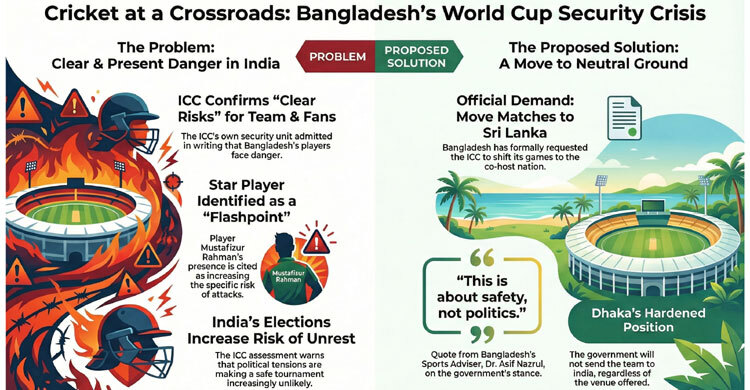
A World Cup security crisis is now out in the open. The ICC’s own security unit has admitted in writing that Bangladesh’s cricketers and supporters would face clear risks on Indian soil during the T20 World Cup, deepening a dispute that has already pushed Dhaka to demand a venue change.
The warning lands at a time when Bangladesh has formally told the ICC it will not send its team to India under the current conditions.
Two letters from the Bangladesh Cricket Board laid out what officials describe as an unsafe environment for players, fans and thousands of travelling supporters. The government has backed that position, saying it cannot gamble with the safety of its citizens.
The flashpoint came after Mustafizur Rahman was dropped from the IPL at the instruction of the BCCI, a move that opened the door to threats from hardline groups and triggered a wider debate about whether Bangladesh’s players would be secure in India at all. “If India cannot ensure the safety of one cricketer, how will they ensure the safety of an entire squad?” Sports Adviser Dr Asif Nazrul asked on Monday.
Despite Bangladesh’s push to shift the matches to Sri Lanka – the tournament’s co-host – the ICC had asked the BCB to detail the security concerns. Those details were sent. What came back has changed the tone of the controversy.
When it comes to cricket, few issues are purely about the game. For Bangladesh, the upcoming T20 World Cup in India has become a matter of national security — a high-stakes mix of politics, public safety, and sports diplomacy.
Mustafizur, the player at the centre of a storm
At the heart of the controversy is Mustafizur Rahman, Bangladesh’s star left-arm pacer. The ICC’s own security assessment has singled him out as a potential flashpoint: his presence on the team allegedly increases the risk of attacks, while fans wearing Bangladesh jerseys in India could also face danger.
“If India cannot provide security for one player, how can they protect an entire team and thousands of fans?” asked Sports Adviser Dr Asif Nazrul at a press briefing in Dhaka.
He stressed that these are not speculative concerns. Recent incidents have shown that Bangladeshi fans on Indian soil have faced harassment and violence, sometimes fatally.
Adding another layer of tension is India’s national election cycle. According to the ICC security team, the closer the polls get, the higher the risk of unrest, making a safe tournament increasingly unlikely.
Sri Lanka: The safety valve
Bangladesh has sent two letters to the ICC, urging a venue shift. Their proposal: Sri Lanka, a co-host nation with a proven track record of hosting international cricket securely. The ICC has yet to respond formally, leaving the BCB in limbo.
“This is about safety, not politics,” said Asif Nazrul. “Expecting us to drop Mustafiz or tell fans to hide their jerseys is absurd. The ICC itself has confirmed the threats. There is no environment in India that guarantees safety for Bangladesh.”
Divisions at home and abroad
The decision has sparked debate across the cricketing world. Former Bangladesh captain Tamim Iqbal criticized the move, warning that revenue losses from skipping matches in India could be significant. Some current players have sided with him, arguing that playing on Indian soil should remain an option.
Meanwhile, Indian media has mocked Bangladesh’s security concerns, framing the team as overly cautious, a narrative that has only fuelled tensions further. But the BCB insists the stakes are real, not theoretical.
The ICC’s dilemma
The ICC faces a tricky balancing act. Bangladesh is a key contender in the tournament, but the security assessment cannot be ignored. Moving matches to a neutral venue like Sri Lanka, Pakistan, or the UAE would disrupt schedules, sponsorship deals, and the optics of hosting, but forcing Bangladesh to play under unsafe conditions risks far worse: injury, unrest, and an international incident.
The ICC security letter has shifted arguments from perception to documented risk. Bangladeshi fans have been frequent targets of mob violence in India in recent years, often attacked on suspicion of being “illegal Bangladeshis.” Now the ICC’s own assessment suggests that even without a jersey, supporters may not be safe.
Dhaka hardens position
Dhaka’s position has hardened. The government says it will not send the team to India regardless of what venue inside the country is offered. The BCB says it is waiting for the ICC’s next move and will continue to push for Sri Lanka as the alternate host.
For now, the cricket world is left with a World Cup where a full participant is unwilling – and perhaps unable – to play in the main host nation. And the ICC’s own security assessment has given Bangladesh the strongest argument yet.
Cricket beyond the boundary
For Bangladesh, the T20 World Cup is about more than runs and wickets. It is a test of diplomatic acumen, player safety, and national pride. “We cannot postpone elections for the sake of cricket,” Asif Nazrul said, highlighting how external factors – politics, elections, communal tensions – are now intertwined with the sport.
The clock is ticking. The ICC must weigh logistics, revenue, and the credibility of the tournament against the very real risks facing Bangladesh’s team and supporters. One thing is clear: this World Cup is shaping up to be as much about security strategy as it is about cricketing skill.