
Apparel avalanche: Bangladesh exports to Netherlands double in 6 years

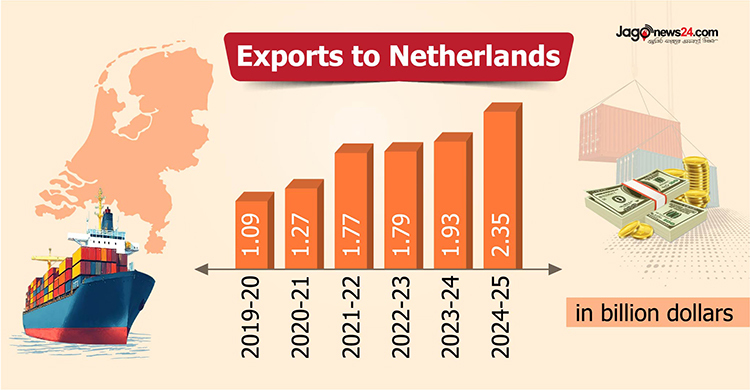
Bangladesh’s exports to the Netherlands have surged over the past six fiscal years, more than doubling from $1.09 billion in FY2020 to an estimated $2.35 billion in FY2025, a remarkable 115 per cent increase largely propelled by the apparel sector.
According to data from the Export Promotion Bureau (EPB), the Netherlands has emerged as one of Bangladesh’s most promising export destinations within the European Union, buoyed by strong demand for sustainable, high-quality garments.
Apparel dominates the export basket
Out of the total $2.35 billion in export earnings from the Netherlands in FY2025, readymade garments (RMG) accounted for $2.08 billion, representing a commanding 88.51 per cent share.
Apparel shipments alone grew by 21.21 per cent year-on-year, up from $1.72 billion in FY2024.
Knitwear exports posted robust growth of 31.69 per cent, reaching $1.21 billion compared to $926 million the previous year.
Woven products rose 9.04 per cent to $879 million, up from $797 million in FY2024.
Other key export categories included textile articles and worn clothing ($50 million), footwear and gaiters ($96.75 million), and headgear ($7.35 million).
Strong year-on-year performance
The country’s exports to the Netherlands climbed from $1.93 billion in FY2024 to $2.35 billion in FY2025 — an impressive 21.8 per cent year-on-year growth.
Exporters attribute this momentum to improved product quality, better supply chain management, a focus on sustainability, timely deliveries, and gradual diversification of product lines.
Branding Bangladesh in Europe
Trade analysts note that Bangladesh’s proactive trade promotion initiatives have also bolstered its European presence. The Best of Bangladesh in Europe exposition, held in Amsterdam and organised by the Bangladesh Apparel Exchange (BAE), has been a major catalyst in connecting Bangladeshi exporters with European brands and buyers.
“Dutch consumers are fashion-conscious and willing to pay for quality and sustainability. This plays in Bangladesh’s favour, as our apparel industry has made tremendous progress in environmental compliance and responsible sourcing,” said Mohiuddin Rubel, former director of BAE and Additional Managing Director of Denim Expert Ltd.
Rubel added that the Netherlands also serves as a major gateway for EU-bound shipments, meaning a portion of Bangladesh’s goods reach other European markets through Dutch ports – further boosting export figures.
Sustainability: The competitive edge
Bangladesh’s growing reputation for sustainable manufacturing has resonated strongly with Dutch buyers. In recent years, the country has invested heavily in green factories, renewable energy use, and transparent labour practices – all of which align with the Netherlands’ strict sustainability standards.
“This commitment to sustainability has not only improved our brand image but also created trust with high-end European retailers,” Rubel observed.
Diversification: The next frontier
While the RMG sector remains the backbone of export earnings, experts warn that overdependence on apparel poses long-term risks.
“To deepen Bangladesh’s export footprint in the Netherlands, we must move beyond our traditional reliance on garments,” Dr Zahid Husain, former Lead Economist of the World Bank, told Jago News. “The leather industry, for instance, holds immense potential, but only if we meet environmental and labour compliance standards in line with EU regulations.”
He cautioned that failure to comply with EU green and ethical standards could limit market access, even as demand for diversified goods grows. “Bangladesh needs to pivot from volume-driven exports to value-added, compliant, and diversified trade offerings,” Husain said.
Pathway to sustainable growth
Analysts suggest that the next phase of growth should focus on expanding into high-value sectors such as pharmaceuticals, ICT services, and processed foods, all of which align with the Netherlands’ import priorities and sustainability goals.
“The rising export trend to the Netherlands is a clear signal of Bangladesh’s growing competitiveness in Europe,” Husain added. “By leveraging our strengths and embracing diversification, we can secure a stronger and more resilient position in the global market.”