
Recovering laundered money must not be stalled for politics: BB governor

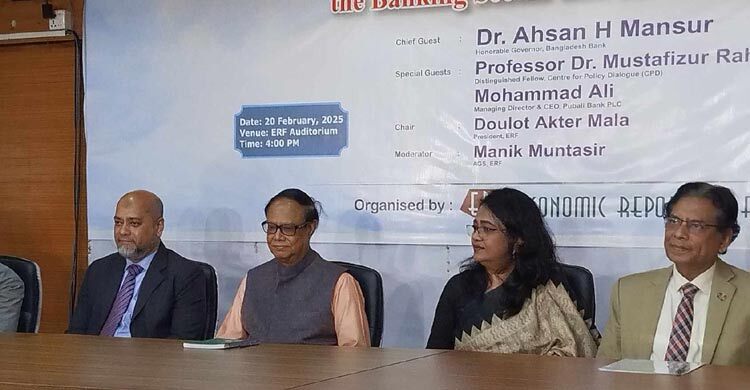
Bangladesh Bank Governor Dr Ahsan H Mansur has called for sustained efforts to recover laundered money, emphasising that the initiative should not be derailed by political changes.
Speaking at a seminar titled 'Macroeconomic Challenges and Banking Sector Reforms' organised by the Economic Reporters Forum (ERF) in Dhaka on Thursday (February 20), Dr Mansur highlighted examples of countries like Angola, Niger, and Sri Lanka successfully repatriating laundered funds.
"Angola recovered $15 billion in five years. Niger and Sri Lanka have also brought back laundered money. We don’t know how much we can recover in a year, but we will strive to bring back as much as possible. It’s crucial that the next government continues this effort. The recovery of laundered money must not stop due to political reasons," he said.
The event, chaired by ERF President Daulat Akhter Mala, featured special guests Professor Dr Mustafizur Rahman, Honorary Fellow of the Centre for Policy Dialogue (CPD), and Mohammad Ali, Managing Director of Pubali Bank. ERF Acting General Secretary Manik Muntasir moderated the discussion.
Addressing economic challenges
Dr Mansur outlined the significant challenges facing Bangladesh’s economy, including revenue shortfalls, high inflation, declining reserves, and currency market instability. "Our economy faces unique challenges that cannot be resolved in a year. For instance, citizens pay taxes at 4 lakh points but earn only 24 thousand points. This disparity needs to be addressed through reforms," he explained.
He noted improvements in key economic indicators, stating, "Our reserves are increasing without IMF support, and the currency market has stabilised. Remittances have grown by 24 percent this fiscal year, with a 30 per cent increase this month alone. We expect $30 billion in remittances this year. However, some groups in Dubai are attempting to manipulate remittance rates, but we remain focused on larger markets like Saudi Arabia."
Inflation and interest rates
On inflation, Dr Mansur said, "High inflation didn’t occur overnight, and it will take 12 to 16 months to bring it down. We’ve only had six months, but inflation is already decreasing. Treasury bill interest rates have dropped from 12 per cent to 10 per cent, forcing banks to focus on profitable lending rather than relying on government bonds."
Banking sector reforms
The governor stressed the need for banking sector reforms, starting with the autonomy of Bangladesh Bank. "We aim to make Bangladesh Bank completely independent, free from government interference. We are working on this and will present our recommendations to the chief adviser in the next four to five months. However, we face a shortage of manpower at the central bank," he said.
He also addressed low investment growth, attributing it to sluggish deposit growth rather than high interest rates. "Deposit growth is at 7.5 percent, with deposits increasing by Tk 190,000 crore annually. The government has reduced its borrowing target from Tk 137,000 crore to Tk 99,000 crore, freeing up more funds for private sector loans. The era of bank MDs profiting effortlessly is ending," he added.
Interest rate reduction
Dr Mansur linked interest rate reductions to inflation control. "If inflation decreases, interest rates will follow. Rates have already dropped from 12.5 per cent to 9.5 per cent. The full impact of our policies will take about a year to materialise," he said.
Strengthening public trust in banks
He highlighted the recovery of banks previously plagued by mismanagement. "Public confidence in banks is growing. Even Islamic banks, which were heavily impacted, are now standing on their own, increasing deposits and distributing loans," he said.
CPD’s perspective
Professor Dr Mustafizur Rahman of CPD emphasised the need for visible progress in recovering laundered money to ensure continuity by future governments. "The interim government must demonstrate tangible results. Banking sector reforms should prioritise the central bank’s autonomy to prevent interference from the Ministry of Finance. While contractionary monetary policy increases interest rates, obstacles to investment must also be removed to boost purchasing power," he said.