
Pabna hosiery industry on brink as India land import ban drags on

Published: 17 July 2025, 10:24 PM
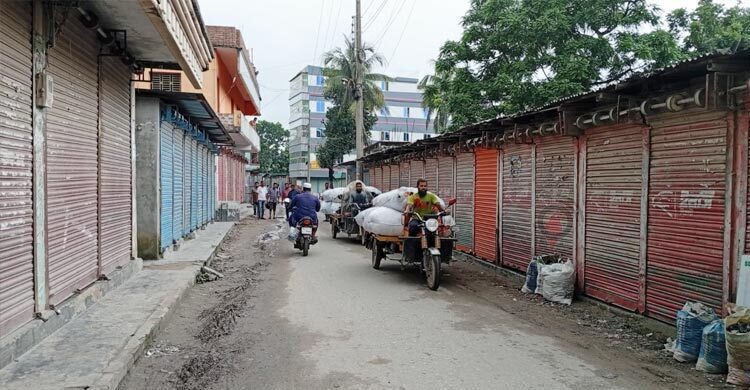
The hosiery industry in Pabna, once a thriving sector built on recycling discarded fabrics and apparel factory waste into garments, is now on the brink of collapse following India’s suspension of import through land border ports.
Small-scale hosiery factories that once exported millions of dollars worth of shirts, sweaters, socks, and vests to India and other countries have been shuttering one after another.
Industry insiders estimate that 3,000-4,000 factories have already closed, leaving two-thirds of the workforce unemployed.
Previously, factory owners exported goods worth $1–1.5 million per month, mostly to India. Now, with land ports closed since May 17, traders are struggling to survive.
Mirajul Islam, owner of Asan Hosiery, once exported over Tk 6 crore worth of garments monthly. His seven factories employed over 1,000 workers. Today, only about 100 workers remain, and a massive stockpile of unsold garments sits in his warehouse.
“This is the worst time for our business,” he said. “We can’t deliver our goods. We can’t pay our workers. We can’t even cover our costs.”
Sea route: Costly and slow
While exporters have tried to shift to sea routes, the transition has proven expensive and inefficient. Deliveries that once took a day now take 20 days to a month, and transport costs have doubled.
Russell, owner of SB Russell Hosiery Factory, said it now takes 45 days to ship a consignment through Chittagong Port. “Our buyers are losing confidence,” he said. “We need urgent government intervention.”
Md Rafiq Sheikh, President of the Bangla Bazar Hosiery Traders Association, confirmed that only about 100 factories remain operational out of an estimated 400 in the area. “More than a lakh of workers have lost their livelihoods,” he said.
He added, “We used to export 70-80 truckloads of garments every month. That’s completely stopped. We’re stuck with unsold stock, and our debts are piling up.”
Debt crisis and worker hardship
The crisis has triggered a wave of layoffs and debt defaults. Factory owners are struggling to repay bank and NGO loans, while workers are surviving on reduced hours and wages.
Anwar Hossain, a veteran trader, said he has not been able to pay three months of house rent, let alone loan instalments. “We’re completely ruined,” he said.
Abdul Khalek, another exporter, lamented that a consignment he sent on June 17 has yet to reach its buyer. “I had a thriving business. Now I can’t even run my factory,” he said, adding that he employs over 100 workers and has a Tk 50 lakh bank loan to repay.
Silent factories, empty streets
In areas like Bangla Bazar and Sadhupara Jhutpatti, once buzzing with activity, silence has replaced the hum of sewing machines. Most shops and factories are closed, with many owners unable to repay loans or sustain operations.
Shafiful Islam, Sujan Ali, and Sultan Mahmud Khokon, fabric traders in Bangla Bazar, said that despite ample stock of raw materials, sales have dried up. “We can’t move the goods. We can’t pay our debts. We’re stuck,” said one.
Workers like Ashraf and Alam said their working hours have been cut in half, and their wages have dropped significantly. “We’re surviving on half income,” Ashraf said. “We can’t feed our families properly anymore.”
A threat to local economy
The hosiery industry once employed over a lakh of workers, both men and women, and contributed significantly to local and national economies. It all started in the early 2000s when wastes from Dhaka and Narayanganj garment factories was repurposed into affordable garments.
By 2015, the sector had grown to over 5,000 small factories in Pabna.
Now, with the India export route blocked, the entire industry is at risk.
Sardar Md Selim Reza, President of the Pabna District Hosiery Manufacturers Group, warned that if the situation does not improve, Pabna’s economic growth will stall.
“This is a lifeline industry,” he said. “If it collapses, thousands will be thrown into poverty. We urge the government to create alternative markets or reopen land exports to India.”
Calls for government action
Pabna Chamber of Commerce and Industry President Saiful Alam Swapan Chowdhury said traders are urging the government to act quickly. “We need alternative markets or a resumption of cross-border trade,” he said.
Pabna Deputy Commissioner Md Mofizul Islam said he had only recently learned of the crisis and would soon convene a meeting with traders to assess the damage and forward a proposal to the Ministry of Commerce.