
Full duty waiver if 20% US raw materials used: BGMEA chief

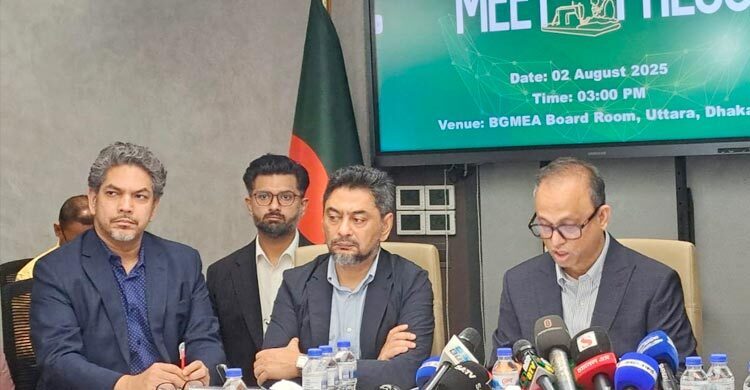
In a major boost for Bangladesh’s export sector, products – including ready-made garments – that contain at least 20 per cent US-sourced raw materials, such as American cotton, will be fully exempt from US countervailing duties.
The announcement was made by Mahmud Hasan Khan, President of the Bangladesh Garment Manufacturers and Exporters Association (BGMEA), during a press conference at the BGMEA headquarters in Uttara on Saturday.
This measure follows the United States’ reduction of countervailing duties on Bangladeshi goods, from an initial 35 per cent down to 20 per cent.
“This is a game-changing development,” said Khan. “Approximately 75 per cent of our exports to the US are cotton-based garments. Under the revised US executive order, if we use at least 20 per cent American raw materials in our products, the additional 20 per cent countervailing duty will be completely waived. This opens a strategic pathway for duty-free access and enhances our competitiveness.”
He emphasised that this conditional exemption is not just a relief but an opportunity: “By sourcing more American inputs, we can effectively neutralise the tariff burden and strengthen trade ties with our largest export market.”
The journey to this outcome was fraught with uncertainty. On April 2, the US announced the so-called ‘Liberation Day Tariff’, imposing a staggering 37 per cent duty on Bangladeshi exports – higher than on competitors like India (26 per cent), Pakistan (30 per cent), and Indonesia (32 per cent).
This sent shockwaves through Bangladesh’s $47 billion export economy, where the US accounts for nearly 20 per cent of total export earnings, and 87 per cent of exports to the US are RMG products.
Although implementation was delayed for 90 days, an additional 10 per cent base tariff took effect from April 5, compounding the pressure.
“There was panic in the industry,” Khan recalled. “With such a high tariff gap, maintaining market share became nearly impossible. Factories feared order cancellations, layoffs, and even closures.”
But the interim government launched intense negotiations.
While details remained under non-disclosure agreements (NDAs), BGMEA learned in mid-June that a draft agreement was underway. However, progress seemed slow – on July 2, Vietnam’s duty was slashed from 46 per cent to 20 per cent, while Bangladesh saw only a 2 per cent reduction to 35 per cent by July 7, with a deadline to renegotiate by July 31.
“The next two weeks were critical,” Khan said. “We saw Indonesia and the Philippines secure deals at 19 per cent. We intensified our efforts – engaging with the US Embassy, sharing data, analysis, and policy recommendations, and urging the government to prioritize the sector.”
The final agreement, reducing the duty to 20 per cent and introducing the 20 per cent US input waiver, has been hailed as a diplomatic and economic victory.
Khan welcomed the new tariff structure, noting it now aligns Bangladesh with, or even improves upon, key competitors: China (30 per cent) and India (25 per cent).
“I extend our sincere gratitude to the US government for adopting a balanced approach,” he said. “And we commend the leadership of our interim government – particularly the Commerce Adviser, Security Adviser, and their teams – whose relentless efforts averted a national economic crisis. This did not happen overnight. It was a journey of resilience, negotiation, and unity.”
Despite the relief, Khan warned against complacency. “A 20 per cent duty still increases production costs at a time when factories are already struggling with rising energy, logistics, and compliance expenses.”
He urged the government to take immediate steps to support the sector, especially small and medium-sized enterprises (SMEs) at risk of closure. He called for ensuring industry-friendly customs policies: improving efficiency at Chattogram Port; guaranteeing uninterrupted power and gas supply; and enhancing the effectiveness of the National Board of Revenue (NBR).
Looking ahead, BGMEA pledged to intensify its efforts to boost competitiveness through data-driven strategies, stakeholder consultations, and board-level reforms.
“We believe this moment can be transformative,” Khan said. “If industry owners, the government, educational institutions, labour unions, and civil society work together, this tariff challenge can become a catalyst for modernisation, value addition, and sustainable growth.”
“This is not the end,” he concluded. “It’s the beginning of a new chapter – one where Bangladesh doesn’t just survive global trade shocks, but learns to thrive in them.”