
PRAN-RFL recruits 2,000 in 22-year-old mill, eyes 12,000 more

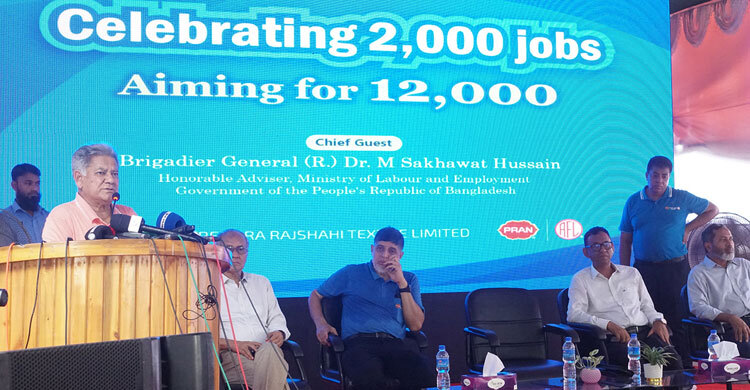
In a powerful revival of a long-dormant industrial legacy, PRAN-RFL Group, one of Bangladesh’s largest conglomerates, has successfully created 2,000 new jobs within just six months by reopening the state-run Rajshahi Textile Mills, now rebranded as Barendra Rajshahi Textile Limited under public-private partnership.
The milestone was celebrated Saturday at an event titled “Celebrating 2,000 Jobs – Aiming for 12,000”, held at the factory premises in Sapura, Rajshahi.
The occasion marked not just a corporate achievement, but a transformative moment for the region’s economy.
Brigadier General (Retd) Dr M Sakhawat Hussain, Adviser to the Ministry of Labour and Employment, graced the event as Chief Guest and cut a ceremonial cake to honour the employment breakthrough.
He also personally handed over appointment letters to several newly hired workers, symbolising renewed hope and opportunity.
The programme was attended by AHM Shafiquzzaman, Secretary of the Ministry of Labour and Employment; Ahsan Khan Chowdhury, Chairman and CEO of PRAN-RFL Group; Farzana Islam, Superintendent of Police, Rajshahi; Nurul Alam, Manager of Bangladesh Textile Mills Corporation (BTMC); and senior officials from the local administration.
In his address, Brigadier General (Retd) Dr Sakhawat Hussain hailed the initiative as a landmark step toward inclusive development.
“This is not just the reopening of a factory,” he said. “It is the revival of a community’s livelihood, the beginning of socio-economic transformation in northern Bangladesh. PRAN-RFL has shown how private investment, when aligned with public assets, can spark sustainable change.”
He emphasised the broader significance: “At a time when rural youth are forced to migrate to cities in search of work, initiatives like this bring jobs to the people, not the other way around. This is the essence of equitable and sustainable development.”
Once a state-owned textile mill, the Rajshahi Textile Mills had been closed for 22 years, a silent relic of industrial decline. But in October 2023, PRAN-RFL signed a public-private partnership (PPP) agreement with BTMC to breathe new life into the facility.
After taking over the site in December 2023, the group launched rapid rehabilitation. Within months, they repaired and repurposed the only viable shed on the sprawling campus and began production of bags and shoes – with plans to expand into ready-made garments (RMG) and other export-oriented products.
Ahsan Khan Chowdhury, Chairman and CEO of PRAN-RFL Group, outlined an ambitious roadmap: Creating 10,000 additional jobs in the coming years through strategic investments in labour-intensive sectors such as tele-marketing, textiles, and light manufacturing.
“Our mission is clear and purposeful,” Chowdhury declared. “We believe the era of rural youth migrating to Dhaka or abroad for survival is coming to an end. Our goal is to deliver job offer letters to their doorsteps.”
He announced plans to establish a fully sustainable, green industrial park in Rajshahi, 100% export-focused, that will prioritise environmental sustainability and worker welfare.
One of the most promising initiatives is the upcoming tele-marketing hub, designed to create thousands of new employment opportunities, especially for women.
“This hub will empower women with digital skills, flexible work hours, and safe working environments,” Chowdhury said. “We are not just creating jobs, we are building careers and confidence.”
The revival of Barendra Rajshahi Textile Limited is being seen as a blueprint for revitalising Bangladesh’s idle state-owned industries through private sector dynamism.
With its focus on local employment, export growth, and inclusive development, the project exemplifies how strategic partnerships can turn economic liabilities into engines of progress.
As the first 2,000 workers clock in, and the promise of 10,000 more looms on the horizon, Rajshahi is no longer just looking back at its industrial past, it is stepping boldly into its future.
“This is just the beginning,” said Chowdhury. “Rajshahi will rise – not as a forgotten town, but as a symbol of Bangladesh’s next industrial revolution.”