
Tax tide swamps local marine paint as foreign brands sail to dominance

Published: 25 September 2025, 08:02 PM | Updated: 25 September 2025, 09:07 PM
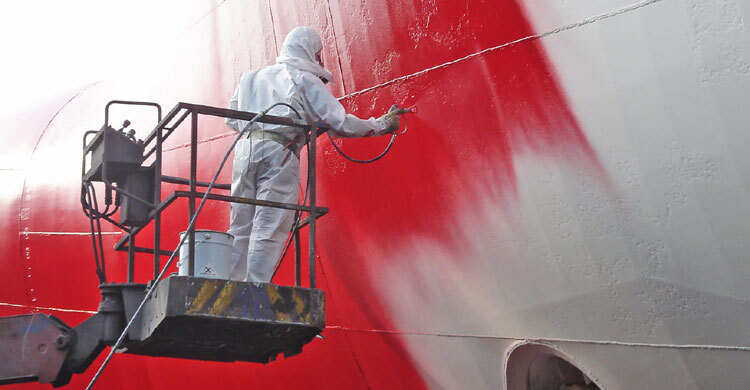
Despite being a key player in global maritime trade, with a significant share of its import-export activity conducted by sea, Bangladesh remains almost entirely dependent on foreign brands for marine paint, a critical component in shipbuilding and repair.
Domestic manufacturers, though technically capable, are being squeezed out of the market due to high import duties, unequal competition, and policy neglect, industry insiders warn.
Marine paint, essential for protecting vessels from saltwater corrosion, algae, barnacles, and rust, accounts for just 3% of Bangladesh’s total paint consumption, yet it is nearly 100% dominated by international brands such as Norway’s Jotun, Denmark’s Hempel, and Japan’s Nippon Paint.
Even when used locally, these products often enter the market through well-established local agents or are sourced directly by shipowners via letters of credit.
According to the Bangladesh Paint Manufacturers Association (BPMA), the country consumed approximately 230,000 tonnes of paint in the 2024-25 fiscal year, with marine paint making up only 4,500 tons (roughly 2%).
While domestic players like Berger, Rainbow, Imperial, and Roxy do produce marine-grade coatings, some using advanced technologies like Berger’s Chugoku Marine Paints (CMP) antifouling system, they struggle to compete on price and perception.
“Foreign paints are available at lower effective tariffs through their local agents, while we, as domestic producers, pay 10% supplementary duty and 15% VAT on raw materials and finished products,” said Arun Mitra, General Secretary of BPMA. “The government still classifies paint as a ‘luxury item’—a misclassification that undermines asset protection, environmental safety, and long-term cost savings.”
The imbalance is particularly acute in Chattogram, the hub of Bangladesh’s shipbuilding and shipbreaking industries.
At Western Marine Shipyard, the country’s largest shipbuilder, Executive Director Abdul Quader confirmed that buyers typically specify international brands like Jotun or Hempel in their contracts. “Jotun has even set up a factory here, which gives them a huge advantage. We do use Berger when needed, it’s qualitative, but the preference remains foreign.”
Similarly, Mohiuddin Bakul, owner of Shah Amanat Dockyard, noted that while his yard uses Berger for repairs, “domestic marine paints still can’t match international standards for deep-sea vessels.”
Others, like Engineer SM Sanwarul Islam of FMS Marine Service, rely on Malaysian ‘Olive’ brand or Hempel due to client demand and availability.
Compounding the challenge is the informal influx of marine paint from Chittagong’s shipbreaking yards, where leftover or salvaged foreign paints are reused, further undercutting formal domestic sales.
“We’re moving forward in backward linkages, sourcing welding rods, furniture, tiles locally, but paint remains an import,” Quader added, highlighting a paradox: even as Bangladesh advances in shipbuilding, it cannot secure a foothold in one of its most critical ancillary sectors.
Industry leaders argue that with the right policy support, particularly removing punitive duties and reclassifying industrial paints as essential goods, local manufacturers could scale up and reduce foreign dependency. “We have the technology and expertise,” Mitra insisted. “But without a level playing field, we’re being forced out of our own market.”
As Bangladesh aims to expand its blue economy and maritime capabilities, experts warn that continued reliance on imported marine coatings not only drains foreign exchange but also exposes the sector to supply chain vulnerabilities – making the case for urgent policy reform more compelling than ever.