
In God we trust, in liquor we profit: Carew’s record Tk 190cr windfall

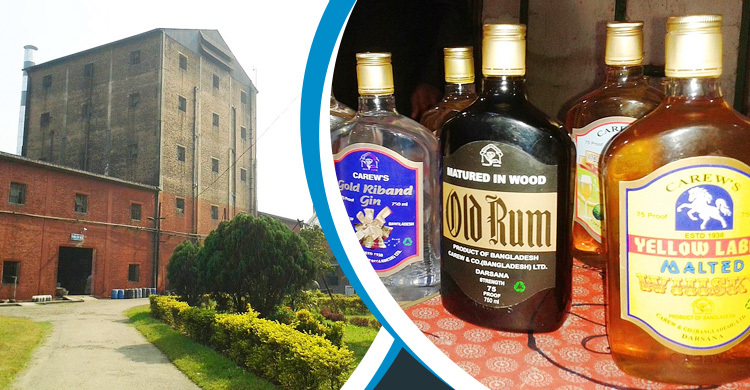
In the dry moral climate of Muslim-majority Bangladesh, where alcohol is officially frowned upon and strictly rationed, few would expect the government to be in the liquor business. Fewer still would imagine it to be one of the country’s most profitable enterprises.
Yet that is precisely what Carew & Company (Bangladesh) Limited has become. The 87-year-old, state-owned distiller — the only legal maker of alcohol in the country — has just reported a record Tk 190 crore ($16.15 million) profit for the 2024–25 fiscal year, its highest since the company’s founding in 1938.
Operating from a sprawling compound in the south-western town of Darshana, Carew’s distillery produces a dozen brands of spirits from molasses, a byproduct of sugarcane. Its liquor line has now eclipsed every other part of the business, including its original sugar mill, which last year ran up a loss of Tk 62 crore.
A paradox in policy
For a government that bans the sale of alcohol to Muslims and routinely invokes “moral values” in public policy, the success of a state-backed distillery presents a striking paradox.
A company officials said that demand for Carew’s products has risen sharply since 2021, as consumers turned to local alternatives when foreign liquor became scarce. The scarcity stems from tighter import controls on foreign alcohol, which the government introduced under the dual justifications of conserving foreign exchange and curbing what it described as “immoral consumption.”
The unintended result has been a protected monopoly for Carew, whose brands now dominate the country’s legal market.
Premium foreign whiskies and vodkas — once common in Dhaka’s expatriate clubs and high-end hotels — have either vanished or become prohibitively expensive. In their place, Carew’s bottles have quietly taken over shelves and bar counters, their labels a discreet emblem of state-sanctioned indulgence.
Profit from prohibition
The financials are striking. The distillery unit alone generated Tk 400 crore in revenue and Tk 100 crore in net profit, marking its third consecutive year of double-digit growth. The 43 per cent net margin rivals that of Bangladesh’s most efficient private manufacturers.
Even brief disruptions — such as the political unrest of mid-2024 — barely dented profits. While revenues dipped marginally, the unit’s earnings rose 32 per cent on the back of cost efficiencies and a pivot towards higher-margin spirits.
Across the rest of the enterprise, the picture is bleaker. Carew’s sugar mill, once the group’s backbone, now bleeds red ink. Fertiliser and pharmaceutical side ventures contribute little. Yet the alcohol division’s steady cash flow has turned the company into one of the few profitable entities in the moribund state industrial sector.
A quiet market, a steady thirst
Alcohol consumption remains deeply stigmatised in Bangladesh. Muslims require special permits to drink, though such rules are rarely enforced among the elite. For non-Muslim minorities — Hindus, Christians and Buddhists — and for foreign residents, Carew has become a reliable supplier.
Industry insiders estimate that Bangladesh’s legal alcohol market is worth more than Tk 600 crore annually, much of it cornered by Carew. Off the books, the figure is likely higher, with parallel networks importing or adulterating foreign brands.
“Carew’s operation is a fascinating contradiction,” says an industry analyst in Dhaka. “The government officially disapproves of alcohol but happily banks its profits.”
Faith, finance and the future
Founded by British entrepreneurs before independence and nationalised in 1972, Carew was intended to support rural sugarcane growers. Over the decades, its identity has flipped: from a sugar refiner with a small distillery to a distiller carrying an unprofitable sugar arm.
Despite its curious position, few in government appear troubled by the optics. Officials in the Bangladesh Sugar and Food Industries Corporation, which oversees Carew, say the enterprise is “vital for revenue generation”.
Privately, some admit the moral discomfort. “It’s awkward,” one bureaucrat said. “But it’s also one of the only state industries that actually makes money.”
A state of spirits
With seven straight years of profit growth and margins that rival the private sector, Carew’s alcohol business may soon force a reckoning. Should a Muslim-majority state depend on liquor to balance its books?
For now, fiscal pragmatism trumps moral hesitation. Carew’s casks are full, its accounts flush, and its spirits — quite literally — are high.