
DCCI, Canadian team explore expanded trade and investment ties

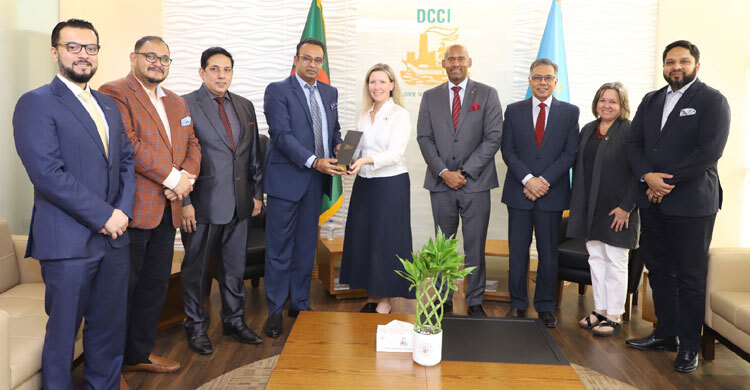
The Dhaka Chamber of Commerce & Industry (DCCI) and a high-level Canadian trade delegation held a strategic meeting on Sunday to identify new avenues for strengthening bilateral economic cooperation, as both sides expressed strong interest in diversifying trade and deepening investment links.
The discussion took place at the DCCI Gulshan Centre and was led by DCCI Acting President Razeev H. Chowdhury and Sara Wilshaw, Canada’s Senior Assistant Deputy Minister for International Trade and Chief Trade Commissioner. Canadian High Commissioner to Bangladesh, H.E. Ajit Singh, also attended the session, underscoring Ottawa’s growing focus on Bangladesh as a key emerging market.
Trade and investment snapshot
Razeev H Chowdhury highlighted that bilateral trade between Bangladesh and Canada reached USD 2.22 billion in fiscal year 2024, with Bangladesh exporting $1.32 billion worth of goods – primarily ready-made garments – and importing $901.09 million from Canada.
He noted that Canada ranks as the 20th largest source of foreign direct investment (FDI) in Bangladesh, with a cumulative FDI stock of $132.83 million.
Chowdhury emphasised significant untapped potential for Canadian investment in sectors such as renewable energy, green technology, waste management, automotive components, healthcare, medical equipment, financial services, IT and digital infrastructure, smart logistics, warehousing, and cold chain systems. He also pointed to export opportunities for Bangladesh in leather goods, jute products, handicrafts, bicycles, high-end RMG, ceramics, furniture, pharmaceuticals, processed and frozen foods, software, and BPO services.
Canada seeks market diversification
Sara Wilshaw acknowledged that while the majority of Canadian trade and investment remains concentrated in the United States – with SMEs accounting for 75% of exports – Ottawa is actively pursuing market diversification. “To remain competitive globally, we must broaden our export destinations, products, and partnerships,” she said.
She highlighted Canada’s strengths in education, automotive manufacturing, and food processing, and expressed interest in supporting Bangladesh’s integration into resilient global supply chains. “The Canadian automotive sector is exploring new markets for diversification – and Bangladesh could be a promising destination,” she noted. Wilshaw also stressed mutual opportunities in education and skills development, pointing to the large number of Bangladeshi students already studying in Canada.
Private sector as growth engine
High Commissioner Ajit Singh underscored the importance of chamber-to-chamber collaboration in fostering business-to-business linkages. “The private sector is the engine of Bangladesh’s growth,” he said, adding that Canada is keen to enhance cooperation in skills training, vocational education, nursing, agri-tech, and ease of doing business reforms.
“We see tremendous potential to elevate our bilateral trade relationship to new heights in the coming years,” he affirmed.
The meeting was also attended by DCCI Vice President Md. Salim Sulaiman, members of the Board of Directors, and Debra Boyce, Counsellor and Senior Trade Commissioner at the Canadian High Commission.
Both sides agreed to maintain regular dialogue and explore joint initiatives to facilitate trade, investment, and capacity-building – signalling a strategic pivot toward deeper economic integration between the two Commonwealth nations.