
Bangladesh unlocks new revenue stream: Bhutan’s 1st transit cargo cleared

Published: 25 November 2025, 04:00 PM
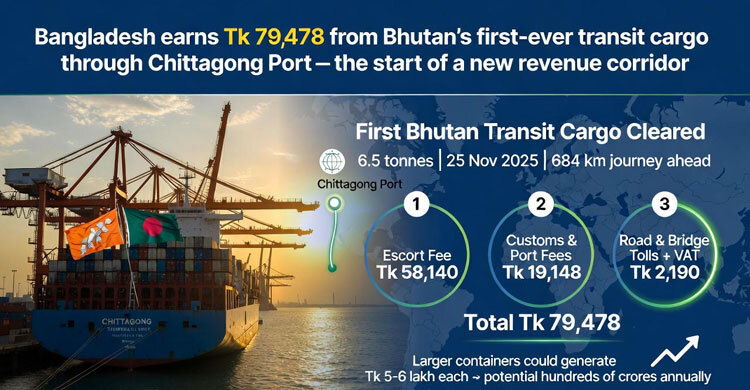
In a landmark development for sub-regional trade, Bangladesh has completed customs formalities for Bhutan’s first-ever commercial transit shipment through Chittagong Port, generating an immediate revenue of Tk 79,478 from a single 6.5-tonne trial container.
It opens the door to potentially hundreds of millions of takas in annual earnings if full-scale operations commence.
The modest but symbolically important consignment – containing everyday consumer items such as mineral water, iced tea, dried palm fruit, jelly, chocolate, shampoo, and orange juice – marks the operationalisation of the Agreement on the Movement of Traffic-in-Transit signed between Bangladesh and Bhutan on March 22, 2023.
For land-locked Bhutan, which currently routes almost all seaborne imports via the Indian port of Kolkata (a detour of roughly 1,100–1,300 km from Chittagong), the new arrangement via Bangladesh shortens the overland journey to the border by several hundred kilometres.
Breakdown of revenue from the pioneer consignment
Bangladesh has generated an immediate revenue of Tk 79,478 from Bhutan’s pioneering transit consignment, with Chittagong Customs House collecting the amount across several heads.
This includes Tk 2,087 in direct customs documentation and processing fees that flow straight to the National Board of Revenue, plus a further Tk 17,061 in assorted customs and port-related charges covering transshipment, security, scanning, and administrative costs.
An additional Tk 2,190 has been levied for road and bridge tolls together with 15% VAT, incorporating charges for crossing the Meghna, Meghna-Gumti, Jamuna, and Teesta bridges. By far the largest component is the transit escort fee of Tk 58,140, calculated at Tk 85 per kilometre for the full 684-kilometre escorted journey from Chittagong Port to Burimari Land Port.
Deputy Commissioner (Preventive) HM Kabir highlighted that this escort fee will become the dominant revenue generator once regular, larger consignments begin moving.
For heavier or longer containers the charge scales rapidly, making the 684 km corridor a highly lucrative income stream for the government.
Waiver of penalties reflects strategic importance
The 20-ft container arrived on the Bangladeshi-flagged vessel HR Hera on 22 September but remained in the port for over two months while both governments finalised procedures. Under normal circumstances this would have incurred demurrage and store-rent penalties running into several lakh taka.
Chittagong Port Secretary Md. Omar Faruk confirmed that the government explicitly waived all such charges to ensure the success of this flagship shipment.
“Penalties have been fully exempted on government orders,” Faruk said. “Only standard port handling and equipment charges will apply.”
Route and logistics
After release on Tuesday November 25, the container, handled by local C&F agent NM Trading Corporation C&F Ltd, will travel under armed escort on a trailer chassis along the following corridor:
Chittagong Port → Dhaka → Jamuna Bridge → Bogura → Rangpur → Burimari Land Port (684 km) → Jaigaon-Phuentsholing border → Thimphu (additional ~170 km inside Bhutan)
The entire Bangladesh leg is expected take 20-24 hours under the escorted convoy system.
Future revenue potential
Industry analysts and shipping agents in Chittagong project that, should Bhutan shift even 10-15% of its current annual import volume (estimated at 1.2–1.5 million tonnes, mostly via Kolkata) to the Bangladesh corridor, the implications for Bangladesh would be substantial:
At current tariff rates, a standard 25-tonne 40-ft container would generate approximately Tk 4,50,000-5,50,000 in escort fees alone (684 km × Tk 85 × 2 TEUs).
Additional bridge tolls, VAT, security, and customs fees could push total government revenue per large container above Tk 6,00,000.
5,000 such containers annually would yield roughly Tk 300 crore (Tk 3 billion) for Bangladesh, excluding ancillary benefits such as fuel sales, driver accommodation, warehousing, and insurance.
Senior officials at the Ministry of Commerce and the National Board of Revenue privately acknowledge that Bhutan has expressed strong interest in scaling up quickly, particularly for food & beverages, construction materials, and vehicles, provided the trial run proceeds smoothly.
Wider sub-regional implications
The development is being closely watched by Nepal, which signed a similar transit agreement with Bangladesh in 2022 but has not yet operationalised it at scale. A successful Bhutan model could accelerate Nepal’s use of Chittagong and Mongla ports, further cementing Bangladesh’s emerging role as the transit hub for the eastern Himalayas under the BBIN (Bangladesh-Bhutan-India-Nepal) initiative.
For now, all eyes are on the 6.5-tonne container as it rolls out of Chittagong Port gates on Tuesday morning – a small load carrying very large economic and diplomatic possibilities.