
A Tk 20,000 blower ends the era of onion crises

Published: 7 December 2025, 04:01 PM
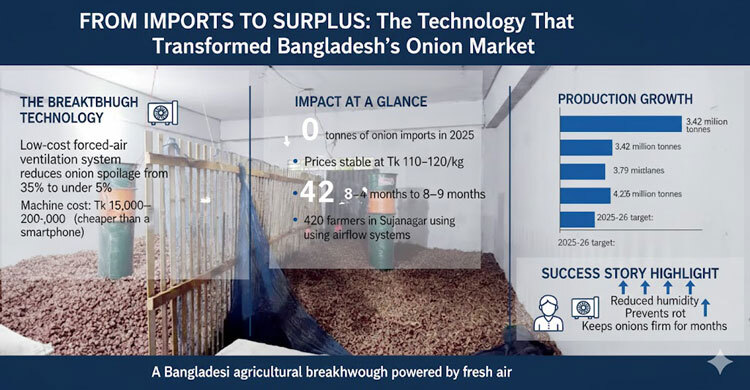
For more than a decade, onions were Bangladesh’s most politically explosive vegetable. A poor harvest or an Indian export ban could topple ministers, trigger street protests, and send retail prices soaring past Tk 250 per kg.
In 2025, something extraordinary has happened: Bangladesh has imported precisely zero tonnes of onions in the past year, domestic prices have held steady at Tk 110-120 per kg even in the lean winter months, and farmers are building new houses with their profits.
The weapon behind this quiet revolution? A remarkably simple forced-air ventilation system that costs less than a medium-quality smartphone.
From 35% wastage to under 5% – the power of moving air
“Every year we grew enough onions, sometimes more than the country needed,” says Dr Shailendra Nath Majumder, recently retired senior scientific officer at the Bangladesh Agricultural Research Institute (BARI). “Yet 30-35 % would rot within weeks because of high humidity and poor storage. That wastage created an artificial shortage, forcing imports of 5,00,000-7,00,000 tonnes annually, mostly from India.”
The solution is elegantly low-tech: onions are no longer heaped directly on the floor. Instead, farmers stack them on raised bamboo or wooden platforms with gaps underneath. A heavy-duty blower – the “air flow machine” – is installed beneath or beside the store, pushing a constant stream of air through the pile. Temperature stays low, moisture evaporates instantly, and fungal spores never get a foothold.
Result: fresh, firm onions after eight to nine months of storage instead of the previous three to four.
A machine capable of ventilating 10 tonnes (roughly 250 maunds) costs just Tk 15,000. The 12-tonne version is Tk 17,000, and the largest 14-tonne model a mere Tk 20,000 – cheaper than many farmers’ smartphones.
Pabna: Ground Zero of the onion revolution
Pabna remains Bangladesh’s undisputed onion capital. In the 2024-25 season the district cultivated 53,150 hectares and harvested nearly 9,00,000 tonnes. In Sujanagar upazila alone, 420 farmers now operate air flow systems – 320 received machines free under government incentive schemes, while 100 bought their own.
“Last season we produced 320,000 tonnes in Sujanagar,” says Upazila Agriculture Officer Md Asaduzzaman. “Many farmers still have stocks from February’s harvest. That has never happened before.”
Across the district, concrete storage rooms with bright blue or green blowers humming underneath bamboo platforms have become the new status symbol.
One season’s onion profit earns Faridpur farmer brand new home
In Joykali village, Saltha upazila, Faridpur, Hannan Matubbar proudly shows off his brand-new two-storey home with a corrugated-sheet roof.
“Four bighas of onions last season,” he says, grinning. “Thanks to two air flow machines, I sold gradually at the best prices. Profit after all costs: nearly Tk 5,00,000. This house is built entirely from onion money.”
The numbers tell the story
The steady climb is unmistakable. In the 2022-23 fiscal year, onion was grown on 2,46,752 hectares and yielded 3.42 million tonnes. The following year, 2023-24, saw cultivation rise to 2,58,790 hectares, lifting output to 3.79 million tonnes. By 2024-25 the area had expanded to 2,80,100 hectares, delivering a bumper 4.25 million tonnes. For the current 2025-26 season, the government has set an ambitious target of 2,86,300 hectares and a harvest of 4.26 million tonnes.
With annual national demand hovering steadily between 3 and 3.2 million tonnes, Bangladesh has moved from chronic shortfall to comfortable surplus. For the first time in living memory, the country is not just meeting demand; it is exceeding it – and doing so without a single ship unloading foreign onions at Chattogram port.
A textbook case of appropriate technology
SM Sohrab Uddin, Director General of the Department of Agricultural Extension (DAE), calls it “the most successful rapid-scale adoption we have ever seen.”
“These are not cold stores costing crores,” he emphasises. “They are affordable, electricity-efficient blowers that any smallholder can operate. Yet the macroeconomic impact is enormous: hundreds of crores saved in foreign exchange, stable consumer prices, and a complete end to the old import panic.”
Farmers plan ahead instead of praying
In Bera upazila, Pabna, farmer Md Siddiq Ali is preparing eight bighas for the premium “Super King” and “Super Queen” varieties.
“Earlier we stored onions in the loft and prayed they wouldn’t sprout or rot,” he says, standing beside his new dedicated storage room. “Now the Agriculture Office has given us an air flow machine. We are building proper ventilated sheds. Next year we will store right through to the following monsoon and sell when prices peak.”
As Bangladesh heads into the 2025-26 rabi season, the mood in the onion belts of Pabna, Faridpur, Kushtia and Rajshahi is one of quiet confidence. For perhaps the first time in the country’s history, farmers are not merely growing a crop; they are running a sophisticated, year-round supply business – powered by little more than fresh air and a Tk 20,000 blower.
In an age of climate shocks and global food-chain fragility, Bangladesh has proved that sometimes the most powerful agricultural breakthrough is also the simplest.