
Tk 14cr fuel oil vanishes between ship and refinery

Published: 24 January 2026, 08:27 PM
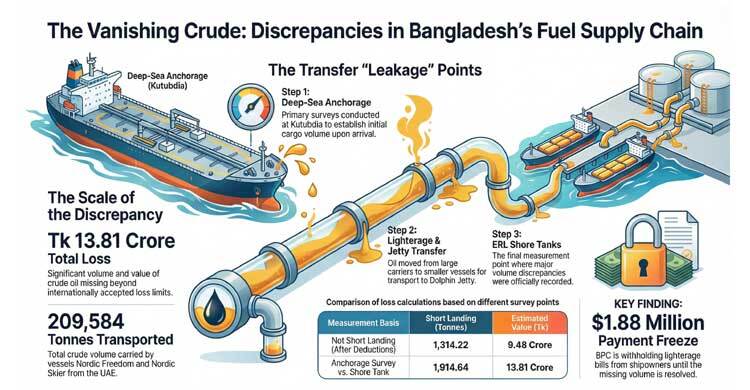
Fuel oil worth nearly Tk 14 crore has allegedly disappeared during the unloading of two crude oil consignments destined for Eastern Refinery Limited (ERL), triggering serious concerns over possible irregularities in Bangladesh’s state-run fuel supply chain.
The consignments were transported to Bangladesh aboard two foreign vessels – Nordic Freedom and Nordic Skier – from the United Arab Emirates in March and October 2025. According to Bangladesh Shipping Corporation (BSC), an “abnormal short landing” was detected when the crude oil was transferred from the ship to shore tanks, far exceeding internationally accepted loss limits.
BSC records show that the two vessels carried a combined 2,09,584.09 tonnes of crude oil, as per Bills of Lading (BL). However, joint surveys conducted at different stages – from deep-sea anchorage at Kutubdia, to Patenga Dolphin Jetty, and finally at ERL’s shore tanks – revealed unexplained discrepancies in volume.
Where did the oil go?
Under standard international procedures, crude oil is measured at multiple points: at the loading port, at anchorage through joint survey, during lighterage at Dolphin Jetty, and finally at the refinery’s shore tanks. Temperature variations are also factored in, with Bangladesh Petroleum Corporation (BPC) allowing a maximum ocean loss of 0.5 per cent.
Despite these allowances, BSC calculations show a net short landing of 1,314.22 tonnes after deducting permissible loss. At CIF value and an exchange rate of Tk 123 per dollar, this translates into a financial loss of about Tk 9.48 crore.
However, if the discrepancy is calculated by comparing anchorage survey figures with final shore tank measurements – as per established rules – the total short landing rises to 1,914.64 tonnes, valued at approximately Tk 13.81 crore, BSC officials said.
Bills withheld, dispute escalates
Due to the unresolved discrepancy, BPC has withheld payment of the lighterage bill amounting to $1.88 million (around Tk 23 crore), demanded by the shipowners. In a letter dated January 13, BSC urged BPC to urgently settle the dues, warning that failure to do so could jeopardise future crude oil transportation arrangements.
Bangladesh currently imports about 92 per cent of its annual fuel oil demand, with roughly 1.5 million tonnes of crude refined locally each year at ERL. BSC is responsible for transporting all imported crude, while lighterage is necessary because Chattogram port cannot accommodate large crude carriers due to channel depth limitations.
Conflicting claims
BSC Managing Director Commodore Mahmudul Malek told Jago News that such losses are unacceptable.
“After joint surveys confirm the quantity at Dolphin Jetty, there should be no further loss when the oil moves to the shore tank. But we are seeing continuous shortages there,” he said, adding that the issue has been formally raised with BPC multiple times.
He warned that persistent discrepancies could discourage shipowners from engaging in lighterage operations in the future, potentially disrupting the country’s fuel supply.
Eastern Refinery PLC Managing Director Engineer Sharif Hasnat, however, rejected allegations of losses occurring at the refinery.
“There is no leakage or loss in our tanks. If anyone claims otherwise, let them show concrete evidence,” he said, adding that the refinery is open to scrutiny by independent surveyors.
He hinted that any irregularity may have occurred earlier in the transfer process. “The problem is not in the tank. The complexity lies elsewhere. A deeper investigation will reveal the truth,” he said.
Calls for investigation
The incident has raised red flags over oversight, accountability and transparency in the handling of high-value fuel imports. With millions of dollars at stake and conflicting claims between state-owned entities, industry insiders say an independent investigation is crucial to determine whether the losses were due to technical lapses, negligence, or deliberate misappropriation.
So far, neither BPC nor ERL has announced a formal probe into the matter.