
Energy crunch threatens production as industries seek fuel priority

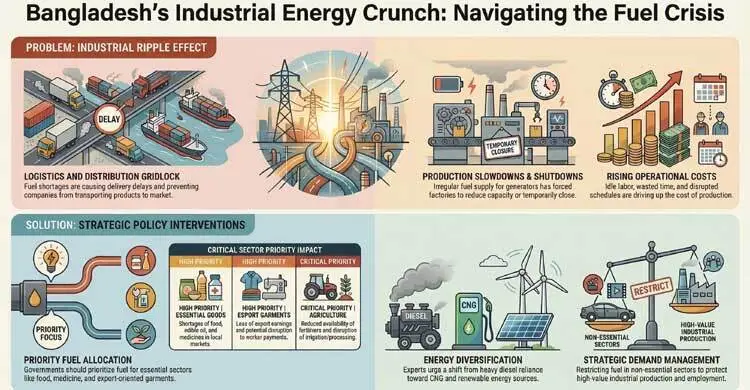
Industrial production across Bangladesh is coming under growing pressure as delays and shortages in fuel supply disrupt factory operations, transportation and product distribution, raising concerns over possible supply chain disruptions and inflation.
Economists, industrial entrepreneurs and energy experts warn that if the energy situation persists, it could affect the availability of daily essentials in the market. They urge the government to take immediate policy measures to ensure fuel supply on a priority basis for industries – particularly those producing food, edible oil, medicines, fertilizers and agriculture-related products.
According to them, any prolonged halt in factory operations during an energy crisis can put pressure on supply chains, potentially creating shortages of essential goods and pushing up prices in the market.
Global crisis spills into domestic market
The ongoing conflict in the Middle East has already affected global fuel supply, creating uncertainty in energy markets. In Bangladesh, fears of an energy shortage have triggered a rush at filling stations, with many trying to stock up on fuel.
In response, the Bangladesh Petroleum Corporation (BPC) on March 6 instructed fuel stations to limit the supply of oil. As a result, many businesses and transport operators are struggling to obtain fuel, while others are forced to queue for hours at petrol pumps to receive limited quantities.
Industry insiders say the delays are affecting logistics and preventing companies from delivering products on time.
Industrial sector calls for priority fuel allocation
Industrial entrepreneurs say an uninterrupted fuel supply is crucial for maintaining production. With limited fuel available and long waiting times at filling stations, many factories are already facing operational difficulties.
They argue that the government must ensure priority access to fuel for industries to keep production and supply chains functioning.
Biswajit Saha, director of City Group, one of the country’s largest suppliers of consumer goods, said the situation is linked to a broader global energy crisis.
“The current situation is not just a domestic problem; it is basically part of a global crisis,” he told Jago News.
He said companies are trying to keep their supply and marketing systems running despite the challenges, but emphasised that government intervention is critical to maintaining market stability.
“It is important to ensure the supply of fuel oil and gas so that activities are not disrupted, especially in the daily necessities and productive industries.”
Saha also said City Group had already sent a letter to the Ministry of Commerce requesting adequate fuel arrangements to keep the supply of edible oil stable.
“Because if the supply of fuel is disrupted, problems arise in all areas - transportation, storage and distribution of goods, which can ultimately weaken the supply system in the market. Therefore, he opined that the government should consider these issues seriously.”
Supply chains under pressure
Kamruzzaman Kamal, marketing director of PRAN-RFL Group, said the fuel shortage is already affecting the company’s distribution network.
“Currently, the oil crisis is directly affecting our supply system. Regular and adequate fuel is essential for the transportation of goods of industrial enterprises and their distribution to various destinations. But currently, due to the shortage of oil, transportation activities are not being conducted normally. As a result, it is becoming difficult to deliver products on time, and there are delays in the delivery process.”
He warned that the impact could become more serious if the situation continues.
“Although the cost of production has not increased significantly at the moment, its impact may be clearly visible if the situation persists for a long time. Because in many cases, due to transportation or logistics constraints, the factory's resources and capacity are not being fully utilised. At the same time, a section of workers and employees have to wait for work, which reduces the efficiency of operations.”
Kamruzzaman Kamal added that disruptions in production schedules and delivery timelines can increase operational costs.
“Such a situation can increase the overall cost of the organisation. Disruption of production and delivery schedules creates additional transportation costs, waste of time and managerial pressure. As a result, there is a risk of increasing costs in both product production and market supply. All in all, the oil crisis is not just a matter of fuel shortage; it is affecting the effectiveness of the entire supply chain. Such disruptions in the supply system not only waste time, but can also gradually have a negative impact on production and distribution costs.”
Garment sector also affected
The country’s export-oriented garment industry is also feeling the pressure from fuel shortages.
Mohammad Hatem, president of the Bangladesh Knitwear Manufacturers and Exporters Association (BKMEA), said factories are facing difficulties operating generators and transporting goods due to irregular fuel supply.
“The ongoing oil crisis is clearly having an impact on the activities of the country's garment industry. Many factory owners said that the amount of fuel required to operate generators and transport goods is not being delivered on time. As a result, the production process in many factories is being disrupted – somewhere production is running slowly, while others have to be temporarily shut down.”
He warned that the crisis is affecting the entire supply chain.
“Due to fuel shortage, not only production but also the entire supply system is under pressure. In many cases, workers are not being deployed regularly. Because it is not possible to keep the production line running normally. In addition, due to insufficient fuel for transportation, it is also becoming difficult to send finished products to the market or destination on time.”
Hatem called for a special fuel allocation for industries, especially export-oriented sectors.
According to him, the garment sector plays a crucial role in Bangladesh’s economy, generating employment and export earnings. Ensuring uninterrupted operations in this sector is therefore essential for economic stability.
Experts warn of wider economic impact
Energy expert and former professor of Bangladesh University of Engineering and Technology (BUET), Dr Ijaz Hossain, said industries need fuel supply according to demand to maintain production capacity.
“Factory workers will go on a five to six-day holiday. This problem will go away on March 17. So that the industry can work according to its capacity, fuel supply must be provided as per the demand. Factory owners are already affected. If they cannot work in the factory, how will they pay the workers? Therefore, attention should definitely be paid to this sector.”
He also criticised the reluctance to allocate diesel to industries.
“Our total consumption of diesel is very low in the industrial sector. It is the government's mentality that I will not give it or not. Their demand is low, so why not give it? This can cause huge losses.”
Ijaz Hossain further stressed the importance of diversifying fuel sources.
“I am trying to convince the policymakers of the country that diesel consumption in our country is extremely high. Now we should not be on one fuel. We should shift to another fuel. We have done it, some have gone to CNG. This should be done more.”
Former World Bank chief economist for Dhaka, Dr Zahid Hossain, also emphasised the need to prioritise the industrial sector in fuel distribution.
“Ensuring fuel supply to the country’s industrial sector on a priority basis is very important. Industrial factories create employment through production, increase exports and play a major role in overall economic growth. If industrial production is disrupted due to an energy crisis, then production will decrease, employment will be threatened, and export earnings may also decrease. As a result, there will be a negative impact on the country’s economy.”
Demand management also crucial
Economists say that during an energy crisis, managing demand is as important as increasing supply. Temporary restrictions on fuel use in non-essential sectors could help protect industrial production.
Professor Mostafizur Rahman, honorary fellow at the Centre for Policy Dialogue (CPD), said disruptions in industrial output can create widespread economic pressure.
“When industrial production stops, there is a multidimensional pressure on the economy. This reduces employment, damages exports and increases the price of goods in the market. Therefore, ensuring fuel supply to the industrial sector is very important for economic stability.”
He also stressed the need to strengthen fuel import and distribution systems through improved ports, storage and transportation infrastructure.
“In the long term, there is no permanent solution except diversifying energy sources. It is important to increase the use of renewable energy and expand energy-efficient technology in the industrial sector.”
According to economists and industry leaders, Bangladesh must adopt both short-term and long-term strategies to manage the energy crisis. Prioritising fuel supply for industries, promoting alternative energy and improving fuel management systems could help maintain stability in both production and the broader economy.