
Middle East tensions threaten $13.5b labour market for Bangladesh

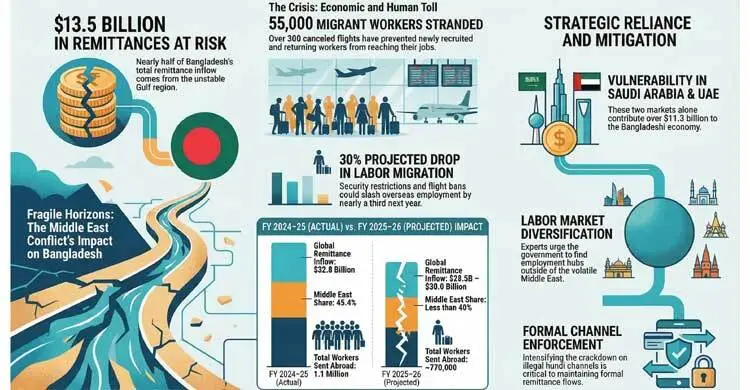
Rising tensions in the Middle East following military confrontations involving Iran, Israel, and the United States are creating deep uncertainty for Bangladesh’s overseas labour market, putting at risk more than $13.5 billion in remittance earnings from the region, economists and migration experts warn.
The escalating conflict in the Gulf has already begun to disrupt labour markets, aviation and employment, directly affecting millions of Bangladeshi migrant workers living across the region.
Casualties and growing uncertainty
The crisis has already turned tragic for Bangladeshi migrants. According to reports, at least three Bangladeshi nationals have been killed and seven others injured in incidents linked to the regional conflict.
Casualties have been reported from the United Arab Emirates, Bahrain, and Kuwait, raising fresh concerns about the safety of expatriate workers.
At the same time, disruptions in aviation have severely affected worker mobility. Since late February, nearly 300 flights from Dhaka and Chattogram to Gulf destinations have been cancelled within nine days after the conflict intensified.
This has left an estimated 55,000 passengers stranded, most of them migrant workers, said Reaz-ul-Islam, senior vice-president of the Bangladesh Association of International Recruiting Agencies.
The disruption poses a double threat: workers on leave in Bangladesh are unable to return to their jobs, while thousands of newly recruited migrants risk losing their employment opportunities as their entry visas expire.
Remittance lifeline at risk
The Middle East remains the backbone of Bangladesh’s remittance inflows. According to the Bangladesh Bank, nearly half of the country’s remittance comes from Gulf countries, including Saudi Arabia, the United Arab Emirates, Qatar, Kuwait, Bahrain, and Oman.
Bangladesh recorded a historic high of $32.8 billion in remittances in 2025, with over $13.5 billion coming from the Middle East alone.
Currently, more than 4.5 million Bangladeshi workers are employed in the region, making it the largest overseas employment hub for the country.
Analysts warn that if the conflict continues, the strong growth in remittances seen over the past year could slow significantly.
Possible economic pressure ahead
A comparison between the current fiscal year and projections for the next year indicates potential economic pressure on Bangladesh.
In FY 2024–25, the country received $32.8 billion in global remittances. However, for FY 2025–26, the figure could decline to $28.5 billion to $30 billion if the conflict worsens.
Remittances from the Middle East accounted for 45.4 per cent of Bangladesh’s total inflow in FY 2024–25. Experts warn that this share could fall below 40 per cent if labour markets and travel routes in the region remain disrupted.
Overseas employment may also take a hit. Bangladesh sent about 1.1 million workers abroad in FY 2024–25, but labour migration could drop by around 30 per cent next year if flight bans and security restrictions persist.
Saudi Arabia and UAE critical to Bangladesh
The crisis poses a direct threat to Bangladesh’s two largest overseas labour markets – Saudi Arabia and the United Arab Emirates.
Saudi Arabia remains the single largest destination for Bangladeshi workers, hosting more than 2.5 million migrants. In FY 2024-25 alone, remittances from the Kingdom reached about $6.5 billion.
However, the ongoing regional instability has slowed some infrastructure and service-sector activities in Saudi Arabia. Experts fear that new recruitment linked to the country’s ambitious Vision 2030 development programme could face delays if tensions escalate.
The United Arab Emirates is the second-largest contributor to Bangladesh’s remittance earnings, sending over $4.8 billion last fiscal year.
As a global aviation and trade hub, the UAE’s economy is particularly sensitive to regional security conditions. The recent wave of flight cancellations has affected routes to cities such as Dubai, Abu Dhabi and Sharjah, preventing thousands of Bangladeshi workers from returning to their jobs.
Economists warn of a major shock
In a recent meeting with Md Mostaqur Rahman, governor of Bangladesh Bank, leading economists warned that Bangladesh should prepare for a possible “major shock” if the Middle East conflict persists.
Among them, Mustafa K Mujeri, former chief economist of Bangladesh Bank, suggested several urgent policy measures.
These include intensifying the crackdown on illegal hundi channels so that remittances flow through formal banking systems, creating a special crisis-monitoring task force under the central bank, and diversifying overseas labour markets beyond the Middle East.
“A prolonged war could lead to job cuts and lower wages as businesses in the Gulf slow down,” said migration expert Asif Munier.
Similarly, Shariful Islam Hasan, who oversees the migration programme at BRAC, warned that thousands of workers could face financial ruin after investing Tk 3-4 lakh each in migration costs but remaining unable to travel due to flight cancellations.
Government monitoring situation
Expatriates’ Welfare and Overseas Employment Minister Ariful Haque Chowdhury said the government is closely monitoring the situation and prioritising the safety of Bangladeshi citizens abroad.
Speaking in Sylhet, he said a temporary drop in remittance is possible if the conflict drags on.
“We are providing logistical support and medical assistance to those injured. If the situation deteriorates further, we are prepared to consider large-scale repatriation of workers,” he said.
Economic implications
Remittances and the Ready-Made Garment industry of Bangladesh are widely considered the two main pillars of Bangladesh’s economy.
Economists warn that a prolonged disruption in the Middle East labour market could put pressure on the country’s foreign exchange reserves and overall macroeconomic stability.
Industry leaders from BAIRA also cautioned that new recruitment may come to a standstill if regional security conditions do not improve soon, potentially affecting Bangladesh’s labour export sector for years to come.
Source: UNB