
IMF loan programme on track, next review due in July: Finance Minister

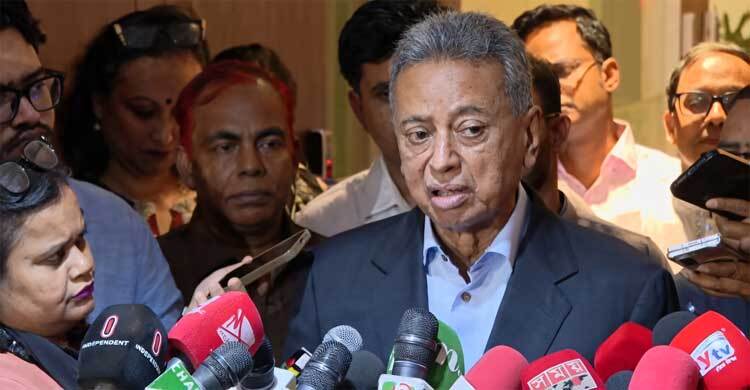
Bangladesh’s ongoing programme with the International Monetary Fund remains on track, with the next formal review due in July, Finance Minister Amir Khosru Mahmud Chowdhury said on Tuesday, as the government steps up reforms while navigating global uncertainties linked to the Iran war.
Speaking to reporters after a meeting with an IMF delegation led by Krishna Srinivasan at the ministry, the minister said the programme had been in place for several years and would proceed to the next review without complications. “There is a programme, it is ongoing, and there should be no problem in moving to the next review,” he said.
However, he urged restraint from all stakeholders to maintain economic stability amid external shocks. “The war is not in our hands; it is happening elsewhere, but we are among those affected,” he said, calling on citizens to cooperate with the government. “We must show restraint and work together to overcome the crisis and move the economy forward.”
The minister acknowledged that Bangladesh is facing multiple structural challenges, including weaknesses in the banking sector, a fragile capital market and a persistently low tax-to-GDP ratio. “There is a context of war, there are challenges in the banking sector and the capital market, and our tax-GDP ratio remains very low. We must determine how to improve these,” he said.
He noted that the government, which has been in office for just one month, had to manage the economy during Ramadan and amid the onset of war-related disruptions. Despite concerns over fuel supply and inflation, he said the situation remained largely stable. “There was no disruption to transport services, people were able to travel home for Eid without fare increases, and essential commodity prices remained stable,” he said.
He also highlighted stability in the garment sector, which often experiences unrest ahead of Eid. “This time, there was no instability. Workers received their wages on time, and there was no disruption despite the pressures,” he said, attributing the outcome to proactive economic management.
The minister added that even amid a global oil supply crisis, there were no major transport disruptions due to fuel shortages. He stressed that while the government had taken preparatory measures to stabilise markets, broader public cooperation would be essential to sustain stability.
On IMF financing, the minister said discussions on the next tranche remain ongoing, but emphasised that disbursement is tied to policy implementation. He indicated that the next review, scheduled for July, would determine the timing of the expected $1.3 billion tranche.
He added that further discussions would take place during the upcoming IMF-World Bank Spring Meetings in Washington, DC, in April, where Bangladesh may also explore additional areas of cooperation.
Responding to questions, Srinivasan said IMF financing discussions are closely linked to policy engagement and remain ongoing with the government. He also pointed to global uncertainties, including the economic fallout from ongoing conflicts, noting that such risks affect all countries, including Bangladesh.
The finance minister said the government inherited a difficult economic situation and is now working to implement reforms outlined in its election manifesto. These include deregulation, improving the ease of doing business and reducing the cost of doing business.
Several social-sector initiatives are already underway, including family support programmes, farmer assistance schemes and agricultural credit measures. He also noted that many development projects stalled due to financial constraints during the previous interim period would be revived as part of broader recovery efforts.
“To restart these projects, we must stabilise the economy through financial reforms. Some steps have already been taken, and others will follow soon,” he said, adding that further measures would be reflected in the upcoming national budget.
While discussions with the IMF continue, the minister stressed that not all reform conditions can be implemented simultaneously. “We must consider what is feasible in the current economic context. Everything cannot be done at once if we are to bring the economy back on track,” he said.