
Export orders dip, costs surge as West Asia war disrupts Bangladesh trade

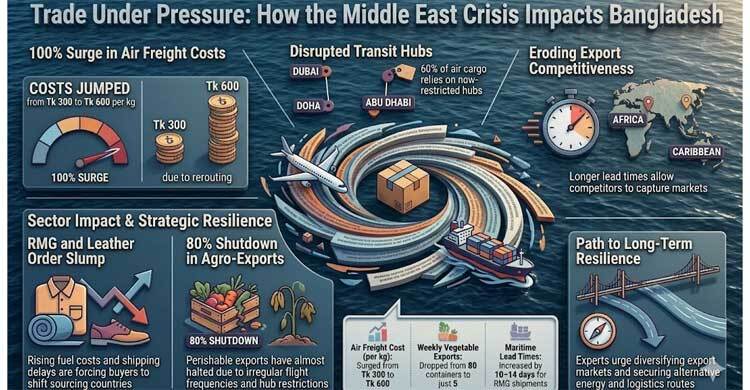
A month-long conflict between Iran and Israel and their surroundings is sending shockwaves through global trade routes, triggering a sharp rise in costs and a decline in export orders for Bangladesh, industry insiders and economists say.
The fallout, marked by soaring freight rates, disrupted supply chains, volatile energy prices and weakening demand, has placed Bangladesh’s export-oriented industries under intense, multi-layered pressure.
While the immediate impact is visible in declining shipments and rising operational costs, experts warn that the crisis is also exposing structural vulnerabilities in the country’s export model.
Three key pressure points
Economists identify three main transmission channels of the crisis: rising fuel prices, supply chain disruptions, and declining demand in key export destinations.
The combined effect is raising fears of slower export growth, mounting pressure on foreign exchange reserves, and a broader drag on economic activity.
Exports of agro and food products to the Middle East have been hit particularly hard, while sectors such as ready-made garments (RMG), leather and leather goods are also facing setbacks due to shrinking consumer demand amid economic uncertainty in importing countries.
Air cargo disruption hits perishables
Nearly 60 per cent of Bangladesh’s air cargo typically moves through West Asian transit hubs like Dubai, Doha and Abu Dhabi. However, reduced flight frequencies due to the conflict have severely disrupted this network.
Mohammad Mansur, general secretary of the Bangladesh Fruits, Vegetables and Allied Products Exporters Association, said fruit and vegetable exports have “almost come to a halt.”
“Only 20-25 per cent of shipments are moving irregularly on limited routes such as the UK, Italy and Toronto. Around 80 per cent of export activities are effectively shut down,” he said, adding that restrictions at transit hubs are further complicating shipments.
Leather sector faces order slump
The leather industry is also grappling with declining orders and rising input costs.
Md Sakhawat Ullah, senior vice chairman of the Bangladesh Tanners Association, said new export orders have slowed significantly, while some existing orders have been suspended.
“Production is being disrupted as chemical prices, especially imports from China, have surged, and in some cases suppliers are not even accepting bookings,” he said, estimating that at least 5 per cent of ongoing orders have been put on hold.
Freight costs double, competitiveness erodes
Exporters report a sharp spike in air freight costs – from Tk 250-300 per kg to as high as Tk 600 – largely due to longer flight routes avoiding high-risk zones.
Abul Hossain, a vegetable exporter, said the business has “virtually collapsed.”
“Where we used to export 70-80 containers a week, now it’s down to just 3-5,” he said, noting that cheaper supplies from countries in Africa and the Caribbean are outcompeting Bangladeshi goods in European markets.
Shipping delays strain RMG sector
Maritime trade has also been disrupted, particularly around the Strait of Hormuz and the Persian Gulf, forcing vessels to take longer alternative routes.
As a result, lead times for shipments to Europe and the US have increased by 10-14 days, posing a major challenge for the RMG sector, which accounts for about 84 per cent of Bangladesh’s total exports.
Mohammad Hatem, president of the Bangladesh Knitwear Manufacturers and Exporters Association (BKMEA), said rising fuel costs are also pushing up electricity, gas and transportation expenses.
“Our competitiveness depends on cost and timely delivery. If lead times increase, buyers can easily shift to other sourcing countries,” he warned.
Energy market volatility adds to risks
Global energy markets have turned volatile amid fears of supply disruptions in the Middle East, a key oil-producing region.
Rising oil prices are fuelling inflation in major economies like Europe and the United States, which could further dampen consumer demand for imported goods.
Economists caution that prolonged conflict could simultaneously weaken both supply and demand in global markets, posing a significant threat to Bangladesh’s export growth trajectory.
Structural weaknesses exposed
Experts say the crisis has highlighted Bangladesh’s over-reliance on Middle Eastern shipping routes and imported fuel, as well as limited diversification in export products and markets.
Zahid Hossain, former chief economist of the World Bank’s Dhaka office, said the impact is global but particularly challenging for interconnected economies like Bangladesh.
“To navigate this situation, Bangladesh must secure alternative energy sources, diversify export markets, and restructure its trade strategy,” he said.
Policy challenge ahead
Exporters and economists agree that the Iran–Israel conflict has created a complex, multi-dimensional crisis for Bangladesh’s export sector.
They stress that policymakers now face a critical challenge: mitigating the impact of global shocks by ensuring energy security, exploring alternative logistics routes, and accelerating export diversification to build long-term resilience.