
New commission needed to review pay scale: Debapriya

Economist Dr Debapriya Bhattacharya has said that the current government should form its own commission to determine a new pay scale. He stressed that the pay commission report proposed by the previous government should not be accepted outright, but rather considered as one of several inputs.
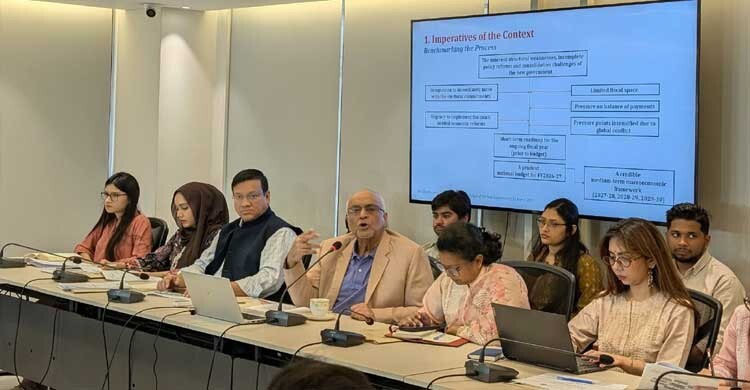
He made these remarks on Tuesday (March 31) at a pre-budget media briefing titled “Citizen Thoughts and Expectations Surrounding the Budget,” held at the office of the Centre for Policy Dialogue in Dhanmondi, Dhaka. The event was organised by the Citizen’s Platform for SDGs.
Debapriya Bhattacharya said that the previous government had initiated steps on the pay scale toward the end of its tenure, effectively leaving the responsibility for implementation to the current administration. This, he noted, has created a form of “extended liability,” which in many cases may be considered unjust.
“The current government should form its own commission and review the matter accordingly. The previous pay commission report can be treated as a component, but there is no scope to accept it unquestioningly,” he added.
Emphasising the need to repatriate laundered money, he said, “Stolen funds must be brought back. Assets seized both at home and abroad should be sold through legal processes, and the proceeds returned to the country.” Referring to the recent recovery of Tk 44 crore from abroad, he questioned why larger sums are not being repatriated.
On increasing revenue collection, he said that it is possible if political commitment is ensured and administrative barriers are addressed. He noted that the interim government could not make significant progress due to a lack of political strength. However, he warned that the first year of an elected government is the most critical, and failure to achieve progress early would make it difficult to do so later.
Regarding government expenditure and subsidy management, he said that subsidy demands in the agriculture and energy sectors are likely to rise. Therefore, inefficient and unjust subsidy allocations must be identified and restructured. He also advised gradually moving away from cash incentives.
For the upcoming budget, he called for reducing tax exemptions, expanding the tax base, and prioritising the recovery of laundered funds to increase fiscal space.