
Bangladesh sees eight months of consecutive export decline

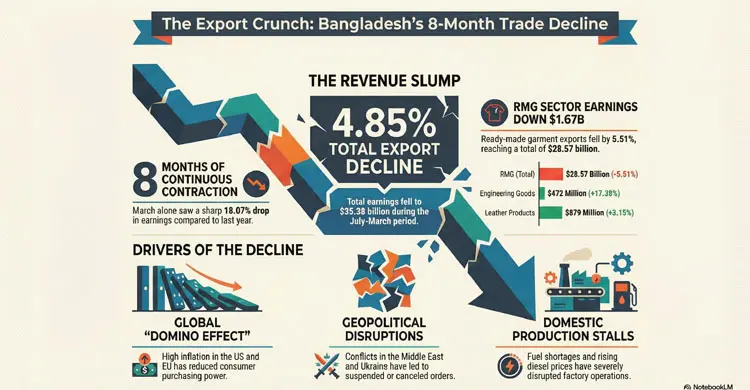
Bangladesh’s export earnings have continued a downward trend for the eighth consecutive month. In March, export earnings fell by 18.07% to $3.48 billion, compared with $4.24 billion in the same month last year.
During the July-March period of the current fiscal year 2025-26, total export earnings dropped by 4.85% to $35.38 billion, compared with $37.19 billion in the same period last year. This marks eight months of continuous decline in export revenue.
The ready-made garments (RMG) sector, which accounts for 84% of the country’s total exports, also experienced negative growth. Export earnings from this sector fell 5.51% to $28.57 billion, down from $30.24 billion in the same period last year. Exporters and experts largely attribute the decline to reduced shipments in the RMG sector.
Data released by the Export Promotion Bureau (EPB) on Thursday (April 2) confirmed that overall export earnings for July-March of 2025-26 fell 4.85% to $35.39 billion from $37.19 billion in the previous fiscal year.
Exporters cited weak global demand, fewer orders from buyers, geopolitical tensions, and intense competition in European markets as key reasons behind the decline. Concerns have also been raised over the recent Middle East conflict, warning that any disruption in the Strait of Hormuz could further pressure the global economy.
In March alone, the country earned $2.78 billion from the RMG sector, down 19.35% from $3.45 billion in the same month last year. Exports of both woven and knitwear sub-sectors also fell during this period.
Mohammad Hatem, president of the Bangladesh Knitwear Manufacturers and Exporters Association (BKMEA), told Jago News that negative trends in export earnings have continued for months. He noted that the RMG sector had never faced such conditions before and traced the initial decline to tariffs imposed during the Trump administration, which increased import costs for US and EU buyers and reduced their orders.
Hatem added that although inflation was expected to ease in international markets, the outbreak of war in the Middle East has worsened the situation. Rising fuel prices and diesel shortages due to the closure of the Strait of Hormuz have disrupted factory production, further affecting exports. He urged the government to prioritize fuel supply to factories and provide policy support to offset business losses.
Dr. Zahid Hossain, former chief economist at the World Bank’s Dhaka office, said the continuous decline is a combined “domino effect” of global and domestic political uncertainty and ongoing war situations. High inflation in export destinations has reduced consumer demand, leading buyers to cut orders, directly impacting Bangladesh’s RMG sector.
Commenting on overall export performance, the EPB reported negative growth in most major export sectors compared with the same period last year. However, frozen and live fish, leather and leather products, and engineering goods showed positive growth, which helped partly offset the overall decline. The EPB noted that global factors—including US-Israel-Iran tensions affecting fuel markets and the prolonged Russia-Ukraine war—have created uncertainty in major export destinations such as the EU, US, and Southeast Asia. Reduced purchasing power and lower international demand have led to suspended or canceled export orders, negatively impacting overall export growth.
Export Earnings by Sector
During the first nine months of the current fiscal year, the RMG sector earned $28.58 billion, down 5.51% from $30.25 billion in the same period last year. Knitwear exports fell 6.42% to $15.11 billion, while woven garments fell 4.48% to $13.47 billion.
Agricultural exports dropped 9.21% to $733 million, while leather and leather products grew 3.15% to $879 million. Home textile exports fell 0.73% to $673 million, and jute and jute products declined 1.30% to $618 million. Engineering goods, however, showed strong growth, rising 17.38% to $472 million.