
Export dip, rank jump: Bangladeshi RMG overtakes China in US market

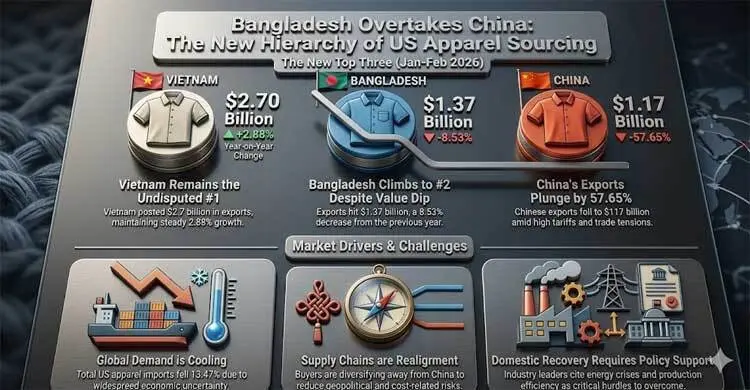
In a significant shift in global apparel trade, Bangladesh has overtaken China to become the second-largest exporter of garments to the United States, even as its own export earnings to the market declined at the start of the year.
Data released by the Office of Textiles and Apparel (OTEXA) on April 4 shows Bangladesh exported apparel worth $1.37 billion to the US in January-February 2026, down 8.53 per cent from $1.5 billion in the same period last year.
Despite the drop, Bangladesh moved ahead of China, whose exports to the US plunged sharply by 57.65 per cent to $1.17 billion from $2.77 billion a year earlier. The decline comes amid the impact of US reciprocal tariffs and broader global trade tensions that have significantly reshaped sourcing patterns.
Vietnam retained its position at the top, posting $2.7 billion in exports during the period, marking a modest 2.88 per cent year-on-year growth.
A gain in rank, but not in value
The latest figures highlight a paradox for Bangladesh: a stronger global position, but weakening export earnings.
Overall, US apparel imports fell 13.47 per cent year-on-year to $11.53 billion in the first two months of 2026, reflecting slowing global demand and economic uncertainty.
Industry leaders say Bangladesh’s rise in ranking is largely the result of China’s steep decline rather than a surge in its own performance.
“Export growth remains negative, which is not a good sign,” said Mohammad Hatem, president of the Bangladesh Knitwear Manufacturers and Exporters Association. He pointed to higher tariffs and ongoing global instability, including war-driven disruptions, as key factors behind the slowdown.
Shifting global supply chains
The data underscores a broader realignment in the global apparel supply chain. China, long the dominant supplier to the US market, is steadily losing ground amid rising costs, geopolitical tensions and trade restrictions.
Countries like Bangladesh and Vietnam have increasingly benefited as global buyers diversify sourcing to reduce risk.
Still, the current downturn suggests that external pressures – from energy costs to logistics disruptions – are affecting all major exporters.
Policy support key to recovery
Industry insiders believe Bangladesh can turn the situation around if domestic challenges are addressed.
Hatem stressed the need for stronger policy support and urgent resolution of the energy crisis, which has been affecting factory operations and production efficiency.
“If these issues are addressed, the sector can recover from the current negative growth,” he said.
Strong base, uncertain outlook
The latest slowdown comes after a strong performance in 2025, when Bangladesh’s apparel exports to the US grew by 11.75 per cent to $8.20 billion, up from $7.34 billion in 2024. Export volumes also rose by over 12 per cent during the year.
That momentum, however, now faces headwinds from a cooling global market and shifting trade dynamics.
For Bangladesh, the climb to second place marks a milestone – but sustaining that position will depend on how quickly it can navigate both global uncertainty and domestic constraints.