
‘Laapataa Ladies’ reigns supreme at the 70th Filmfare Awards

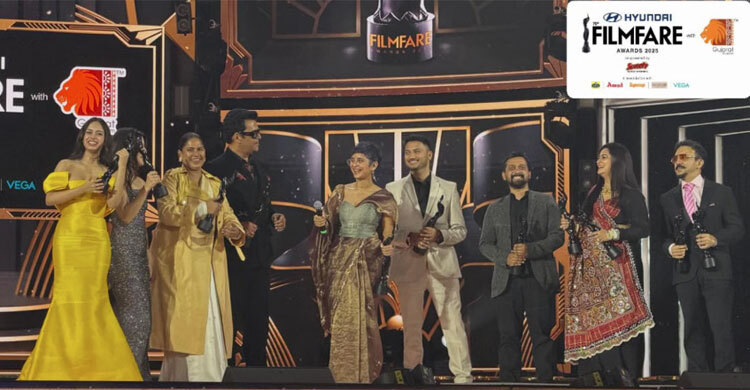
Under the glittering lights of Gujarat’s cultural capital, the 70th Filmfare Awards unfolded like a cinematic sonnet—honouring legends, launching luminaries, and crowning a quiet revolution in storytelling. Hosted with signature charm and wit by Shah Rukh Khan and Karan Johar, the star-studded gala at Ahmedabad’s grand venue was equal parts celebration, tribute, and coronation.
And the crown? It belonged unequivocally to Kiran Rao’s Laapataa Ladies—a film that began as a whisper and ended the night echoing through history. The poignant satire on rural India and female agency swept the ceremony, claiming Best Film, Best Director, Best Screenplay, Best Dialogue, Best Music Album, Best Lyrics, Best Supporting Actor (Male and Female), Best Costume Design, Best Background Score, and Best Debut Actress for the luminous Nitanshi Goel.
The evening opened with a reverent homage to the titans of Indian cinema—Dilip Kumar, Nutan, and Meena Kumari—their black-and-white grace flickering on screen as the audience rose in silent awe. Their legacy, it seemed, had paved the way for tonight’s new guard.
Veteran icon Zeenat Aman, resplendent in ivory silk, received a thunderous standing ovation as she accepted the Lifetime Achievement Award, her eyes glistening with seven decades of stardust. The honour was shared posthumously with the late master Shyam Benegal, whose humanist cinema redefined Indian realism—his absence felt, his spirit palpable.
Newcomers shone brightly: Lakshya took home Best Debut Actor (Male) for his ferocious turn in the action thriller Kill, a film that itself emerged as a technical powerhouse—sweeping Best Cinematography, Best Editing, Best Production Design, Best Sound Design, and Best Action (awarded to Seayoung Oh and Parvez Shaikh).
In the acting categories, the night belonged to depth over dazzle. Alia Bhatt won Best Actress for her fiercely protective performance in Jigra, while Abhishek Bachchan (I Want To Talk) and Kartik Aaryan (Chandu Champion) shared the Best Actor (Male) trophy—a rare dual win reflecting two sides of masculine vulnerability.
Critics’ honours went to raw authenticity: Rajkummar Rao for Srikanth and Pratibha Ranta for her breakout role in Laapataa Ladies. Shoojit Sircar’s I Want To Talk was named Critics’ Best Film, its adapted screenplay also lauded.
The stage pulsed with energy as Akshay Kumar, Ananya Panday, and Maniesh Paul delivered high-voltage dance sequences—though none outshone the emotional choreography of the night’s quieter moments.
Music soared: Arijit Singh won Best Male Playback for Laapataa Ladies, while Madhubanti Bagchi claimed the female honour for Stree 2. Rising composer Achint Thakkar received the R.D. Burman Award for his soulful work in Jigra and Mr & Mrs Mahi.
As the final trophy was handed out, Shah Rukh Khan—ever the showman—paused. “Seventy years,” he said, voice thick with emotion, “and Indian cinema still dares to dream, to question, to love.”
In a night where legacy met rebellion, silence spoke louder than spectacle, and a film about lost brides found its place in history—Laapataa Ladies didn’t just win awards. It redefined what Indian cinema can be