
They write the hate on their skin so you’ll finally see it

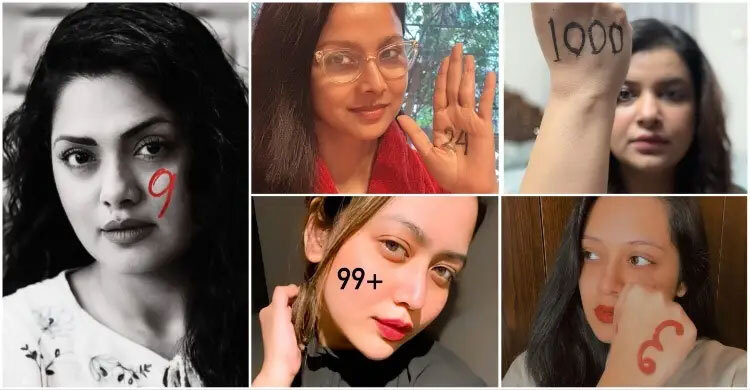
Open any social-media feed in Bangladesh right now and the images hit like a punch: the country’s most recognisable women – actresses you’ve cried with, singers you’ve danced to – staring defiantly down the lens with thick black numerals scrawled across their faces, necks, wrists and palms.
9. 24. 72. 1000. 99+.
These are not cryptic teasers for a new web series. They are receipts.
Nusrat Imroz Tisha, the woman whose smile has lit up a thousand Eid dramas, stares out with a thick black 9 slashed across her cheek like war-paint.
Runa Khan, national treasure, lifts a trembling palm daubed with 24.
Shabnam Faria posts a mirror selfie: 1000 scrawled in lipstick-red across her throat, eyes blazing.
Young Prarthana Fardin Dighi, barely 21, has a tiny, heartbreaking 3 on her wrist (small enough to hide under bangles, large enough to break your heart).
Ashna Habib Bhavana went for both cheeks: 99+ in dripping marker, the ink bleeding like fresh bruises.
These are not aesthetic choices. These are casualty figures.
This is #MyNumberMyRules, the campaign that erupted on November 25 and has since become the most confronting act of collective rage Bangladeshi women have ever staged.
The rule is merciless: write on your body, in public, the exact number of rape threats, slut-shaming comments, morphed nudes, acid-attack fantasies, and suicide-baiting messages you receive online every single day.
Tisha fired the starting gun. Her post (a raw close-up, no filter, no smile) landed like a grenade: “Behind this 9 are the mornings I wake up shaking because some stranger has promised to find my daughter. Behind this 9 are the nights I scrub my skin raw trying to wash off words that crawl. You see a number. I live the war.”
The replies came in waves. First disbelief. Then screenshots (hundreds of them) from ordinary women holding up pieces of paper: 47, 189, 312. The comment sections, once cesspits, turned into confession booths.
Runa Khan’s 24 came with a voice note that’s been viewed 3.8 million times: “Twenty-four times a day someone reminds me I’m too old, too dark, too outspoken, too female. Twenty-four times a day I have to decide whether to laugh it off or let it kill another piece of me. I’m tired of choosing.”
Shabnam Faria’s 1000 broke something in the internet. Trolls screamed “liar” until she posted a 47-second screen-recording of her inbox (blurred for legal reasons, but the timestamps visible). The video ends with her whispering, “That was just one hour.”
Mousumi Hamid wrote 72 across her collarbones and captioned it: “I counted while breastfeeding my son. That’s how normal this has become.”
And still the numbers climb.
The women are explicit about the tipping point: August 5, 2024. The day the regime fell, the gates of hell online swung open. In the anarchy that followed, organised misogynist networks (many with political backing) weaponised the new freedom. Female journalists, activists, and yes, actresses became priority targets. Fake nudes multiplied overnight. Home addresses were doxxed. Children were threatened.
Now, for the next 16 days, every morning brings fresh skin and fresh ink.
The campaign has synced with the global 16 Days of Activism against Gender-Based Violence, but this feels less like activism and more like exorcism.
Men are reacting in real time. Some are deleting old comments in panic. Others are rage-typing harder (only to find themselves ratioed by an army of women quietly adding their own numbers). A few, for the first time, are simply shutting up and listening.
Because when the woman who taught a generation to dream has to mark her face like a crime-scene body count just to prove the violence is real, every excuse in the country dies in your mouth.
They are not asking for sympathy any more. They are making the invisible body count impossible to ignore.
And every time another marker touches skin, the message is the same: We have been counting in silence for years. Now you count with us.