
The office that never was: Inside China’s 'Pretend to Work' trend

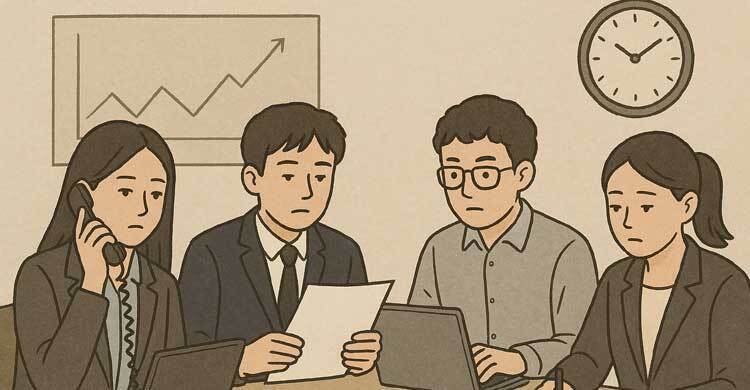
Imagine paying to go to a job that doesn’t exist. No salary. No title. No promotion. Just an empty desk, a laptop, and the illusion of a 9-to-5.
In China, this isn’t satire, it’s survival.
As youth unemployment hovers at a staggering 14%, a growing number of young adults are turning to a surreal new coping mechanism: paying companies to pretend they have jobs.
From Dongguan to Shanghai, “pretend offices” are quietly emerging across major Chinese cities – fully equipped with Wi-Fi, meeting rooms, tea breaks, and even fake colleagues. For a daily fee of 30 to 50 yuan ($4-7), unemployed graduates and failed entrepreneurs can rent a desk, dress for work, and walk into a space that feels like a real office because being seen as unemployed feels worse.
"I feel very happy" – A job that isn’t a job
Take Shui Zhou, 30, from Dongguan. After his food business collapsed in 2024, Zhou found himself adrift unemployed, unmotivated, and facing the silent judgment of family and society.
Then he discovered Pretend To Work Company on Xiaohongshu, China’s answer to Instagram and Pinterest. For 30 yuan a day, he could “commute” to a shared office, sit beside five others in the same boat, and act like he was part of the working world.
“I feel very happy,” says Zhou. “It’s like we’re working together as a group.”
He arrives between 8 and 9 am, sometimes stays until 11 pm, and only leaves after the manager does just to make it look convincing. He’s even sent photos of the office to his parents. “They feel much more at ease now,” he says.
But it’s not just about appearances. The space has become his sanctuary. He chats with his “colleagues,” shares meals, plays games, and recently started teaching himself AI tools, a skill he’s noticed popping up in real job postings. “It’ll make it easier to get hired,” he says. “This place gives me a reason to keep going.”
The “internship” that never was
For Xiaowen Tang, 23, the pretend office was a necessity, not a choice.
After graduating last year, Tang couldn’t find a full-time job. But her university had an unwritten rule: submit proof of employment or internship within a year, or no diploma.
So she rented a workstation in a pretend office in Shanghai. She paid her daily fee, sat at her desk, and sent photos to her school as “proof” of her internship. In reality, she was writing online novels to earn a little pocket money.
“If you’re going to pretend it,” she says, “just pretend it to the end.”
Selling dignity, not desks
The man behind the Dongguan office is Feiyu (a pseudonym), a 30-year-old former retail entrepreneur who lost his business during the pandemic. “I was depressed. I felt useless,” he recalls. “I wanted to turn things around, but I had no power.”
In April, he launched Pretend To Work as a social experiment. Within a month, every desk was taken. Now, applicants must be approved.
Among his customers 40% are fresh graduates faking internships for their universities and 60% are freelancers – digital nomads, e-commerce sellers, online writers – who crave structure and community
They’re officially classified as “flexible employment professionals,” a bureaucratic euphemism that also covers delivery drivers and gig workers.
But Feiyu sees his business as more than a rental service. “I’m not selling workstations,” he says. “I’m selling the dignity of not being a useless person.”
A social safety net built on lies
Experts see the trend as a symptom of deeper systemic failure.
Dr Christian Yao, a Chinese economy expert at Victoria University of Wellington, calls it a “transitional solution” born from a mismatch between education and the job market. “Young people need a space to think, to plan, to breathe,” he says. “These offices are becoming incubators for survival.”
Dr Biao Xiang of the Max Planck Institute for Social Anthropology goes further: “This is a shell young people have built for themselves—a slight distance from mainstream society, giving them a little space to exist without shame.”
Can a pretend office lead to a real future?
Feiyu admits the model may not last. “Long-term profitability? I doubt it,” he says. “But if we can help someone turn this fake office into a real starting point, then the experiment has value.”
For Zhou, the dream isn’t far off. He spends most of his days now mastering AI, building a portfolio, and applying to real jobs. The pretend office hasn’t replaced work, it’s become a bridge to it.
“I don’t want to pretend forever,” he says. “But for now, this is how I keep going.”
In a world where being seen as productive matters more than actual productivity, these offices aren’t just a joke. They’re a lifeline.
And perhaps, in the quiet hum of a pretend office, a generation is quietly rehearsing for the real thing.
Source: BBC