
Buying Britishness: The baby, the tutor, £180,000 quest to raise a perfect gentleman

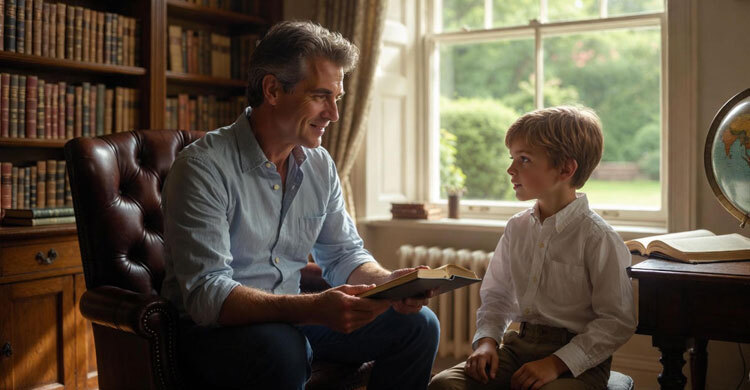
In a discreetly affluent corner of north London, where cappuccinos are ordered with moral restraint and every Range Rover looks recently valeted, a young family has embarked on a very British experiment in social engineering.
They are hiring a private tutor – not for phonics, or maths, or Mandarin. The job description is altogether loftier: to guide their one-year-old son on his “first steps towards becoming an English gentleman.”
Salary: £180,000 per year.
That’s roughly the going rate for a senior surgeon – or, apparently, for someone who can teach a baby how to exude Britishness.
Tutoring by osmosis
The assignment comes via Tutors International, a firm specialising in bespoke education for the internationally well-heeled. Its founder, Adam Caller, initially thought the request was a joke. Then he met the parents.
“They knew it sounded unusual,” he admitted, “but they’d waited too long with their older child. By five, the cultural bias had already set in.”
Bias, in this context, meaning perhaps the wrong accent, the wrong cutlery grip, or the faintest whiff of emotional expression.
The plan, Caller explained, is for the tutor – British, well-spoken, ideally horse-friendly – to radiate Britishness in the child’s presence until it seeps into his very being. No flashcards required; just a steady waft of heritage.
“It’s osmosis,” he said cheerfully. “They’ll influence him simply by being around. They’ll do things they don’t even realise they’re doing.”
One imagines the child marinating gently in Received Pronunciation, exposed to small doses of irony and a mild distrust of enthusiasm.
The gentleman factory
The tutor, according to the advert, should possess a “strong sense of cultural identity” and enjoy skiing, opera and country pursuits – the usual equipment of a modern aristocrat. By age three, the child should be horse-riding, playing an instrument, and “presenting himself appropriately.”
It’s not childcare. It’s gentleman-crafting.
Critics, of course, have been quick to scoff. Peter Cui, founder of Blue Education and a Cambridge graduate, called the idea “idealistic and unrealistic.”
“You can’t engineer culture,” he said. “It’s something you live into, not something you hire by the hour.”
Perhaps. But try telling that to parents who see Britishness as a lifestyle brand — as exportable, aspirational, and best taught before the child learns to talk back.
The business of being British
Caller, for his part, sees no absurdity in the arrangement. “The world holds us in high regard,” he said. “An English accent implies you’re well-read and well-educated – even if you’re not.”
There it is: the distilled genius of British soft power. Not empire, not invention – intonation.
In a world increasingly desperate for identity, “Britishness” is the ultimate accessory. You can buy it by the bottle, or apparently by the nanny.
And business is booming.
Laura Windsor’s Etiquette Academy, for instance, offers bespoke lessons in comportment, dining, and polite conversation. “Society has become diluted and unrestrained,” Windsor lamented. “People want to go back to the way it was.”
In her view, teaching a one-year-old might even make sense. “If you start early, it becomes instinct,” she said. “People nowadays just need a little refinement – a little awareness of what they do.”
Translation: everyone could stand to behave more like a Downton extra.
Not everyone’s buying it
Not all of Caller’s clients are quite so nostalgic. One father, who asked not to be named (because, of course), said his focus wasn’t etiquette but adaptability. “We’re not chasing Britishness,” he explained. “We’re preparing for AI. The school system’s obsolete – this is about survival.”
His tutor is teaching his children philosophy, coding, and mindfulness, which, depending on your cynicism, either sounds visionary or like a new form of Pilates.
Defining the indefinable
And yet, this story – absurd, lucrative, faintly tragic – raises a perfectly serious question: what does ‘being British’ even mean anymore?
Is it the accent? The etiquette? The ability to apologise when someone else steps on your foot?
For this family, it appears to mean refinement, restraint, and a lifetime subscription to subtle superiority. For others, perhaps it’s just a well-placed shrug in the face of chaos.
Still, there’s something irresistibly modern about it: in a world where culture is fluid and citizenship is transactional, Britishness has become a product – and every product has a market.
So somewhere in north London, a baby is being rocked to sleep by a professional embodiment of the Home Counties, absorbing lessons in understatement before he can form full sentences.
And one day, when he grows up, he may well speak with perfect diction, hold doors open, and display the unflappable composure of someone born to rule – or at least to moderate panel discussions at the BBC.
But deep down, he’ll know the truth:
He wasn’t born British. He was professionally curated.
Source: BBC