
Putin agrees to western security guarantees for Ukraine: Trump

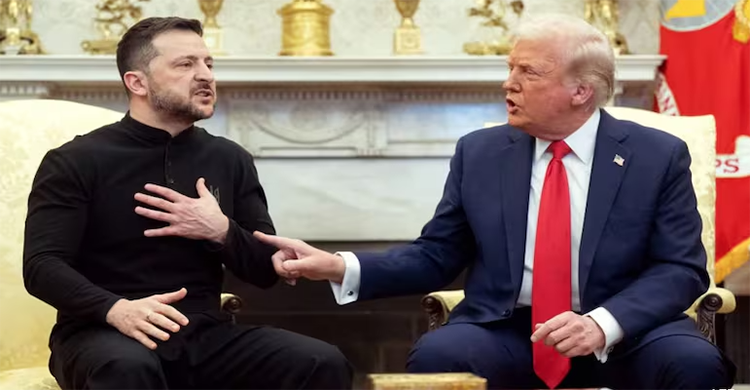
In a major diplomatic development, US President Donald Trump announced Monday that Russian President Vladimir Putin has agreed, during last week’s summit talks, to accept Western-provided security guarantees for Ukraine as part of any future peace agreement ending the ongoing war.
Speaking at the White House ahead of high-level discussions with European leaders and Ukrainian President Volodymyr Zelensky, Trump called the concession “a very significant step” in the push for lasting peace.
"President Putin agreed that Russia would accept security guarantees for Ukraine," Trump said. "This is one of the key points we need to consider – and we’re going to be considering that at the table. Also, who will do what, essentially."
The remarks mark a notable shift in momentum, suggesting Moscow may be softening its long-standing opposition to a robust international security framework designed to deter future aggression against Ukraine.
Trump indicated that European nations would take the lead in providing those guarantees, with US support.
"I think the European nations are going to take a lot of the burden. We're going to help them, and we're going to make it very secure," he said.
Ceasefire not 'necessary,' Trump iterates
Despite the breakthrough on security assurances, Trump reiterated his controversial stance that a formal ceasefire is not a prerequisite for ending the war - a position that aligns closely with Putin’s own public statements.
"I don't think you need a ceasefire," Trump said, seated beside President Zelensky. "I know it might be good to have, but I can also understand strategically why one country or the other wouldn't want it. You have a ceasefire and they rebuild and rebuild and rebuild – and maybe they don't want that."
The comment drew quiet surprise from allies in the room but was consistent with Trump’s long-held scepticism of prolonged military entanglements and his preference for negotiated outcomes over tactical pauses.
Path to peace: What security guarantees could look like
Discussions among US, European, and Ukrainian officials focused on the structure of future security commitments aimed at preventing renewed Russian aggression. While the US has historically hesitated to commit directly, leaving the initiative to a "coalition of the willing" led by Britain and France, new signals from the White House suggest Washington may now be willing to play a more active role.
Experts outline four potential forms the US contribution could take:
Boots on the ground deemed the least likely. Trump has consistently framed the conflict as “Europe’s problem” and has opposed sending American troops, arguing the war “would never have happened if he had been in office.”
Air and sea patrols are more plausible option. The US already conducts surveillance flights over the Black Sea, but transitioning to armed deterrence patrols, potentially confronting Russian forces, remains a high-risk proposition given Russia’s nuclear status.
Intelligence sharing is seen as a likely area of continued US involvement. American satellite and aerial intelligence have been instrumental in helping Ukraine resist Russian advances and could be formalized under a peace arrangement.
Logistical support is also a non-combat role where Washington could assist a European-led “reassurance force” with transport, supply chains, and coordination, areas where the Trump administration may feel comfortable contributing without deep military engagement.
Zelensky hails 'constructive' talks
Ukrainian President Volodymyr Zelensky described the meeting as “constructive, specific” and praised Trump for engaging directly with Kyiv’s concerns.
"We had a very good conversation with President Trump," Zelensky said. "I thank him for meeting with me."
He confirmed that Trump is working to organize a trilateral summit involving himself, Putin, and the US president, adding that Ukraine would welcome Trump’s participation. Zelensky also revealed he presented detailed battlefield maps to Trump, underscoring Ukraine’s strategic realities.
Trump pushes for trilateral summit
Trump expressed optimism about brokering a direct agreement between Kyiv and Moscow, offering to host and attend a three-way meeting if all parties agree.
"I want to try and arrange a three-party meeting with President Zelensky and President Putin," Trump said. "And I have a feeling we will work something out."
He emphasised that any final decision rests with the leaders and people of Ukraine and Russia, but added: "All of us would obviously prefer an immediate ceasefire while we work on a lasting peace, and maybe something like that could happen. As of this moment, it's not happening."
Drawing on past diplomatic efforts, Trump noted that some conflicts he helped end did not begin with ceasefires, suggesting alternative pathways to resolution.
"A peace agreement at the end of all of this is very attainable," he said.
What comes next?
With Putin’s reported acceptance of external security guarantee, a key Ukrainian demand, the path toward negotiations appears to be opening. However, significant hurdles remain, including defining the scope and enforcement mechanisms of those guarantees, securing consensus among European allies, and ensuring Ukraine’s sovereignty is fully respected.
As diplomatic momentum builds, all eyes turn to the possibility of a historic summit in the coming weeks, one that could reshape the future of European security and bring the war in Ukraine closer to an end.
Source: AFP, BBC